1960 Morris Minor 1000

1960 Morris Minor 1000 Navigation
History
Considered to be the 'World's Supreme Small Car', by the motoring press at the launch, the demand for the vehicle outstripped the supply of the Morris Minor.
The Morris Minor was the first British car to ever reach a production rate of one million.
Originally called the Mosquito, the Morris Minor was introduced at the Earls Court Motor Show on September 20th, 1948. After the millionth Minor rolled off the production line on December 22nd, 1960, the Morris Minor 1000 was introduced.
The Morris Minor was built by William Morris, (Lord Nuffield) of the Nuffield Organization. The same team that eventually designed the Mini, it was led by Alec Issigonis, who was proudest of his participation in designing the Morris Minor.
Originally tried and tested with 918cc side-valve from the Series E Morris Eight, Issigonis had originally intended the Morris Minor to have an 800 cc and 1100cc flat-four water, cooled engine.
The prototype name was originally classified the 'Mosquito' and together with Jack Daniels and Reg Job, they set out to create a completely new and innovative vehicle.
The most significant of Issigonis' decisions regarding the Morris Minor was the decision to widen the vehicle by four inches.
Every prototype was a total of 57 inches wide, but the designer felt that this was too narrow, so he ordered one of the eight prototypes to be split down the middle.
Obviously, there were serious design implications for the design team who were responsible for recalculating hundreds of dimensions. But the extra width did give the car enhanced stability and road holding.
The flat stripe running down the center of the bonnet is a tribute to the historic decision regarding the Morris Minors.
With unique features such as a monocoque design rather than the traditional chassis/body, striking styling lines, independent front suspension, small fourteen-inch wheels, and rack-and-pinion steering.
A vehicle that combined the luxuries and conveniences of a reliable motor vehicle with a price even the working class could afford. When compared to competitor products in the late 1940's, the Morris Minor excelled as a roomy vehicle with superior corning/handling characteristics.
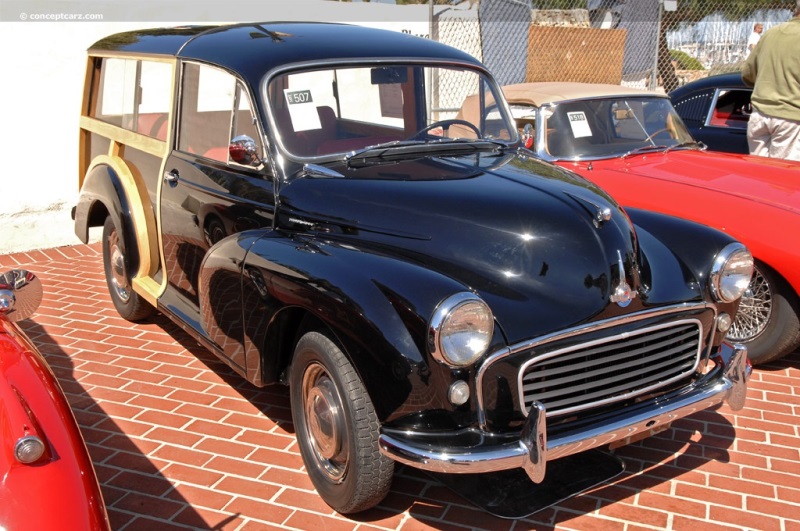
Updated in 1956, the Minor 1000 had an engine with an increased capacity to 0.9 L (948 cc/57 in³). Replacing the two-piece split windscreen, it now had a curved one-piece one and an enlarged rear window.
With an even larger engine, 1.1 L (1098 cc/67 in³) in 1962, the Minor 1000 could now achieve 77 mph. Additional modifications included a new dashboard layout, a different heater, and a new larger tail/flasher with front side/flasher lamps.
The first British car to sell over 1,000,000 units, the Morris Minor was produced in 1961 to commemorate this event.
A limited-edition of 349 two-door saloons was produced with distinctive lilac paintwork and a white interior. The models were designed with white and gold leather seats. Modified, the badge on the side of the bonnet read 'Minor 1,000,000' instead of the standard 'Minor 1000'.
Receiving another upgrade in 1962, the Minor 1000 now featured the 1098cc engine which improved power output. It also received a larger clutch, a more improved heater and rear lights, and larger drums on the front.
The Morris Minor was a limited sale in America, which may have been a result of internal politicking by inside manufacturer BMC (British Motor Corporation).
Produced in manufacturing plants at Cowley, Oxfordshire, over 1.6 million Morris Minors were produced and exported in numerous variations worldwide. Production of the Morris Minor continued until 1971 and has continued to remain a very collectible vehicle.
Because of the transatlantic styling that resembled a late 1940's Chevrolet, it eventually became a popular basis to build a hot rod on.
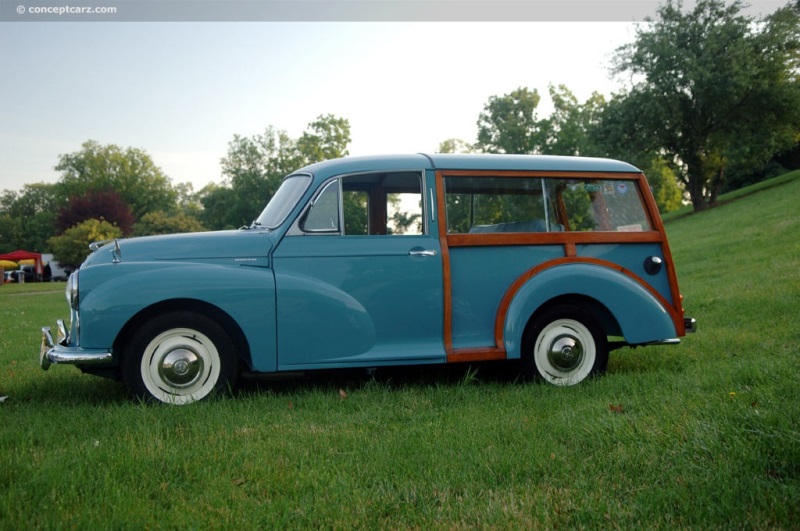
Unfortunately, production declined. In 1969, the production of the Tourer was ended with the Saloon line dropping out the following year. The final year for the Traveller and commercial versions was 1971.
By the end of its production, nearly 850,000 Minor 1000s were produced. Officially replaced by the Morris Marina, which replaced it o the Cowley production lines which in 1971 had mutated into the British Leyland Motor Corporation.
Lasting from 1948 to 1953, the original Minor MM series included a pair of 4-seat saloons, a convertible 4-seat tourer, and a 2 and 4-door.
Among the best-served classic, family-sized car, the Morris Minor and 1000 continue to gain popularity. The number of rebuilt and improved Morris Minors that are currently produced in Britain reflects its continuing status. Today it is updated with a more powerful engine and the replacement of the 'original equipment' drum brakes with disc brakes.
Available in three different model variations, all models had significant differences though pretty much the same shape.
The series MM was available from September 1948 until February of 1953 and came with the 918cc side-valve engine which was the least powerful of all Minor engines. It came with a split windscreen with tiny rear windows with headlights mounted in the front grille. Originally the series MM was available in two-door, eventually in 4 door, and finally in 'tourer' soft top / convertible form. This series is most likely the most expensive and sought-after models.
The Series II was created when the old Morris side-valve engine was ditched in favor of the more modern 803cc overhead valve from the Austin A30. This series lasted from 1952 to 1956.
Increasing its performance considerably, the Series two adopted the Austin gearbox in 1955. In May of 1953, the 'Light Commercial Vehicles' were launched and each had separate chassis. Available in pick-up and van version, the Traveller was introduced in October 1953.
It was in 1956 that the Minor was once again modernized. It was updated with a larger 948 cc engine, which now increased power output by 20%By Jessica Donaldson
The Morris Minor was the first British car to ever reach a production rate of one million.
Originally called the Mosquito, the Morris Minor was introduced at the Earls Court Motor Show on September 20th, 1948. After the millionth Minor rolled off the production line on December 22nd, 1960, the Morris Minor 1000 was introduced.
The Morris Minor was built by William Morris, (Lord Nuffield) of the Nuffield Organization. The same team that eventually designed the Mini, it was led by Alec Issigonis, who was proudest of his participation in designing the Morris Minor.
Originally tried and tested with 918cc side-valve from the Series E Morris Eight, Issigonis had originally intended the Morris Minor to have an 800 cc and 1100cc flat-four water, cooled engine.
The prototype name was originally classified the 'Mosquito' and together with Jack Daniels and Reg Job, they set out to create a completely new and innovative vehicle.
The most significant of Issigonis' decisions regarding the Morris Minor was the decision to widen the vehicle by four inches.
Every prototype was a total of 57 inches wide, but the designer felt that this was too narrow, so he ordered one of the eight prototypes to be split down the middle.
Obviously, there were serious design implications for the design team who were responsible for recalculating hundreds of dimensions. But the extra width did give the car enhanced stability and road holding.
The flat stripe running down the center of the bonnet is a tribute to the historic decision regarding the Morris Minors.
With unique features such as a monocoque design rather than the traditional chassis/body, striking styling lines, independent front suspension, small fourteen-inch wheels, and rack-and-pinion steering.
A vehicle that combined the luxuries and conveniences of a reliable motor vehicle with a price even the working class could afford. When compared to competitor products in the late 1940's, the Morris Minor excelled as a roomy vehicle with superior corning/handling characteristics.
Updated in 1956, the Minor 1000 had an engine with an increased capacity to 0.9 L (948 cc/57 in³). Replacing the two-piece split windscreen, it now had a curved one-piece one and an enlarged rear window.
With an even larger engine, 1.1 L (1098 cc/67 in³) in 1962, the Minor 1000 could now achieve 77 mph. Additional modifications included a new dashboard layout, a different heater, and a new larger tail/flasher with front side/flasher lamps.
The first British car to sell over 1,000,000 units, the Morris Minor was produced in 1961 to commemorate this event.
A limited-edition of 349 two-door saloons was produced with distinctive lilac paintwork and a white interior. The models were designed with white and gold leather seats. Modified, the badge on the side of the bonnet read 'Minor 1,000,000' instead of the standard 'Minor 1000'.
Receiving another upgrade in 1962, the Minor 1000 now featured the 1098cc engine which improved power output. It also received a larger clutch, a more improved heater and rear lights, and larger drums on the front.
The Morris Minor was a limited sale in America, which may have been a result of internal politicking by inside manufacturer BMC (British Motor Corporation).
Produced in manufacturing plants at Cowley, Oxfordshire, over 1.6 million Morris Minors were produced and exported in numerous variations worldwide. Production of the Morris Minor continued until 1971 and has continued to remain a very collectible vehicle.
Because of the transatlantic styling that resembled a late 1940's Chevrolet, it eventually became a popular basis to build a hot rod on.
Unfortunately, production declined. In 1969, the production of the Tourer was ended with the Saloon line dropping out the following year. The final year for the Traveller and commercial versions was 1971.
By the end of its production, nearly 850,000 Minor 1000s were produced. Officially replaced by the Morris Marina, which replaced it o the Cowley production lines which in 1971 had mutated into the British Leyland Motor Corporation.
Lasting from 1948 to 1953, the original Minor MM series included a pair of 4-seat saloons, a convertible 4-seat tourer, and a 2 and 4-door.
Among the best-served classic, family-sized car, the Morris Minor and 1000 continue to gain popularity. The number of rebuilt and improved Morris Minors that are currently produced in Britain reflects its continuing status. Today it is updated with a more powerful engine and the replacement of the 'original equipment' drum brakes with disc brakes.
Available in three different model variations, all models had significant differences though pretty much the same shape.
The series MM was available from September 1948 until February of 1953 and came with the 918cc side-valve engine which was the least powerful of all Minor engines. It came with a split windscreen with tiny rear windows with headlights mounted in the front grille. Originally the series MM was available in two-door, eventually in 4 door, and finally in 'tourer' soft top / convertible form. This series is most likely the most expensive and sought-after models.
The Series II was created when the old Morris side-valve engine was ditched in favor of the more modern 803cc overhead valve from the Austin A30. This series lasted from 1952 to 1956.
Increasing its performance considerably, the Series two adopted the Austin gearbox in 1955. In May of 1953, the 'Light Commercial Vehicles' were launched and each had separate chassis. Available in pick-up and van version, the Traveller was introduced in October 1953.
It was in 1956 that the Minor was once again modernized. It was updated with a larger 948 cc engine, which now increased power output by 20%By Jessica Donaldson
The British Motor Corporation came into existence in 1952 by the merging of two manufacturers, Nuffield Motors and Austin. Nuffield was known for its Morris line of vehicles, while Austin had its 'Seven' model line. The transition for the two manufacturers was difficult and had been forced out of necessity. After World War II, many vehicle manufacturers could not stay in business due to destroyed factories, recovering economies, strained resources, and lack of funds. Combining the two companies was a means to stay in business.
A fuel shortage was occurring. German engineers quickly adapted and began producing fuel-efficient vehicles. Examples include the Volkswagen Beetle. Leonard Lord, Chairman of BMC and former head of Austin, commissioned Sir Alec Issigonis to design a vehicle to compete with the German-made vehicles.
Alec Issigonis was a graduate of Battersea Technical College. After graduation he worked as a draftsman for a plethora of engineering projects. Later, he joined Morris Motors where he was tasked with creating and fitting suspensions to the Morris vehicles.
Issigonis was outfitted with requirements to create a fuel-efficient, affordable, safe vehicle capable of carrying four individuals including luggage. To save on development costs, it was requested that an existing BMC engine be used. What he created was a vehicle that sat atop of 10 inch wheels. By using smaller wheels there was little need for wheel wells.
The car was expected to carry four individuals; the combined weight of the passengers being greater than the entire vehicle. A suspension was needed that could accept this pay-load. With his prior experience creating and working with suspensions, Issigonis designed a rubber cone suspension.
A 950 cc, four cylinder, BMC engine was selected. It was mounted in the front and expected to power the front wheels, a system that was revolutionary at the time. Instead of mounting the engine longitudinally, it was place transversely. The transmission was place under the engine due to space constraints.
When Issigonis presented his designs and recommendations to Lord in 1958, changes were requested. Instead of the 950 cc engine, a 34 horsepower, 848 cc engine would be used, making the vehicle slower but more importantly, more safe. The other request was to make the vehicle two inches wider.
There were two versions of the car when it was first introduced on August 26, 1959. The only difference between the 1959 Austin and Morris versions was their badges.
John Cooper had designed vehicles that successfully won the Formula One championships in 1959 and 1960.
He proposed a marriage between his 1000 cc Formula Junior engine with the Mini. Lord approved the idea and in 1961 the Mini Cooper was born. It was fitted with a 997 cc engine producing 55 horsepower. Later, the Cooper S came into being with the advent of the 970 cc and the 1275 cc engine - the latter capable of 76 horsepower.
From 1964 through 1967 the little car dominated the Monte Carlo Rally. The car easily achieved these victories using a 91 horsepower engine.
Minis became more than just a practical car, they became a fashion statement. This, combined with their practicality, fuel efficiency, and success on the race track, created an overwhelming demand for the little car.
In the 1980's, the Mini was starting to loose momentum. Rover tried to revitalize the Mini brand by creating special editions. In all, there were more than 40 different editions created between 1980 and 2000.
A merger with British Motor Corporation and another company produced the Britsh Leyland Company. Later, it became Rover Group. Currently, it is owned by BMW.
In 2001, BMW introduced the MINI. The MINI currently has three Cooper models. Their main differences being the size of the engine and the horsepower rating. A convertible has also been included to the line-up.
By Daniel Vaughan | Jan 2007
A fuel shortage was occurring. German engineers quickly adapted and began producing fuel-efficient vehicles. Examples include the Volkswagen Beetle. Leonard Lord, Chairman of BMC and former head of Austin, commissioned Sir Alec Issigonis to design a vehicle to compete with the German-made vehicles.
Alec Issigonis was a graduate of Battersea Technical College. After graduation he worked as a draftsman for a plethora of engineering projects. Later, he joined Morris Motors where he was tasked with creating and fitting suspensions to the Morris vehicles.
Issigonis was outfitted with requirements to create a fuel-efficient, affordable, safe vehicle capable of carrying four individuals including luggage. To save on development costs, it was requested that an existing BMC engine be used. What he created was a vehicle that sat atop of 10 inch wheels. By using smaller wheels there was little need for wheel wells.
The car was expected to carry four individuals; the combined weight of the passengers being greater than the entire vehicle. A suspension was needed that could accept this pay-load. With his prior experience creating and working with suspensions, Issigonis designed a rubber cone suspension.
A 950 cc, four cylinder, BMC engine was selected. It was mounted in the front and expected to power the front wheels, a system that was revolutionary at the time. Instead of mounting the engine longitudinally, it was place transversely. The transmission was place under the engine due to space constraints.
When Issigonis presented his designs and recommendations to Lord in 1958, changes were requested. Instead of the 950 cc engine, a 34 horsepower, 848 cc engine would be used, making the vehicle slower but more importantly, more safe. The other request was to make the vehicle two inches wider.
There were two versions of the car when it was first introduced on August 26, 1959. The only difference between the 1959 Austin and Morris versions was their badges.
John Cooper had designed vehicles that successfully won the Formula One championships in 1959 and 1960.
He proposed a marriage between his 1000 cc Formula Junior engine with the Mini. Lord approved the idea and in 1961 the Mini Cooper was born. It was fitted with a 997 cc engine producing 55 horsepower. Later, the Cooper S came into being with the advent of the 970 cc and the 1275 cc engine - the latter capable of 76 horsepower.
From 1964 through 1967 the little car dominated the Monte Carlo Rally. The car easily achieved these victories using a 91 horsepower engine.
Minis became more than just a practical car, they became a fashion statement. This, combined with their practicality, fuel efficiency, and success on the race track, created an overwhelming demand for the little car.
In the 1980's, the Mini was starting to loose momentum. Rover tried to revitalize the Mini brand by creating special editions. In all, there were more than 40 different editions created between 1980 and 2000.
A merger with British Motor Corporation and another company produced the Britsh Leyland Company. Later, it became Rover Group. Currently, it is owned by BMW.
In 2001, BMW introduced the MINI. The MINI currently has three Cooper models. Their main differences being the size of the engine and the horsepower rating. A convertible has also been included to the line-up.
By Daniel Vaughan | Jan 2007
For three generations and over 50 years, the Cooper name has identified a MINI offering even more in the way of driving fun. The idea, hatched by brilliant Formula One designer John Cooper, to fuel the agile small car with an extra hit of performance and turn it into a sporting machine for the road and track has lost none of its appeal. But the Cooper has never been about horsepower, as a comparison between the classic Mini and its two successors resoundingly proves. The key here is the basic principle of the creative use of space, combined with the inimitable go-kart feeling that runs like a thread through the three generations of the legendary small car. These famous handling traits are enjoyed by drivers on bendy country roads and city streets around the world, with the classic Mini and 21st-century MINI still regularly crossing each other's path.
The small British car positively craves twists and turns demanding quick and precise changes in direction; this is where it feels most at home. The classic Mini was tailor-made for tackling hairpins and corner-strewn roads, and it still looks the part today – aided by the healthy 46 kW/63 hp available in a Mini Cooper towards the end of its production run. The classic Cooper was built up to autumn 2000, by which time its successor was already twitching in the starting blocks. In contrast to the original Mini, the new model was available in Cooper guise from the outset. And with 85 kW/115 hp under the bonnet, it would do its nameplate proud. From the word go, the car's powerplant and chassis formed a harmonious alliance to deliver unbeatable driving fun. As John Cooper realised, sometimes you actually can't have too much of a good thing. 50 years ago he unveiled the 70 hp Mini Cooper S. And today, its youngest descendant places 135 kW/184 hp at the disposal of its driver. As if that wasn't enough, the turbocharged engine powering the latest MINI Cooper S also sets the benchmark for efficiency in its output class.
When Alec Issigonis set out to develop a new small car for the British Motor Corporation in the mid-1950s, his priorities were space and price. Indeed, at a touch over three metres in length, the classic Mini offered astonishingly generous accommodation for passengers and their gear alike. Issigonis settled on a front transverse installation for the four-cylinder engine, under which lay the gearbox, plumb between the wheels. The positioning of those wheels at the far corners of the car and the Mini's short overhangs did the rest. The Mini was small on the outside but roomy on the inside, not to mention – at around 600 kilograms – extremely light. The principles underpinning its design remain the template for small and compact cars in the modern era.
However, it was left to another key figure in the brand's history to uncover the vast well of sporting talent under that diminutive shell. John Cooper, a friend and business partner of Mini creator Issigonis and winner of two Formula One constructors' world titles, was quick to spot the car's dynamic potential, and in 1961 the first Mini Cooper hit the roads. Production of the Cooper was temporarily suspended in the 1970s, but by that time the Mini Cooper badge had long since become the signature of a sporty and agile small car.
As well as the intervention of John Cooper, the launch of this famous sporting career also relied on the brilliance of the classic Mini's chassis. Issigonis had broken new ground with the steering and suspension of his new creation, and in so doing laid the foundations for the go-kart feeling appreciated by drivers to this day. Homokinetic joints reduced torque steer, a subframe (to which the rear wheels were fixed) improved directional stability, and rubber springs and small telescopic dampers ensured accurate responses and progressive spring action. The wealth of ideas packed into this small car still impresses. And the result of those ideas – the classic Mini's much-celebrated handling – explains why the car continues to enjoy such a loyal community of fans. When the successor to the original car came along in 2001, it was clear that highly advanced chassis technology would be needed in order to set the pace in driving fun all over again. The MINI Cooper rose to the challenge in some style, thanks to MacPherson spring struts at the front axle, axle shafts equal in length, a multi-link rear axle unique in the small car segment, disc brakes on all four wheels, and DSC (Dynamic Stability Control).
The latest-generation MINI Cooper S also features Electric Power Steering with Servotronic function and a DSC system including DTC (Dynamic Traction Control) and an electronic locking function for the front axle differential. Known as Electronic Differential Lock Control (EDLC), this system gives the MINI a crucial edge through the tight bends of Alpine passes, for example, by braking a spinning wheel as required to enhance drive out of corners as well as the car's steering properties. Added to which, pressing the standard Sport Button in the MINI Cooper S makes the steering even more direct and stirs up a particularly sporty soundtrack from the engine. All of this was unimaginable 50 years ago, of course, but you get the impression John Cooper would have wholeheartedly approved.Source - BMW
The small British car positively craves twists and turns demanding quick and precise changes in direction; this is where it feels most at home. The classic Mini was tailor-made for tackling hairpins and corner-strewn roads, and it still looks the part today – aided by the healthy 46 kW/63 hp available in a Mini Cooper towards the end of its production run. The classic Cooper was built up to autumn 2000, by which time its successor was already twitching in the starting blocks. In contrast to the original Mini, the new model was available in Cooper guise from the outset. And with 85 kW/115 hp under the bonnet, it would do its nameplate proud. From the word go, the car's powerplant and chassis formed a harmonious alliance to deliver unbeatable driving fun. As John Cooper realised, sometimes you actually can't have too much of a good thing. 50 years ago he unveiled the 70 hp Mini Cooper S. And today, its youngest descendant places 135 kW/184 hp at the disposal of its driver. As if that wasn't enough, the turbocharged engine powering the latest MINI Cooper S also sets the benchmark for efficiency in its output class.
When Alec Issigonis set out to develop a new small car for the British Motor Corporation in the mid-1950s, his priorities were space and price. Indeed, at a touch over three metres in length, the classic Mini offered astonishingly generous accommodation for passengers and their gear alike. Issigonis settled on a front transverse installation for the four-cylinder engine, under which lay the gearbox, plumb between the wheels. The positioning of those wheels at the far corners of the car and the Mini's short overhangs did the rest. The Mini was small on the outside but roomy on the inside, not to mention – at around 600 kilograms – extremely light. The principles underpinning its design remain the template for small and compact cars in the modern era.
However, it was left to another key figure in the brand's history to uncover the vast well of sporting talent under that diminutive shell. John Cooper, a friend and business partner of Mini creator Issigonis and winner of two Formula One constructors' world titles, was quick to spot the car's dynamic potential, and in 1961 the first Mini Cooper hit the roads. Production of the Cooper was temporarily suspended in the 1970s, but by that time the Mini Cooper badge had long since become the signature of a sporty and agile small car.
As well as the intervention of John Cooper, the launch of this famous sporting career also relied on the brilliance of the classic Mini's chassis. Issigonis had broken new ground with the steering and suspension of his new creation, and in so doing laid the foundations for the go-kart feeling appreciated by drivers to this day. Homokinetic joints reduced torque steer, a subframe (to which the rear wheels were fixed) improved directional stability, and rubber springs and small telescopic dampers ensured accurate responses and progressive spring action. The wealth of ideas packed into this small car still impresses. And the result of those ideas – the classic Mini's much-celebrated handling – explains why the car continues to enjoy such a loyal community of fans. When the successor to the original car came along in 2001, it was clear that highly advanced chassis technology would be needed in order to set the pace in driving fun all over again. The MINI Cooper rose to the challenge in some style, thanks to MacPherson spring struts at the front axle, axle shafts equal in length, a multi-link rear axle unique in the small car segment, disc brakes on all four wheels, and DSC (Dynamic Stability Control).
The latest-generation MINI Cooper S also features Electric Power Steering with Servotronic function and a DSC system including DTC (Dynamic Traction Control) and an electronic locking function for the front axle differential. Known as Electronic Differential Lock Control (EDLC), this system gives the MINI a crucial edge through the tight bends of Alpine passes, for example, by braking a spinning wheel as required to enhance drive out of corners as well as the car's steering properties. Added to which, pressing the standard Sport Button in the MINI Cooper S makes the steering even more direct and stirs up a particularly sporty soundtrack from the engine. All of this was unimaginable 50 years ago, of course, but you get the impression John Cooper would have wholeheartedly approved.Source - BMW
Considered to be the 'World's Supreme Small Car', by the motoring press at the launch, the demand for the vehicle outstripped the supply of the Morris Minor.
The Morris Minor was the first British car to ever reach a production rate of one million.
Originally called the Mosquito, the Morris Minor was introduced at the Earls Court Motor Show on September 20th, 1948. After the millionth Minor rolled off the production line on December 22nd, 1960, the Morris Minor 1000 was introduced.
A total of 349 replicas were produced to mark this auspicious occasion.
The Morris Minor was built by William Morris, (Lord Nuffield) of the Nuffield Organization. The same team that eventually designed the Mini, led by Alec Issigonis, who was proudest of his participation in designing the Morris Minor.
Originally tried and tested with 918cc side-valve from the Series E Morris Eight, Issigonis had originally intended the Morris Minor to have an 800 cc and 1100cc flat-four water, cooled engine.
The prototype name was originally classified the 'Mosquito' and together with Jack Daniels and Reg Job, they set out to create a completely new and innovative vehicle.
The most significant of Issigonis' decisions regarding the Morris Minor, was the decision to widen the vehicle by four inches.
Every prototype was a total of 57 inches wide, but the designer felt that this was too narrow, so he ordered one of the eight prototypes to be split down the middle.
There were serious design implications for the design team who were responsible for recalculating hundreds of dimensions. But the extra width did give the car enhanced stability and road holding.
The flat stripe running down the center of the bonnet is a tribute to the historic decision regarding the Morris Minors.
With unique features such as monocoque design rather than the traditional chassis/body, striking styling lines, independent front suspension, small fourteen-inch wheels and rack and pinion steering.
A vehicle that combined the luxuries and conveniences of a reliable motor vehicle with a price even the working class could afford. When compared to competitor products in the late 1940's, the Morris Minor excelled as a roomy vehicle with superior corning/handling characteristics.
Updated in 1956, the Minor 1000 had an engine with an increased capacity to 0.9 L (948 cc/57 in³). Replacing the two-piece split windscreen, it now had a curved one-piece one and an enlarged rear window.
With an even larger engine, 1.1 L (1098 cc/67 in³) in 1962, the Minor 1000 could now achieve 77 mph. Additional modifications included a new dashboard layout, a different heater, and a new larger tail/flasher with front side/flasher lamps.
The first British car to sell over 1,000,000 units, the Morris Minor was produced in 1961 to commemorate this event.
A limited-edition of 349 two-door saloons was produced with distinctive lilac paintwork and a white interior. The models were designed with white and gold leather seats. Modified, the badge on the side of the bonnet read 'Minor 1,000,000' instead of the standard 'Minor 1000'.
Receiving another upgrade in 1962, the Minor 1000 now featured the 1098cc engine which improved power output. It also received a larger clutch, a more improved heater and rear lights and larger drums on the front.
The Morris Minor was a limited sell in America, which may have been a result of internal politicking by inside manufacturer BMC (British Motor Corporation).
Produced in manufacturing plants at Cowley, Oxfordshire, over 1.6 million Morris Minors were produced and exported in numerous variations worldwide. Production of the Morris Minor continued until 1971 and has continued to remain a very collectible vehicle.
Because of the transatlantic styling that resembled a late 1940's Chevrolet, it eventually became a popular basis to build a hot rod on.
Unfortunately, production declined. In 1969, production of the Tourer was ended with the Saloon line dropping out the following year. The final year for the Traveller and commercial versions was 1971.
By the end of its production, nearly 850,000 Minor 1000s were produced. Officially replaced by the Morris Marina, which replaced it o the Cowley production lines which in 1971 had mutated into the British Leyland Motor Corporation.
Lasting from 1948 to 1953, the original Minor MM series included a pair of 4-seat saloons, a convertible 4-seat tourer and a 2 and 4-door.
Among the best-served classic, family-sized car, the Morris Minor and 1000 continue to gain popularity. The number of rebuilt and improved Morris Minors that are currently produced in Britain reflect its continuing status. Today it is updated with a more powerful engine and the replacement of the 'original equipment' drum brakes with disc brakes.
Available in three different model variations, all models had significant differences though pretty much the same shape.
The series MM was available from September 1948 until February of 1953 and came with the 918cc side-valve engine which was the least powerful of all Minor engines. It came with a split windscreen with tiny rear windows with headlights mounted in the front grille. Originally the series MM was available in two-door, before eventually in 4 door, and finally in 'tourer' soft top / convertible form. This series is most likely the most expensive and sought-after models.
The Series II was created when the old Morris side-valve engine was ditched in favor of the more modern 803cc overhead valve from the Austin A30. This series lasted from 1952 to 1956.
Increasing the performance considerably, the Series two adopted the Austin gearbox in 1955. In May of 1953 the 'Light Commercial Vehicles' were launched and each had separate chassis. Available in pick-up and van version, the Traveller was introduced in October 1953. It was in 1956 that the Minor was once again modernized. It was updated with a larger 948 cc engine, which now increased power output by 20%By Jessica Donaldson
The Morris Minor was the first British car to ever reach a production rate of one million.
Originally called the Mosquito, the Morris Minor was introduced at the Earls Court Motor Show on September 20th, 1948. After the millionth Minor rolled off the production line on December 22nd, 1960, the Morris Minor 1000 was introduced.
A total of 349 replicas were produced to mark this auspicious occasion.
The Morris Minor was built by William Morris, (Lord Nuffield) of the Nuffield Organization. The same team that eventually designed the Mini, led by Alec Issigonis, who was proudest of his participation in designing the Morris Minor.
Originally tried and tested with 918cc side-valve from the Series E Morris Eight, Issigonis had originally intended the Morris Minor to have an 800 cc and 1100cc flat-four water, cooled engine.
The prototype name was originally classified the 'Mosquito' and together with Jack Daniels and Reg Job, they set out to create a completely new and innovative vehicle.
The most significant of Issigonis' decisions regarding the Morris Minor, was the decision to widen the vehicle by four inches.
Every prototype was a total of 57 inches wide, but the designer felt that this was too narrow, so he ordered one of the eight prototypes to be split down the middle.
There were serious design implications for the design team who were responsible for recalculating hundreds of dimensions. But the extra width did give the car enhanced stability and road holding.
The flat stripe running down the center of the bonnet is a tribute to the historic decision regarding the Morris Minors.
With unique features such as monocoque design rather than the traditional chassis/body, striking styling lines, independent front suspension, small fourteen-inch wheels and rack and pinion steering.
A vehicle that combined the luxuries and conveniences of a reliable motor vehicle with a price even the working class could afford. When compared to competitor products in the late 1940's, the Morris Minor excelled as a roomy vehicle with superior corning/handling characteristics.
Updated in 1956, the Minor 1000 had an engine with an increased capacity to 0.9 L (948 cc/57 in³). Replacing the two-piece split windscreen, it now had a curved one-piece one and an enlarged rear window.
With an even larger engine, 1.1 L (1098 cc/67 in³) in 1962, the Minor 1000 could now achieve 77 mph. Additional modifications included a new dashboard layout, a different heater, and a new larger tail/flasher with front side/flasher lamps.
The first British car to sell over 1,000,000 units, the Morris Minor was produced in 1961 to commemorate this event.
A limited-edition of 349 two-door saloons was produced with distinctive lilac paintwork and a white interior. The models were designed with white and gold leather seats. Modified, the badge on the side of the bonnet read 'Minor 1,000,000' instead of the standard 'Minor 1000'.
Receiving another upgrade in 1962, the Minor 1000 now featured the 1098cc engine which improved power output. It also received a larger clutch, a more improved heater and rear lights and larger drums on the front.
The Morris Minor was a limited sell in America, which may have been a result of internal politicking by inside manufacturer BMC (British Motor Corporation).
Produced in manufacturing plants at Cowley, Oxfordshire, over 1.6 million Morris Minors were produced and exported in numerous variations worldwide. Production of the Morris Minor continued until 1971 and has continued to remain a very collectible vehicle.
Because of the transatlantic styling that resembled a late 1940's Chevrolet, it eventually became a popular basis to build a hot rod on.
Unfortunately, production declined. In 1969, production of the Tourer was ended with the Saloon line dropping out the following year. The final year for the Traveller and commercial versions was 1971.
By the end of its production, nearly 850,000 Minor 1000s were produced. Officially replaced by the Morris Marina, which replaced it o the Cowley production lines which in 1971 had mutated into the British Leyland Motor Corporation.
Lasting from 1948 to 1953, the original Minor MM series included a pair of 4-seat saloons, a convertible 4-seat tourer and a 2 and 4-door.
Among the best-served classic, family-sized car, the Morris Minor and 1000 continue to gain popularity. The number of rebuilt and improved Morris Minors that are currently produced in Britain reflect its continuing status. Today it is updated with a more powerful engine and the replacement of the 'original equipment' drum brakes with disc brakes.
Available in three different model variations, all models had significant differences though pretty much the same shape.
The series MM was available from September 1948 until February of 1953 and came with the 918cc side-valve engine which was the least powerful of all Minor engines. It came with a split windscreen with tiny rear windows with headlights mounted in the front grille. Originally the series MM was available in two-door, before eventually in 4 door, and finally in 'tourer' soft top / convertible form. This series is most likely the most expensive and sought-after models.
The Series II was created when the old Morris side-valve engine was ditched in favor of the more modern 803cc overhead valve from the Austin A30. This series lasted from 1952 to 1956.
Increasing the performance considerably, the Series two adopted the Austin gearbox in 1955. In May of 1953 the 'Light Commercial Vehicles' were launched and each had separate chassis. Available in pick-up and van version, the Traveller was introduced in October 1953. It was in 1956 that the Minor was once again modernized. It was updated with a larger 948 cc engine, which now increased power output by 20%By Jessica Donaldson
- 1960 Morris Minor 1000 Menu
- Article
- Image gallery
- Valuation
- Specifications
- Profiles
Morris
Similarly Sized Vehicles
from 1960
- AC Aceca
Alfa Romeo Giulietta Sprint Speciale
Austin-Healey 3000 MKI
Daimler SP 250
Lotus Type 19
Nash Metropolitan
Saab 95
Sunbeam Alpine
Volkswagen Beetle
Similarly Priced Vehicles
- Austin-Healey Sprite ($1,800-$1,800)
- Morris Mini-Minor 850 ($1,300-$1,700)
- BMW 700 ($1,650-$1,900)
- Rambler American ($1,780-$2,240)
- Volkswagen Beetle ($1,565-$2,050)
- Fiat 500 ($1,100-$1,760)
- Ford F-100 ($1,580-$2,270)
- Renault Dauphine ($1,650-$1,700)
- Fiat 600 Multipla ($1,660-$1,660)
Average Auction Sale: $13,071


1960 Morris Minor 1000 Vehicle Profiles
Recent Vehicle Additions


Performance and Specification Comparison
Price Comparison
$1,300 - $1,700
Minor 1000 Specification Comparison by Year
Year
Production
Wheelbase
Engine
Prices
4 cyl., 57.80 CID., 34.00hp
Related Automotive News

Kia Set To Debut One-Of-A-Kind Stinger And K900 At SEMA Built By DUB
Kia has teamed up with DUB to develop an aggressively styled K900 and a fierce Stinger GT built to the exacting standards of todays hottest athletes and musicians.
DUB took the already aggressive Stinger GT fastback sedan and made a series of menacing...

Automobiles with Exceptional Provenance Highlight Gooding & Company's Pebble Beach Auctions
SANTA MONICA, Calif. (July 10, 2014) – Gooding %26 Company, celebrated for its world-class automotive auctions and record-breaking results, will begin its second decade as the official auction house of the Pebble Beach Concours dElegance® on August...

VICARI AUCTION COMPANY OFFERS RARE '62 & '63 Z06 CORVETTES AT 2013 CRUISIN' NOCONA
In a recent rare find, two classic Chevrolet Corvettes (one 62 and one 63) - stored for decades-are being made available by the Vicari Auction Company. Both vehicles will cross the block during 2013 Cruisin Nocona, a north Texas collector car auction...

MINI PLANT OXFORD – A CENTURY OF CAR-MAKING
MINI Plant Oxford celebrates 100 years of car-making this March, against a background of rising production, increased investment and continuing expansion. Today, Plant Oxford employs 3700 associates who manufacture up to 900 MINIs every day, and has...

Barrett-Jackson Flavors Its January Scottsdale Auction With NASCAR Treats
RACING HERITAGE, HIGH PERFORMANCE ARE RECIPES FOR CAR-COLLECTING FEAST
SPEED™ SET FOR 39 HOURS of LIVE COVERAGE STARTING JAN. 15
The great Henry Ford once said, Auto racing began five minutes after the second car was built.
...