Concept Cars Home
Image Left 1986 Testarossa1988 Testarossa Image Right
 

1987 Ferrari Testarossa news, pictures, and information
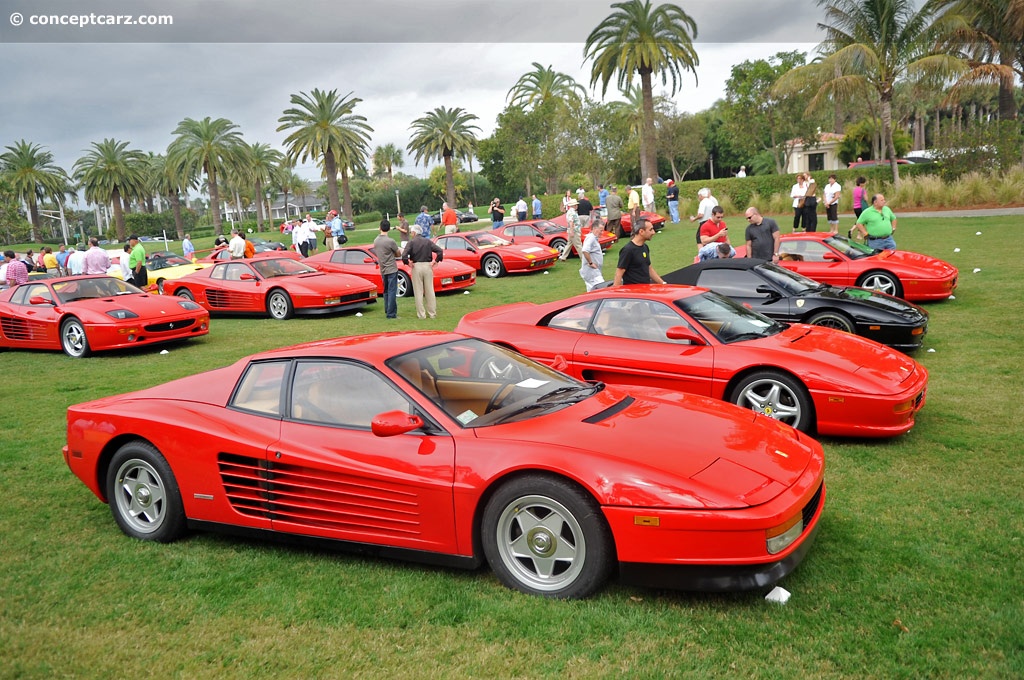
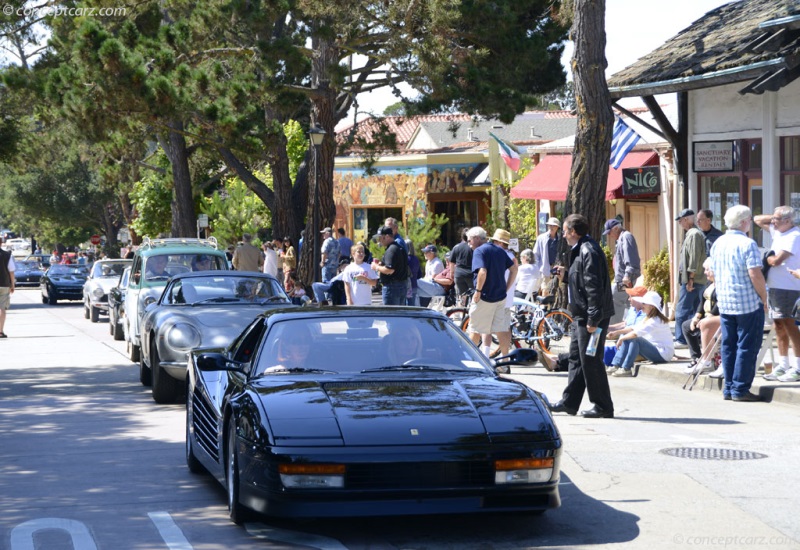
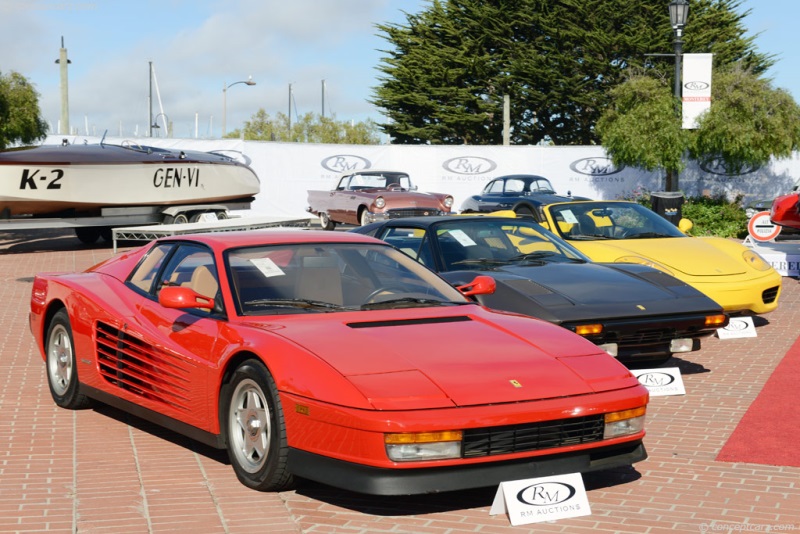
The Pininfarina designed Testarossa was debuted at the Paris Auto Show in September 1984 as a replacement for the 512 BB. This was not the first Testa Rossa in Ferrari's history. In the late 1950's the Test Rossa name was used for one of its vehicles because of red cam covers. Testa Rossa means 'redhead'. This Testarossa was built for the US market and made its way into those showrooms during 1985. The vehicle was designed to comply with the US emissions, regulations, and safety restrictions.

It used a double wishbone suspension with coil-over units at the rear to help with the increase in weight. The body was aluminum with steel doors and roof.


The engine was a modified version of the 512 BB. It had four-valves per cylinder, Marelli electronic ignition, Bosch K-Jetronic fuel injection, and capable of producing 390 bhp from the 4943 cc horizontally opposed 12 cylinder. The zero-to-sixty time was about 5.3 seconds and top speed was above 180 mph.


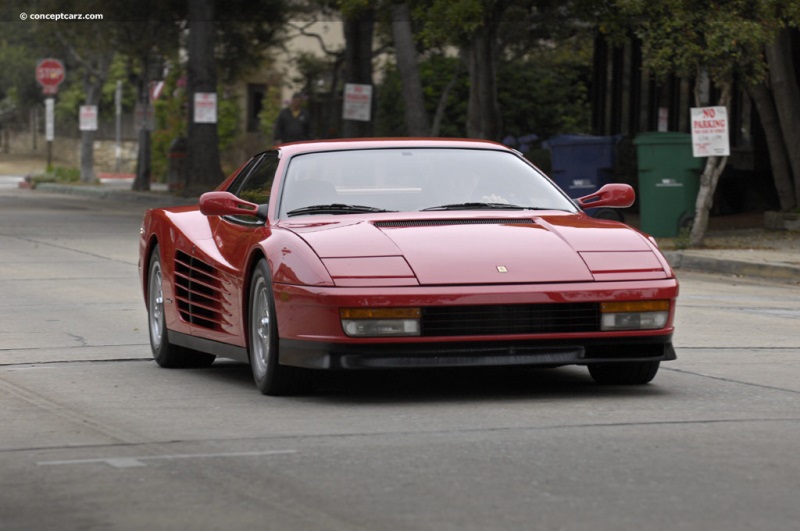
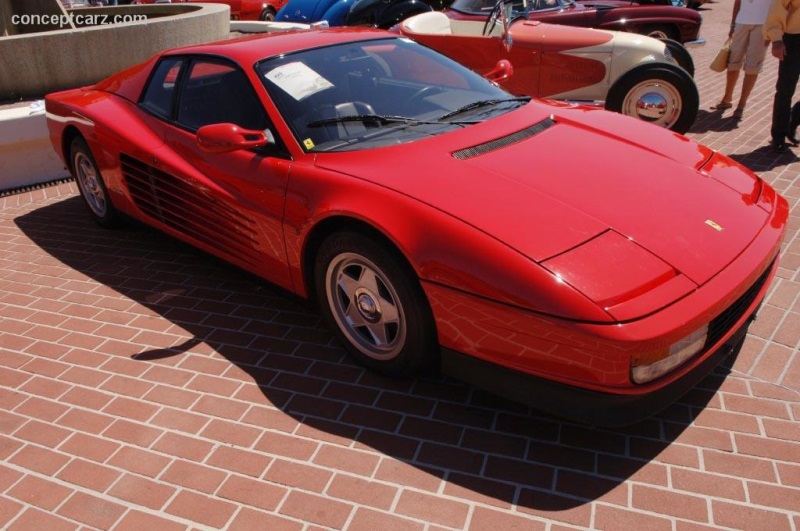
The Testarossa is recognizable by its large cold-air inlets located on the side of the car. This was necessary because of the new location of the twin radiators in the rear. By doing this, it allowed space up front for luggage. There was also special-made luggage that could fit behind the seats of the car.


In 1992 production of the Testarossa ceased after almost 7200 units were sold making it one of the most popular Ferrari models ever.

By Daniel Vaughan | Aug 2005
Coupe
Designer: Pininfarina
Chassis Num: ZFFAA17B000072343
 
Sold for $71,500 at 2006 RM Auctions.
The Ferrari Testarossa was unveiled to the public at the 1984 Paris Auto Show. The name Testarossa means 'red head' in reference to red engine heads. This was not the first Ferrari to bear the name Testarossa, it had been used in years prior. Production of the Testarossa began in 1985 and was created specifically for the US market. Much care was taken to make sure it met all safety, emission, and government regulations. The larger DOHC opposed twelve-cylinder engine was housed mid-ship and produced an impressive 380 horsepower. The five-speed manual gearbox sent the power to the rear wheels while the four-wheel disc brakes provided the stopping power.

The design was the work of Pininfarina and was a departure from their earlier work. It emphasized airflow management, aerodynamics, and modern appeal. The shape was honed in their wind tunnel to create the maximum down force. The side strakes channeled cooling air into the radiators.

By Ferrari's standards the car was large and heavy. The structure was mostly aluminum with steel used for the doors and roof. The interior was rather luxurious for a sports car which pleased the American buyers. The 12-cylinder engine was able to carry the car to a top speed of 175.

At the 2006 RM Auction in Monterey, CA chassis number ZFFAA17B000072343 was estimated to fetch between $70,000 - $90,000. At the conclusion of the bidding, the car had found a home at the low side of the estimate, at $71,500.

By Daniel Vaughan | Dec 2006
Coupe
Designer: Pininfarina
 
The Ferrari Testarossa, which superseded the 512 BB, was launched in Paris in September of 1984, and for nearly 11 years it went unchallenged as the world's fastest series production car. Its market focus was solely the USA, Ferrari making sure that it met all governmental safety and emissions rules. 175 mph was well within the stride of its dry sump, 4942cc, 4-valve, DOHC, flat-12 and its 'ripping silk' exhaust note both entertained and met the regulations. Its namesake, the Testa Rossa, was Ferrari's 1950s sports racing car. Walmart's Sam Walton owned this car, once a cover shot on Carmel's Pine Cone newspaper.
The Ferrari Testarossa leaped to center stage of the automotive world in 1984 and remained there for 11 years as the world's fastest regular production car. It was the definition of 'supercar' in its era, the innovative benchmark against which all contemporary sports cars were measured.

When Ferrari set about creating a replacement for the Berlinetta Boxer, a V12 engine, high performance, style and exemplary design were assumed. Ferrari dictated that luxury and practicality befitting the world's premier production sports car were also to be encompassed. Even as the Testarossa exerted a pull on the hearts and minds of car lovers, not to mention designers, Ferrari did not sit on their laurels. 1984's Testarossa evolved into the 512TR of 1991 and the F512M of 1995. With each evolution the styling, interior, and drivetrain were enhanced in a car that was always capable of speeds exceeding 180mph, accelerated to 60mph in approximately 5 seconds, and attained almost 0.9G lateral acceleration.

Design

In 1982 Pininfarina was commissioned to style a 12-cylinder Ferrari wîth radiators in the flanks like a racing car, GT-level luggage and storage space, extreme comfort, and performance to top the road-car line of the world's premier sports car manufacturer. The Testarossa was to be shaped partly by the wind tunnel to ensure clean airflow, low noise and high speed stability. Rear location of the radiators made the car's aerodynamics even more

important as passive direction of air to and from the engine bay had to be very effective. The result of Pininfarina's labors was easily the most recognizable and influential car of its time. The Testarossa is unmistakable at any distance, and impossible to ignore.

The shape was perfected without wasting space. The details are perfect and natural; the lines fit. This artistry is best seen by lòòking from a front corner to the opposite rear corner; the Testarossa's roofline exactly matches that of the straked flank below it. Amidst traditional Ferrari traits such as the egg crate grille were new stylistic touches such as rectangular rear lights and the broad, squared rear flanks. Early Testarossas had a single mirror located halfway up the driver's side A-pillar, on stalks. The Testarossa's most indelible image is of the five body color strakes that cover the side intakes and stretch between the ridges just below the door mirrors.

Structure

The Testarossa series was made from a variety of materials to appropriately maximize its functional form. Apart from the galvanized steel roof and doors, and various glass fiber pieces, the body panels were crafted entirely from strong but light aluminum.

The Testarossa chassis consisted of square section steel tubes arranged in a strong matrix, like a racing car. This was Ferrari's normal practice in chassis construction until the late 1990's. The Testarossa had a full tube-steel chassis wîth a removable rear sub-frame containing the low-mounted drivetrain and rear suspension. This gave the heavy rear of the car a double layer of support and simplified mechanical service. Vertical bulkheads at either end of the passenger cabin were of strengthened galvanized steel. The floorpan and front luggage bin were semi-monocoques bolted to the tubular chassis. The result was a passenger cabin wîth unsurpassed safety and an extremely rigid platform for a car wîth superlative performance.

Drivetrain

The Testarossa's longitudinally mounted flat 12 was a 4942cc all alloy unit wîth four valves per cylinder actuated by dual overhead cams, and dry-sump lubricated. On North American cars, the engine's compression ratio was 8.7:1. The aluminum pistons moved in nikasil cylinder liners and rotated a seven main bearing, hardened steel, billet turned crankshaft via forged steel connecting rods. The combustion chambers were ellipso-hemispherical. Fuel was metered by two Bosch KE Jetronic systems, one for each bank of cylinders, and delivered to the injectors by two electric pumps. Spark was provided by twin coils through their own distributors, controlled by a Weber-Marelli Microplex system. The combusted mixture exited through tube steel manifolds, catalytic converters and a tuned exhaust system. The engine was cooled by a compact system of twin side-mounted radiators and a single water pump. The North American Testarossa made 380bhp at 5750rpm, and 354lbs-ft at 4500rpm.

Suspension

The front suspension consisted of a coil spring over a Koni shock absorber located by unequal, length dual wishbones at each front wheel. At the rear, dual unequal length steel wishbones located a pair of coil springs over Koni shocks, one fore and one aft of each driveshaft. Front and rear anti-rollbars maintained stability in high speed cornering. The Testarossa's brakes were vented discs a little over a foot in diameter. The hydraulically assisted four piston calipers were controlled by separate circuits front and rear. The parking brake acted on small drums contained within the rear discs. The unassisted §teering was by a direct rack and pinion system.

The Testarossa's one piece cast alloy wheels are dull silver. On early cars, the wheels were secured by large closed nuts, but these soon gave way to five hub bolts. The wheels have five spokes in the shape of a star. The front wheels measure 16'X8' and carry a 225/VR50 tire. The rear wheels measure 16'X10' and carry tires 255/VR50 in size.

Interior

The Testarossa's cabin was bounded on either side by wide sills to accommodate the doors. To the rear, the firewall wîth integrated luggage shelf separated the cabin and engine bay. The Connolly hide covered, electrically adjustable seats were snug and well bolstered. Ancillary controls and switchgear efficiently nestled easy to hand, and the shallow dashboard containing guages fell into a center console containing all the requisite items for touring enjoyment. Commanding the console was the traditional slender gear lever in its polished gate.

The low rectangular instrument binnacle was dominated by a large speedometer and tachometer and smaller auxilliary gauges in a split black facia. Various indicator lights were offset around these orange and white on black readouts. Beneath the instruments the adjustable §teering column extended a thin rimmed, leather covered, three spoke Momo §teering wheel towards the driver.

Along wîth the luggage shelf behind the seats, the Testarossa offered carpeted cargo space beneath the front hood. This compartment was a deep cruciform, providing room for shopping or luggage. The carrying capacity of the Testarossa in the front and passenger compartments was maximized by use of fitted Schedoni luggage, an option available from Ferrari dealers.

Source - Ferrari
For more information and related vehicles, click here

blog comments powered by Disqus

Arrow Right 1987 Ferrari models
Ferrari 328 GTS
Ferrari 412i
Ferrari F40
Ferrari GTO Evoluzione

Similar Automakers
Aston MartinBentley
BugattiDevon
GTAKoenigsegg
LamborghiniLotus
MaseratiMaybach
McLarenPorsche
Rolls-RoyceSpyker
Tesla
Similarly Sized Vehicles from 1987
BMW 325
Chevrolet Corvette C4
Ferrari F40
Ferrari GTO Evoluzione
Ferrari Testarossa
Italdesign Aztec
Lamborghini Countach
Porsche 962C

Tags
five-speed manual, four-valve, Testa Rossa, 1987, 1987 Ferrari, Testarossa
 
Ferrari: 1981-1990
Similar Automakers
Other models by Ferrari
Vehicle Recall Information

Related Articles and Event Coverage
Carmel-By-The-Sea Concours on the Avenue
Concorso Italiano - A Celebration of Italian Style
Cavallino Classic XIX
Concorso Italiano
Le Belle Macchine d'Italia
Monterey Sports & Classic Car Auction
2006 Palm Beach Cavallino Classic XV Concours
2005 Le Belle Macchine d'Italia


156
166
166 F2
195
196
212
246
250 GT
250 Monza
250 Testarossa
275
288
308
312
328
330
333 SP
335
342 America
348
360
365
375
400
410
410 S
456
458
500 F2
500 Superfast
500 TR
512
512 BB/LM
550
553
575
599
612 Scaglietti
625
California
Dino
Enzo
F12berlinetta
F355
F40
F430
F430 GTC
F50
FF
Mondial
Mondial 500
Testarossa
Type 340

Image Left 1986 Testarossa1988 Testarossa Image Right
© 1998-2012. All rights reserved. The material may not be published, broadcast, rewritten, or redistributed.