1976 Penske PC4

1976 Penske PC4 Navigation
Roger Penske's first full-season assault into Formula One ended in tragedy. Throughout the years prior to his first assault on Formula One in 1975, Penske, and Mark Donohue, had achieved a great deal of success. Formula One would end up being more-costly. Deaths were still a very real part of Formula One, even during the middle-1970s. Undaunted by the tragedy, Penske would return in 1976 with a new sponsor and a new car.
Penske had taken part in the 1975 season with his new PC1 chassis. The car had been introduced in the very later-part of the 1974 season and had made some strides forward, but was still struggling for reliability and overall pace. Throughout 1975, the PC1 barely ran any better than it had at the end of the season before. Donohue's 5th place at Sweden was the best the car would achieve. As a result of its struggles, the PC1 would be abandoned for a March 751. It would be this chassis in which Donohue would crash; and later die due to injuries suffered.
Penske would not be undone by the tragedy. He would return with a new car designed by Geoff Ferris at Penske's shop in Poole, England, the new car was the PC3. Penske entered the car in the final race of the 1975 season with John Watson on board. The PC3 bore a striking resemblance to the March 751. Troubles during practice would force Watson to have to use the PC1 in the race. He would struggle throughout the race.
In 1976, the PC3 returned, with Penske's hopes that the second season in Formula One would be vastly more successful than the first. It was not to be. The best the PC3 could do was run somewhere around the middle of the pack. Ferris wasn't sitting idle. He was designing a new chassis. Penske would need it, and sooner than he thought.
At the same event the team had scored one of its best results, the Swedish Grand Prix, Penske unveiled his newest car, the PC4. Compared to the PC3, the new chassis was quite different, which it needed to be if the team had hopes of scoring better results.
Instead of the wedge-shaped nose and splitter element, the nose on the PC4 featured more conventional front wings to help generate downforce. The nose, itself, was wide and flat. The top-line of the bodywork created a rather acute angle as it traveled aft. The nose featured to small wing-like 'ears' that helped create a more aerodynamic profile for the airflow as it came upon the double-wishbone front suspension. The height between the wishbone components was minimal due to low-line of the bodywork.
The front wing was a very conventional, and straight-forward, single-plane element. A small vertical flap, called a 'Gurney flap' could be added to help increase downforce at the front. However, this addition would also increase drag. Although the car featured this large front wing, the downforce levels weren't enough to keep from sliding being the best way to be fast while on track. Compared to the PC3, the new chassis boasted much cleaner lines and a much lower profile.
The narrow-depth front suspension utilized a coil for ride comfort and stabilization. This coil was set at about a forty-five degree angle inward. The top wishbone element had a central hinge, which led to the wishbones rocking up and down as they rode over the bumps. Going over a bump, the wishbones would rock up, which would compress the coil. Just in front of the upper wishbone ran the steering arm. Protruding out of the inside of the front wheels were a single, large air duct. This duct drew airflow into the hot disc brakes to help for cooling.
Aerodynamics were quite important, but limited by the materials used at the time. The car's tub was virtually the entire car, just covered up by bodywork. This is different than today, whereby the tub is a smaller unit and the other components are just attached to complete the car. The nose of the PC4 would be a good example.
On a modern grand prix car, the nose attaches to the nose bulkhead, or, crash structure. Because of the carbon-fiber composites, the actual nose is a monocoque, or hallow, structure that attaches to the crash structure. On the PC4, the aluminum structure underneath the bodywork is the crash structure, and the form for the whole car itself. The bodywork merely creates a more aerodynamic covering for the frame.
The bodywork that forms the cockpit is merely a piece of curved bodywork that rests on and attaches to the wide, flat nose crash structure. The instrumentation and steering wheel is mounted to a tubular frame covered by the bodywork. With the bodywork removed, the driver's feet are visible as it would be necessary for crews to be able to make changes and work on this part of the car.
The bodywork that covered the cockpit rose sharply out of the flat, wide nose and sidepods. Rising up out of the wide nose, the line of the curved bodywork blended seamlessly with the angle produced by the wide, flat nose. This is clearly noticeable when the car is viewed from its side.
Racer
Chassis #: PC4/001
View info and historyStrictly for the purpose of making the area around the cockpit much more aerodynamic, the bodywork actually made for a very tight cockpit. The driver would have to squeeze down inside the clear plexiglass. The driver sitting down inside a clear plexiglass cockpit would be a hallmark of Penske's chassis, even as he would head back to the United States to focus on Indycar racing.The compact bodywork actually angled inward as it went upward. This caused the driver's shoulders to easily touch the sides of the bodywork. The tubular frame to which the instruments and the steering wheel were attached, were also readily apparent to the eye.
Due to the tight nature of the cockpit, there was very little in the way of instrumentation for the driver. The most obvious, and important, instrument the driver had was the rpm gauge. The small gearshift stuck up, right near the driver's right hand so the driver would not have to move very far to shift gears. The transmission was the proven Hewland 5-speed manual.
Directly behind the driver's head was the important roll-hoop. Bodywork covered its support structure, but it also covered the top of the 90 degree, 3.0-liter Ford-Cosworth DFV V8 engine. Weighing in at 370 pounds, the engine, which was capable of producing 465 bhp and turn at speeds close to 11,000 rpm, was normally aspirated and needed air to breathe. Many designs cut out the top of the bodywork in order to expose the induction pipes, or 'trumpets'. On the previous PC3, a tall, large airbox was fitted to the top of the engine and sat above the roll-hoop. Ferris didn't go this route on the PC4. Instead, Ferris decided to employ two large NACA ducts in his bodywork design. These slot-type ducts directed the air inward and over the engine.
Of course cooling the high temperatures of the engine remains of utmost importance. Ferris' new PC4 drew on elements used in the PC3, but went further. Modern Formula One cars place the radiators up front, on either side of the cockpit. On Ferris' PC3, the radiators were placed aft, just in front of the rear wheels. They were also inset slightly. In spite of being inset slightly, a flap that extended outward tended to help direct the airflow in toward the radiator. On the PC4, the sidepods of the car contour outward from right behind the front suspension. However, they too did not house the radiators up front. In a quest to disrupt the airflow as little as possible, the height of the sidepods remained low. They also contoured outward and featured no large opening up front. This helped to keep the car relatively undisturbed at the front of the car. In a quest to keep the same stability at the rear, the radiators were attached to the sides of the sidepods like on the PC3. However, they were mounted more-flush so that the air would not necessarily flow into them, but over. This helped to reduce drag caused by the air being bottled-up trying to go through the radiator. In this fashion, the airflow could more easily continue while some slipped through. Of course, this meant the engine didn't quite receive the cooling it needed.
To further help with engine cooling, the area immediately aft of the engine was created void of any bodywork. A gap also existed between the engine cowling and the sidepod bodywork. This helped to keep access to the engine, but it also helped to further cool it. One other important reason for the lack of bodywork was because of the upper trailing arm for the rear suspension that attached up near the front of the engine and ran aft to the top of the rear wheel hub assembly. This, in turn, was attached to a U-shaped single link, which was attached to the coil spring for both wheels.
The exhaust pipes for the V8 Cosworth exited out of the lower sides of the engine in the space between the radiators and the engine itself. These pipes bend around and blend into one pipe than run after on either side of the car's transmission. The exhaust pipes run underneath the driveshaft and exit out the rear of the car.
When the bodywork was attached to the top of the rear of the car, there remained a slot gap between the top of the engine cowling and the top of the bodywork covering the sidepods themselves. This slot gap was used to go through another cooler for the oil.
The rear wing was conventional in its shape as it featured a straight leading edge. Its two planes were designed with a shrouded central support-pillar. The camber of the lower portion of the rear wing's main plane was greatly contoured and offered decent amounts of downforce.
Due to the fact aerodynamics and downforce properties were still a rather new concept, fast laps times were still dependent, to a large degree, on the driver's ability to drift the car through the corners. The PC4 offered the driver good stability when sideways. The 56 inch front wheelbase and 58 inch rear gave the car a wide stance, and therefore, good stability. In addition, the wide rear tires, and small-diameter front tires, helped provide confidence to push the car. Adorned in a red, white and blue livery, the new car did offer confidence. At 1300 pounds, the car could accelerate quite well. The 465 hp Cosworth could power the car from zero to 60 in only three seconds and could get up to 119 mph in a quarter of a mile.
Racer
Chassis #: PC4/001
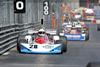
View info and historyUnfortunately, it would take its second race before its true potential could be realized as Watson crashed the car on the first lap of the Swedish Grand Prix. Over the course of the next two grand prix races John Watson would stand on the podium each time. Then, at the race in which Donohue had crashed and would later die, the Austrian Grand Prix, Watson would again stand on the podium, but on the 1st place step. Watson had scored the victory by ten seconds over Jacques Laffite. In only his second full-time season in Formula One Roger Penske had earned a victory, and the PC4 was the car that brought it home. It also caused John Watson to have to shave his trademark beard.
Roger Penske would leave Formula One after 1976, the season in which he had earned his one and only victory. However, the PC4 would continue to race one more season with ATS Racing and Interscope. In its final season of competition, the PC4 would earn ATS Racing a 6th place result at the United States Grand Prix West event.
The PC4 proved to be Penske's redemptive chassis. At the very same place the team had experienced tragedy, one year on, would experience triumph. All of this was due to Ferris and the PC4.Sources:
'Penske Racing PC4', (http://www.histomobile.com/dvd_histomobile/usa/219/1976_Penske_Racing_PC_4.htm). Histomobile. http://www.histomobile.com/dvd_histomobile/usa/219/1976_Penske_Racing_PC_4.htm. Retrieved 31 March 2011.'Penske PC4 Cosworth', (http://www.ultimatecarpage.com/car/4684/Penske-PC4-Cosworth.html). Ultimatecarpage.com: Powered by Knowledge, Driven by Passion. http://www.ultimatecarpage.com/car/4684/Penske-PC4-Cosworth.html. Retrieved 31 March 2011.
Racer
Chassis #: PC4/001
View info and historyWikipedia contributors, 'Penske Racing', Wikipedia, The Free Encyclopedia, 28 February 2011, 06:44 UTC, http://en.wikipedia.org/w/index.php?title=Penske_Racing&oldid=416337404 accessed 31 March 2011'Penske PC3 Cosworth', (http://www.ultimatecarpage.com/car/3725/Penske-PC3-Cosworth.html). Ultimatecarpage.com: Powered by Knowledge, Driven by Passion. http://www.ultimatecarpage.com/car/3725/Penske-PC3-Cosworth.html. Retrieved 31 March 2011.By Jeremy McMullen
Penske had taken part in the 1975 season with his new PC1 chassis. The car had been introduced in the very later-part of the 1974 season and had made some strides forward, but was still struggling for reliability and overall pace. Throughout 1975, the PC1 barely ran any better than it had at the end of the season before. Donohue's 5th place at Sweden was the best the car would achieve. As a result of its struggles, the PC1 would be abandoned for a March 751. It would be this chassis in which Donohue would crash; and later die due to injuries suffered.
Penske would not be undone by the tragedy. He would return with a new car designed by Geoff Ferris at Penske's shop in Poole, England, the new car was the PC3. Penske entered the car in the final race of the 1975 season with John Watson on board. The PC3 bore a striking resemblance to the March 751. Troubles during practice would force Watson to have to use the PC1 in the race. He would struggle throughout the race.
In 1976, the PC3 returned, with Penske's hopes that the second season in Formula One would be vastly more successful than the first. It was not to be. The best the PC3 could do was run somewhere around the middle of the pack. Ferris wasn't sitting idle. He was designing a new chassis. Penske would need it, and sooner than he thought.
At the same event the team had scored one of its best results, the Swedish Grand Prix, Penske unveiled his newest car, the PC4. Compared to the PC3, the new chassis was quite different, which it needed to be if the team had hopes of scoring better results.
Instead of the wedge-shaped nose and splitter element, the nose on the PC4 featured more conventional front wings to help generate downforce. The nose, itself, was wide and flat. The top-line of the bodywork created a rather acute angle as it traveled aft. The nose featured to small wing-like 'ears' that helped create a more aerodynamic profile for the airflow as it came upon the double-wishbone front suspension. The height between the wishbone components was minimal due to low-line of the bodywork.
The front wing was a very conventional, and straight-forward, single-plane element. A small vertical flap, called a 'Gurney flap' could be added to help increase downforce at the front. However, this addition would also increase drag. Although the car featured this large front wing, the downforce levels weren't enough to keep from sliding being the best way to be fast while on track. Compared to the PC3, the new chassis boasted much cleaner lines and a much lower profile.
The narrow-depth front suspension utilized a coil for ride comfort and stabilization. This coil was set at about a forty-five degree angle inward. The top wishbone element had a central hinge, which led to the wishbones rocking up and down as they rode over the bumps. Going over a bump, the wishbones would rock up, which would compress the coil. Just in front of the upper wishbone ran the steering arm. Protruding out of the inside of the front wheels were a single, large air duct. This duct drew airflow into the hot disc brakes to help for cooling.
Aerodynamics were quite important, but limited by the materials used at the time. The car's tub was virtually the entire car, just covered up by bodywork. This is different than today, whereby the tub is a smaller unit and the other components are just attached to complete the car. The nose of the PC4 would be a good example.
On a modern grand prix car, the nose attaches to the nose bulkhead, or, crash structure. Because of the carbon-fiber composites, the actual nose is a monocoque, or hallow, structure that attaches to the crash structure. On the PC4, the aluminum structure underneath the bodywork is the crash structure, and the form for the whole car itself. The bodywork merely creates a more aerodynamic covering for the frame.
The bodywork that forms the cockpit is merely a piece of curved bodywork that rests on and attaches to the wide, flat nose crash structure. The instrumentation and steering wheel is mounted to a tubular frame covered by the bodywork. With the bodywork removed, the driver's feet are visible as it would be necessary for crews to be able to make changes and work on this part of the car.
The bodywork that covered the cockpit rose sharply out of the flat, wide nose and sidepods. Rising up out of the wide nose, the line of the curved bodywork blended seamlessly with the angle produced by the wide, flat nose. This is clearly noticeable when the car is viewed from its side.

Racer
Chassis #: PC4/001
View info and history
Due to the tight nature of the cockpit, there was very little in the way of instrumentation for the driver. The most obvious, and important, instrument the driver had was the rpm gauge. The small gearshift stuck up, right near the driver's right hand so the driver would not have to move very far to shift gears. The transmission was the proven Hewland 5-speed manual.
Directly behind the driver's head was the important roll-hoop. Bodywork covered its support structure, but it also covered the top of the 90 degree, 3.0-liter Ford-Cosworth DFV V8 engine. Weighing in at 370 pounds, the engine, which was capable of producing 465 bhp and turn at speeds close to 11,000 rpm, was normally aspirated and needed air to breathe. Many designs cut out the top of the bodywork in order to expose the induction pipes, or 'trumpets'. On the previous PC3, a tall, large airbox was fitted to the top of the engine and sat above the roll-hoop. Ferris didn't go this route on the PC4. Instead, Ferris decided to employ two large NACA ducts in his bodywork design. These slot-type ducts directed the air inward and over the engine.
Of course cooling the high temperatures of the engine remains of utmost importance. Ferris' new PC4 drew on elements used in the PC3, but went further. Modern Formula One cars place the radiators up front, on either side of the cockpit. On Ferris' PC3, the radiators were placed aft, just in front of the rear wheels. They were also inset slightly. In spite of being inset slightly, a flap that extended outward tended to help direct the airflow in toward the radiator. On the PC4, the sidepods of the car contour outward from right behind the front suspension. However, they too did not house the radiators up front. In a quest to disrupt the airflow as little as possible, the height of the sidepods remained low. They also contoured outward and featured no large opening up front. This helped to keep the car relatively undisturbed at the front of the car. In a quest to keep the same stability at the rear, the radiators were attached to the sides of the sidepods like on the PC3. However, they were mounted more-flush so that the air would not necessarily flow into them, but over. This helped to reduce drag caused by the air being bottled-up trying to go through the radiator. In this fashion, the airflow could more easily continue while some slipped through. Of course, this meant the engine didn't quite receive the cooling it needed.
To further help with engine cooling, the area immediately aft of the engine was created void of any bodywork. A gap also existed between the engine cowling and the sidepod bodywork. This helped to keep access to the engine, but it also helped to further cool it. One other important reason for the lack of bodywork was because of the upper trailing arm for the rear suspension that attached up near the front of the engine and ran aft to the top of the rear wheel hub assembly. This, in turn, was attached to a U-shaped single link, which was attached to the coil spring for both wheels.
The exhaust pipes for the V8 Cosworth exited out of the lower sides of the engine in the space between the radiators and the engine itself. These pipes bend around and blend into one pipe than run after on either side of the car's transmission. The exhaust pipes run underneath the driveshaft and exit out the rear of the car.
When the bodywork was attached to the top of the rear of the car, there remained a slot gap between the top of the engine cowling and the top of the bodywork covering the sidepods themselves. This slot gap was used to go through another cooler for the oil.
The rear wing was conventional in its shape as it featured a straight leading edge. Its two planes were designed with a shrouded central support-pillar. The camber of the lower portion of the rear wing's main plane was greatly contoured and offered decent amounts of downforce.
Due to the fact aerodynamics and downforce properties were still a rather new concept, fast laps times were still dependent, to a large degree, on the driver's ability to drift the car through the corners. The PC4 offered the driver good stability when sideways. The 56 inch front wheelbase and 58 inch rear gave the car a wide stance, and therefore, good stability. In addition, the wide rear tires, and small-diameter front tires, helped provide confidence to push the car. Adorned in a red, white and blue livery, the new car did offer confidence. At 1300 pounds, the car could accelerate quite well. The 465 hp Cosworth could power the car from zero to 60 in only three seconds and could get up to 119 mph in a quarter of a mile.

Racer
Chassis #: PC4/001
View info and history
Roger Penske would leave Formula One after 1976, the season in which he had earned his one and only victory. However, the PC4 would continue to race one more season with ATS Racing and Interscope. In its final season of competition, the PC4 would earn ATS Racing a 6th place result at the United States Grand Prix West event.
The PC4 proved to be Penske's redemptive chassis. At the very same place the team had experienced tragedy, one year on, would experience triumph. All of this was due to Ferris and the PC4.Sources:
'Penske Racing PC4', (http://www.histomobile.com/dvd_histomobile/usa/219/1976_Penske_Racing_PC_4.htm). Histomobile. http://www.histomobile.com/dvd_histomobile/usa/219/1976_Penske_Racing_PC_4.htm. Retrieved 31 March 2011.'Penske PC4 Cosworth', (http://www.ultimatecarpage.com/car/4684/Penske-PC4-Cosworth.html). Ultimatecarpage.com: Powered by Knowledge, Driven by Passion. http://www.ultimatecarpage.com/car/4684/Penske-PC4-Cosworth.html. Retrieved 31 March 2011.

Racer
Chassis #: PC4/001
View info and history
- 1976 Penske PC4 Menu
- Article
- Image gallery
- Specifications
Penske
Similar Vehicles
Similar Automakers
Related Drivers
 Hans Binder
 Hans Heyer
 Jean-Pierre Jacques Jarier
 Danny Ongais
 John Marshall 'Wattie' Watson
Related Teams
ATS Racing Team Citibank Team Penske Interscope Racing 


1976 Penske PC4 Vehicle Profiles

Recent Vehicle Additions


Related Automotive News

Iconic Ex-Briggs Cunningham Corvette Le Mans Headed to Amelia Island Auction
ICONIC EX-BRIGGS CUNNINGHAM 1960 CHEVROLET CORVETTE LE MANS RACE CAR LEADS A LINEUP OF BANNER SPORTS AND RACING CARS FOR THE AMELIA ISLAND AUCTION
MORE THAN 80 OUTSTANDING MOTORS CARS SET FOR THE 22 MAY AUCTION
RM Sothebys announces exci...

The Motor Sport Hall Of Fame Awards Shortlist Of Contenders Is Announced!
Some of the greatest names in motor sport history make up the shortlist of contenders for this years Motor Sport Hall of Fame ceremony. Set to take place at the stunning Royal Automobile Club at Woodcote Park on Wednesday June 7, the event will add...

John Barnard's Finest: Some of the Greatest of Barnard's Design
The latter-part of Barnards Formula One career would be filled with disappointments and disputes. However, there was no disputing the genius of the man from London. In fact, a couple of innovations that are mainstays in Formula One design were first...

1967 Can-Am Road America: The Beginning of the 'Bruce and Denny Show'
While Formula One will be forever considered the pinnacle of motorsport, from a period between 1966 and 1986 there existed a series that would likely be the closest to anything goes as any motor racing series could truly get. Based upon the FIA Group...

1968 Belgian Grand Prix: A First for McLaren
McLaren and Formula One are truly synonymous. Over the course of its history, McLaren has completed 714 races and have garnered no less than 178 victories. But while McLaren and victory in Formula One are an almost certainty, the very first would be...


