2005 Red Bull RB1
2005 Red Bull RB1 Navigation
In 2004 the big cat from Jaguar looked as if it had worn out chasing its prey. Unfortunately, the team would go away famished, never having caught the expectations laid out before it. And while many of the teams it would continue to run away from the new team, as a red bull, the new RB1 would make it clear this would be one team that would not be easily killed in the ring. Dietrich Mateschitz and Red Bull would purchase the Jaguar racing team in November of 2004. The first round of the World Championship, for 2005, would take place in early March. Therefore, the newly named Red Bull Racing team would have a short amount of time to get a lot of work done.
There were many elements that needed to come together in order to prepare for the upcoming season. Thankfully, the new team would not have to start from scratch. And while Jaguar and shown poorly over the last couple of years, Red Bull still had something to build upon, which would give the team that all-important element—time. The team needed some time so it could make strides developing its own car. So while the team would obviously be looking to perform well in its first season, there would still need to be some realistic expectations to prevail.
While a lot of elements needed to come together just to be in a place to go racing, the one good thing was that those elements could be sought out at the same time. So while the search for a Team Manager was ongoing the designers and engineers could stay hard at work preparing the new car. When Christian Horner, David Coulthard and others came on board they would find the designers and engineers working on what would be just an evolution of Jaguar's R5 simply because that is what the team had and time was growing short.
The reality was that Jaguar were making steps at the time Ford announced it would withdraw the brand from the series. A new wind tunnel had been purchased and the aerodynamic department within the team had been expanded in 2002. But while the team was making strides, it was obviously not enough to pull the team from out of the middle of the pack.
Throughout the middle of winter and the early part of the new year, the team, and its drivers, would focus on putting in laps on the circuit to begin digging its way out of the middle of the pack. Throughout these test sessions the team would use the R5 chassis just dressed up in the expected Red Bull livery. Meanwhile, the engineers and designers were still hard at work making the final pieces of the new car. Of course, making a new, or evolved, version of a car isn't fully left up to the designer's imagination. Therefore, Mark Smith and Rob Taylor, the teams designers, would have to make appropriate evolutions while also adhering to any new regulations for the upcoming season.
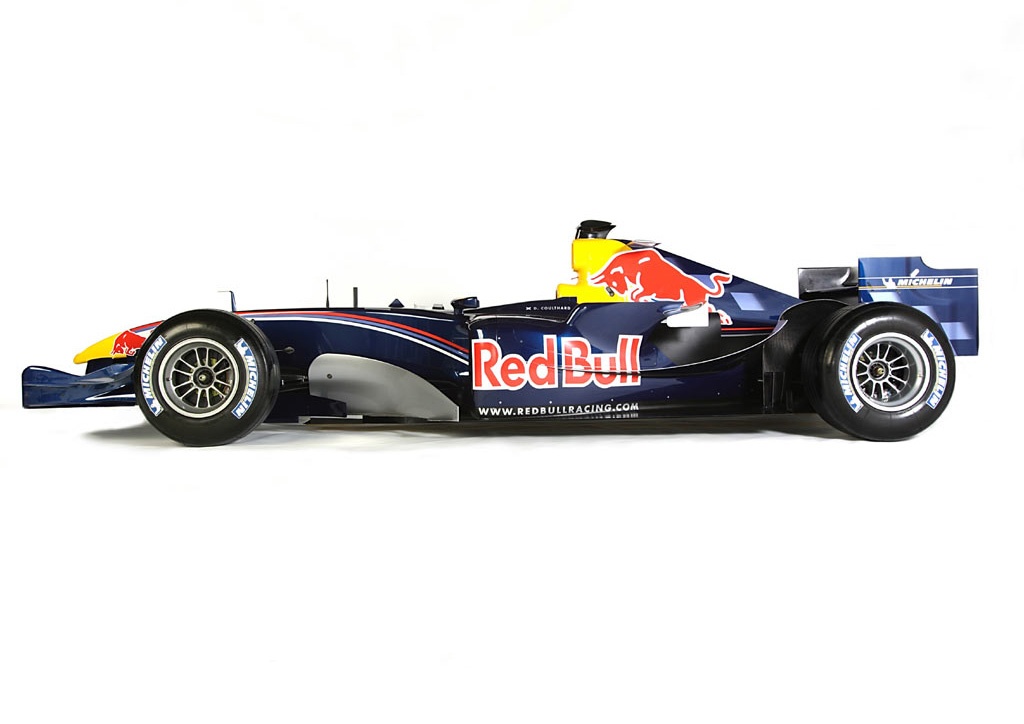
While there would be a number of operational regulations made for the 2005 season, there wouldn't be a large number of drastic changes imposed by the governing-body on all of the teams. This would further help Red Bull's engineers by allowing them to work relatively easily with what was already available. Finally, on the 7th of February, almost exactly a month before the first race of the season, the RB1 would make its debut at Jerez, Spain. The launch would be rather low-key as testing was the order of the day. Nonetheless, as the car was unveiled, it was clear the Jaguar lineage, but it was also obvious this was an entirely different animal altogether. When seen in testing, Red Bull's rendition of the R5 also had an overall blue livery with the red bull and yellow disc adorning the side of the car. However, there would be some notable changes to the livery on the RB1. Besides the obvious increase in sponsors covering the car's bodywork was new on the car, the blue livery was as well. The R5 used in testing would be covered in blue and silver finish and would sport a much smaller red bull on either side of the engine cover. However, when the RB1 was unveiled the car would come complete with a blue finish and larger red bulls on either side. The silver finish would be much more minimal on the RB1. Silver would end up adorning mostly just the appendages and wing elements. In addition, there would be some trim of red, white and blue adorning the car as well.
The livery would be just the beginning of the differences, and similarities, of the RB1 and its Jaguar predecessor.
One of the more obvious changes between the two cars would be found right up at the nose of the car. First of all, it was obvious the front wing was positioned higher out at the endplates than on the Jaguar R5. This was the result of the new regulations for 2005. However, the shaping of the wing would not. The front wing on the Jaguar would sport a shallow scoop in the middle of the wing right where it attached to the nose uprights. However, with the requirements for the outer edges of the front wing to be higher for 2005, the scoop in the middle of the wing would be much more dramatic on the RB1. In addition, the front wing would include a tiered-look, or step-down approach, to its design. Therefore, the front wing consists of a step down on either side of the wing before the dramatic scoop in the middle. This would give the leading edge of the wing the profile of a bird soaring through the air. Attached to either end of the front wing were heavily sculpted endplates and other vanes meant to direct airflow and stabilize the car up at the nose.
Combining with the new front wing, the nose on the RB1 would be slightly altered from its Jaguar predecessor. While the R5 featured a tall but drooping narrow nose, the RB1 would see the bulkhead slightly heading upward in front of the cockpit. And while the nose would droop down, the tip of the nose would still be slightly higher than that on the R5. The extra distance between the nose and the scoop in the wing would be made up by the nose uprights. This subtle change meant even more airflow under the nose making its way to the splitter underneath the driver's legs.
Made entirely of composite monocoque, the structure of the car would be very strong compared to its weight. The nose bulkhead, which formed an important part of the car's crash structure, accommodates the driver's legs, as well as, the steering column and other electronics important to the operation and manipulation of the car. The carbon-fiber nose that attaches to the front of the bulkhead hides many important suspension and steering components on the car. Both of the car's power-steering and Koni dampers are hidden under the nose and are attached to the bulkhead of the car. The pushrod suspension with its cast titanium uprights and carbon upper and lower wishbones are about the only aspect, other than the car's anti-roll bar, that actually protrude out in the airflow.
Hidden inside the large grooved Michelin tires lie the real secret to a Formula One car's performance. The RB1 would utilize AP Racing lithium alloy six-piston calipers. These large calipers would be gripping Brembo carbon/carbon discs. The carbon brakes work great a higher temperatures like those normally seen in a Formula One race with the constant acceleration and braking. However, they tend not to work as well when they are not already hot. The carbon brakes also don't work well when they are incredibly hot. Therefore, cooling is an important issue, especially at some of the slower circuits on the schedule. Therefore, ducts of varying sizes can be made to attach to the inside of the wheel and extend out into the airflow passing through the suspension members. Similar to the R5, the RB1 would feature some relatively small barge-boards in between the front wheels and the radiator sidepods. These barge-boards are an important element in car design in that they help to keep the openings to the radiators as small as possible. This is achieved by the barge-boards effectively passing cooler air directly into the radiator inlet making it much more efficient. The shaping of the barge-board is important for directing airflow into the inlets, but it is also important for directing airflow out and around the side of the car. The sidepods on a Formula One car can be quite inefficient in the airflow as they protrude out of either side of the car. The barge-boards aid in deflecting airflow out and around the side of the car thereby reducing the drag caused. The boards also aid in reducing the amount of build-up of air trying to flow into the inlets. Reducing the build-up around the inlet makes cooling much more efficient, which means smaller inlets and much less turbulence, and therefore, better stability in the middle of the car.
The sidepods of the RB1 would be nearly an exact copy of the R5. The corners of the tall sidepods would be gently rounded. The inlet for the slanted radiators would be wide at the top and drawn in towards the bottom in order to allow as much airflow around the side of the car. The bottom of the sidepod on the RB1 would be pulled in ever so slightly at the bottom where it met the undertray. Of course the shape of the lower portion of the sidepod would be designed so that it worked in unison with the vertical splitter positioned under the driver's legs and that attached to the floor.
The main monocoque structure of the RB1, just like the sidepods, would be virtually identical to the R5. The protective structures to either side of the driver's helmet remained nearly the same trapezoidal-shaped airbox would be retained. On top of the airbox would be one noticeable difference from the R5. A small wing positioned on the top of the airbox would be included to provide extra stability and control in the middle of the car. There would be some more important differences added to the RB1 in the mid-section of the car.
The air passing through the radiators needs a place to go in order to actually provide cooling. Following the example of many other teams, Red Bull would add aerodynamically-contoured stacks to either sidepod. Their shape and the passing air help to reduce the turbulence and instability of the hotter air as it leaves the car.
The RB1 would also feature an evolution of the rear wheel flicks employed on the R5. While the R5 had a rather simple but large rear wheel flick, the RB1 features that and some more. The rear end on the RB1 would be tightened much more than what it was on the Jaguar. This would lead to a much more dramatic sucking in of the sidepods toward the rear of the car. This opened the area between the rear wheel and the structure of the car to a greater degree. This would help pull more air in over the rear diffuser which would aid in the rear of the car generating more downforce. To keep the air flowing through that channel and not upward to disturb the air flowing to the rear wing, a much large rear wheel flick would be employed on the RB1. The leading edge of the vane would start along the side of the sidepod and would extend out to the side as far as the regulations would allow. This would not only aid in directing airflow over the rear tire but it would also trap the air flowing along the side of the car underneath it. This would keep the air under it flowing to the brake duct on the rear wheel, as well as, the all-important rear diffuser.
The same effect is done on the upper portion of the vane. The upper portion would be useful in directing air flowing along the side of the car toward the rear wing. The contoured piece would also extend over the rear suspension cutting off the inside part of the rear wheel. This all aided in reducing the turbulence at the rear of the car, which would be important since the regulations stipulated the rear wing had to be moved forward, thereby reducing downforce at the rear of the car.
As a result of the rear wing positioning further forward rear downforce would be lost to a certain degree, a number of small wing structures and turning vanes would begin to appear on car designs. The rear wheel flick on the RB1 would be one thing the team would use. A much smaller pillar attachment would be mounted just behind the chimneys on the sidepod. This would be just another attempt to control airflow and use it to stabilize the air, and by extension, the car.
The rear wing would obviously be one major change from the R5 to the RB1. Though positioned further forward, the designers would keep to a straight main plane. However, the car would utilize a much smaller lower plane that actually served as the main support for the rear wing. The pillar-less rear wing attached via the wing-like structure to the car's longitudinal gearbox. The endplates, as per regulations, would also extend further backward out of the car to help smooth the airflow as it exited out the back of the car. This was done in an attempt to improve the racing and ability of the cars to pass.
Of course, stability of the car means everything when it comes to handling and agility. And while the rear suspension would use coil springs and a torsion anti-roll bar compared to the torsion bar used on the front suspension, the car seemed to be nimble, and yet, stable in testing.
While none of the wing surfaces were moveable and were out of the control of the driver, the cockpit, in particular the steering wheel, would be arrayed in buttons and switches to affect things like brake bias, fuel mixture and launch control. Steering wheel mounted paddles would control the AP Racing seven-speed longitudinally mounted semi-automatic gearbox. The gearbox would use a triple-plate clutch system to help feed the power to the rear wheels.
Drivers David Coulthard, Christian Klien and Vitantonio Liuzzi would need the triple clutch and the integrated engine/chassis electronic control system to provide the necessary traction control as Cosworth would come into 2005 with a 3.0-liter V10 capable of producing some 50-60 more horsepower than that used in the R5. The TJ 2005 engine would be a 90 degree design that came with 40 valves and a rev limit of 18,000 rpm. All of this meant a horsepower figure believed to be around 900 bhp. It also meant performance numbers ranging from 2.5 seconds going from zero to 60 mph and a speed of over 175 mph in one kilometer. With a total weight of just 1335 pounds making it capable for the car to go from zero to 100 mph and back to zero in well under ten seconds, the new RB1 would be both quick, but also, quite nimble. This had all of the makings of a good car.
It would just keep going from there. By the end of the next race of the season Red Bull would eclipse Jaguar's entire 2004 point total. On top of that, Red Bull's 2005 season tally would end up being more than what the Jaguar team amassed throughout its entire existence from 2000 to 2004. What a different kind of animal the red bull would be.Sources:
'All Cars Ever: 2005: Red Bull RB1', (http://www.f1technical.net/f1db/cars/893/red-bull-rb1?sid=d11772bc9255ccd7dd7a06ff7c13e54b). F1Technical. http://www.f1technical.net/f1db/cars/893/red-bull-rb1?sid=d11772bc9255ccd7dd7a06ff7c13e54b. Retrieved 28 February 2012.'Red Bull RB1 (2005-2005)', (http://www.histomobile.com/dvd_histomobile/usa/1243/2005_Red_Bull_RB1.htm). Histomobile. http://www.histomobile.com/dvd_histomobile/usa/1243/2005_Red_Bull_RB1.htm. Retrieved 28 February 2012.'Jaguar R5', (http://www.ultimatecarpage.com/car/1857/Jaguar-R5.html). Ultimatecarpage.com: Powered by Knowledge, Driven by Passion. http://www.ultimatecarpage.com/car/1857/Jaguar-R5.html. Retrieved 28 February 2012.'Jaguar R5 Cosworth', (http://www.f1technical.net/f1db/cars/874/jaguar-r5). F1 Technical. http://www.f1technical.net/f1db/cars/874/jaguar-r5. Retrieved 28 February 2012.Wikipedia contributors, 'Jaguar Racing', Wikipedia, The Free Encyclopedia, 12 January 2012, 14:33 UTC, http://en.wikipedia.org/w/index.php?title=Jaguar_Racing&oldid=470972119 accessed 28 February 2012By Jeremy McMullen
There were many elements that needed to come together in order to prepare for the upcoming season. Thankfully, the new team would not have to start from scratch. And while Jaguar and shown poorly over the last couple of years, Red Bull still had something to build upon, which would give the team that all-important element—time. The team needed some time so it could make strides developing its own car. So while the team would obviously be looking to perform well in its first season, there would still need to be some realistic expectations to prevail.
While a lot of elements needed to come together just to be in a place to go racing, the one good thing was that those elements could be sought out at the same time. So while the search for a Team Manager was ongoing the designers and engineers could stay hard at work preparing the new car. When Christian Horner, David Coulthard and others came on board they would find the designers and engineers working on what would be just an evolution of Jaguar's R5 simply because that is what the team had and time was growing short.
The reality was that Jaguar were making steps at the time Ford announced it would withdraw the brand from the series. A new wind tunnel had been purchased and the aerodynamic department within the team had been expanded in 2002. But while the team was making strides, it was obviously not enough to pull the team from out of the middle of the pack.
Also considering time was short, the design team and engineers didn't have the time to develop a whole new car. They would have to work with some basic elements that worked and then go on from there. This reduced elements of the car that needed an outright revamping.
While there would be a number of operational regulations made for the 2005 season, there wouldn't be a large number of drastic changes imposed by the governing-body on all of the teams. This would further help Red Bull's engineers by allowing them to work relatively easily with what was already available. Finally, on the 7th of February, almost exactly a month before the first race of the season, the RB1 would make its debut at Jerez, Spain. The launch would be rather low-key as testing was the order of the day. Nonetheless, as the car was unveiled, it was clear the Jaguar lineage, but it was also obvious this was an entirely different animal altogether. When seen in testing, Red Bull's rendition of the R5 also had an overall blue livery with the red bull and yellow disc adorning the side of the car. However, there would be some notable changes to the livery on the RB1. Besides the obvious increase in sponsors covering the car's bodywork was new on the car, the blue livery was as well. The R5 used in testing would be covered in blue and silver finish and would sport a much smaller red bull on either side of the engine cover. However, when the RB1 was unveiled the car would come complete with a blue finish and larger red bulls on either side. The silver finish would be much more minimal on the RB1. Silver would end up adorning mostly just the appendages and wing elements. In addition, there would be some trim of red, white and blue adorning the car as well.
The livery would be just the beginning of the differences, and similarities, of the RB1 and its Jaguar predecessor.
One of the more obvious changes between the two cars would be found right up at the nose of the car. First of all, it was obvious the front wing was positioned higher out at the endplates than on the Jaguar R5. This was the result of the new regulations for 2005. However, the shaping of the wing would not. The front wing on the Jaguar would sport a shallow scoop in the middle of the wing right where it attached to the nose uprights. However, with the requirements for the outer edges of the front wing to be higher for 2005, the scoop in the middle of the wing would be much more dramatic on the RB1. In addition, the front wing would include a tiered-look, or step-down approach, to its design. Therefore, the front wing consists of a step down on either side of the wing before the dramatic scoop in the middle. This would give the leading edge of the wing the profile of a bird soaring through the air. Attached to either end of the front wing were heavily sculpted endplates and other vanes meant to direct airflow and stabilize the car up at the nose.
Combining with the new front wing, the nose on the RB1 would be slightly altered from its Jaguar predecessor. While the R5 featured a tall but drooping narrow nose, the RB1 would see the bulkhead slightly heading upward in front of the cockpit. And while the nose would droop down, the tip of the nose would still be slightly higher than that on the R5. The extra distance between the nose and the scoop in the wing would be made up by the nose uprights. This subtle change meant even more airflow under the nose making its way to the splitter underneath the driver's legs.
Made entirely of composite monocoque, the structure of the car would be very strong compared to its weight. The nose bulkhead, which formed an important part of the car's crash structure, accommodates the driver's legs, as well as, the steering column and other electronics important to the operation and manipulation of the car. The carbon-fiber nose that attaches to the front of the bulkhead hides many important suspension and steering components on the car. Both of the car's power-steering and Koni dampers are hidden under the nose and are attached to the bulkhead of the car. The pushrod suspension with its cast titanium uprights and carbon upper and lower wishbones are about the only aspect, other than the car's anti-roll bar, that actually protrude out in the airflow.
Hidden inside the large grooved Michelin tires lie the real secret to a Formula One car's performance. The RB1 would utilize AP Racing lithium alloy six-piston calipers. These large calipers would be gripping Brembo carbon/carbon discs. The carbon brakes work great a higher temperatures like those normally seen in a Formula One race with the constant acceleration and braking. However, they tend not to work as well when they are not already hot. The carbon brakes also don't work well when they are incredibly hot. Therefore, cooling is an important issue, especially at some of the slower circuits on the schedule. Therefore, ducts of varying sizes can be made to attach to the inside of the wheel and extend out into the airflow passing through the suspension members. Similar to the R5, the RB1 would feature some relatively small barge-boards in between the front wheels and the radiator sidepods. These barge-boards are an important element in car design in that they help to keep the openings to the radiators as small as possible. This is achieved by the barge-boards effectively passing cooler air directly into the radiator inlet making it much more efficient. The shaping of the barge-board is important for directing airflow into the inlets, but it is also important for directing airflow out and around the side of the car. The sidepods on a Formula One car can be quite inefficient in the airflow as they protrude out of either side of the car. The barge-boards aid in deflecting airflow out and around the side of the car thereby reducing the drag caused. The boards also aid in reducing the amount of build-up of air trying to flow into the inlets. Reducing the build-up around the inlet makes cooling much more efficient, which means smaller inlets and much less turbulence, and therefore, better stability in the middle of the car.
The sidepods of the RB1 would be nearly an exact copy of the R5. The corners of the tall sidepods would be gently rounded. The inlet for the slanted radiators would be wide at the top and drawn in towards the bottom in order to allow as much airflow around the side of the car. The bottom of the sidepod on the RB1 would be pulled in ever so slightly at the bottom where it met the undertray. Of course the shape of the lower portion of the sidepod would be designed so that it worked in unison with the vertical splitter positioned under the driver's legs and that attached to the floor.
The main monocoque structure of the RB1, just like the sidepods, would be virtually identical to the R5. The protective structures to either side of the driver's helmet remained nearly the same trapezoidal-shaped airbox would be retained. On top of the airbox would be one noticeable difference from the R5. A small wing positioned on the top of the airbox would be included to provide extra stability and control in the middle of the car. There would be some more important differences added to the RB1 in the mid-section of the car.
The air passing through the radiators needs a place to go in order to actually provide cooling. Following the example of many other teams, Red Bull would add aerodynamically-contoured stacks to either sidepod. Their shape and the passing air help to reduce the turbulence and instability of the hotter air as it leaves the car.
The RB1 would also feature an evolution of the rear wheel flicks employed on the R5. While the R5 had a rather simple but large rear wheel flick, the RB1 features that and some more. The rear end on the RB1 would be tightened much more than what it was on the Jaguar. This would lead to a much more dramatic sucking in of the sidepods toward the rear of the car. This opened the area between the rear wheel and the structure of the car to a greater degree. This would help pull more air in over the rear diffuser which would aid in the rear of the car generating more downforce. To keep the air flowing through that channel and not upward to disturb the air flowing to the rear wing, a much large rear wheel flick would be employed on the RB1. The leading edge of the vane would start along the side of the sidepod and would extend out to the side as far as the regulations would allow. This would not only aid in directing airflow over the rear tire but it would also trap the air flowing along the side of the car underneath it. This would keep the air under it flowing to the brake duct on the rear wheel, as well as, the all-important rear diffuser.
The same effect is done on the upper portion of the vane. The upper portion would be useful in directing air flowing along the side of the car toward the rear wing. The contoured piece would also extend over the rear suspension cutting off the inside part of the rear wheel. This all aided in reducing the turbulence at the rear of the car, which would be important since the regulations stipulated the rear wing had to be moved forward, thereby reducing downforce at the rear of the car.
As a result of the rear wing positioning further forward rear downforce would be lost to a certain degree, a number of small wing structures and turning vanes would begin to appear on car designs. The rear wheel flick on the RB1 would be one thing the team would use. A much smaller pillar attachment would be mounted just behind the chimneys on the sidepod. This would be just another attempt to control airflow and use it to stabilize the air, and by extension, the car.
The rear wing would obviously be one major change from the R5 to the RB1. Though positioned further forward, the designers would keep to a straight main plane. However, the car would utilize a much smaller lower plane that actually served as the main support for the rear wing. The pillar-less rear wing attached via the wing-like structure to the car's longitudinal gearbox. The endplates, as per regulations, would also extend further backward out of the car to help smooth the airflow as it exited out the back of the car. This was done in an attempt to improve the racing and ability of the cars to pass.
Of course, stability of the car means everything when it comes to handling and agility. And while the rear suspension would use coil springs and a torsion anti-roll bar compared to the torsion bar used on the front suspension, the car seemed to be nimble, and yet, stable in testing.
While none of the wing surfaces were moveable and were out of the control of the driver, the cockpit, in particular the steering wheel, would be arrayed in buttons and switches to affect things like brake bias, fuel mixture and launch control. Steering wheel mounted paddles would control the AP Racing seven-speed longitudinally mounted semi-automatic gearbox. The gearbox would use a triple-plate clutch system to help feed the power to the rear wheels.
Drivers David Coulthard, Christian Klien and Vitantonio Liuzzi would need the triple clutch and the integrated engine/chassis electronic control system to provide the necessary traction control as Cosworth would come into 2005 with a 3.0-liter V10 capable of producing some 50-60 more horsepower than that used in the R5. The TJ 2005 engine would be a 90 degree design that came with 40 valves and a rev limit of 18,000 rpm. All of this meant a horsepower figure believed to be around 900 bhp. It also meant performance numbers ranging from 2.5 seconds going from zero to 60 mph and a speed of over 175 mph in one kilometer. With a total weight of just 1335 pounds making it capable for the car to go from zero to 100 mph and back to zero in well under ten seconds, the new RB1 would be both quick, but also, quite nimble. This had all of the makings of a good car.
At the first round of the World Championship everyone got to see just how good of a car it was. David Coulthard would make a stellar start and even Christian Klien would be punching out of his weight class. Over the majority of the race, Coulthard would be in 2nd place and would be one of the fastest cars on the circuit. Klien would continually run near the top five. Coulthard, who had been dropped by McLaren, was well ahead of both of their team cars. He would also be hounded every lap of the race by Mark Webber in a Williams. Webber couldn't wait to leave Jaguar after the difficult time he had with the team, and yet, here it basically was beating him in the race. At the end of the event, Coulthard would finish a fantastic 4th while Klien would finish 7th. This would give the team 7 points in its first race. Jaguar had only scored 10 the whole previous season.
'All Cars Ever: 2005: Red Bull RB1', (http://www.f1technical.net/f1db/cars/893/red-bull-rb1?sid=d11772bc9255ccd7dd7a06ff7c13e54b). F1Technical. http://www.f1technical.net/f1db/cars/893/red-bull-rb1?sid=d11772bc9255ccd7dd7a06ff7c13e54b. Retrieved 28 February 2012.'Red Bull RB1 (2005-2005)', (http://www.histomobile.com/dvd_histomobile/usa/1243/2005_Red_Bull_RB1.htm). Histomobile. http://www.histomobile.com/dvd_histomobile/usa/1243/2005_Red_Bull_RB1.htm. Retrieved 28 February 2012.'Jaguar R5', (http://www.ultimatecarpage.com/car/1857/Jaguar-R5.html). Ultimatecarpage.com: Powered by Knowledge, Driven by Passion. http://www.ultimatecarpage.com/car/1857/Jaguar-R5.html. Retrieved 28 February 2012.'Jaguar R5 Cosworth', (http://www.f1technical.net/f1db/cars/874/jaguar-r5). F1 Technical. http://www.f1technical.net/f1db/cars/874/jaguar-r5. Retrieved 28 February 2012.Wikipedia contributors, 'Jaguar Racing', Wikipedia, The Free Encyclopedia, 12 January 2012, 14:33 UTC, http://en.wikipedia.org/w/index.php?title=Jaguar_Racing&oldid=470972119 accessed 28 February 2012By Jeremy McMullen
The Red Bull Racing RB1 was driven by David Coulthard, Christian Klien, and Vitantonio Liuzzi. Liuzzi raced in four of the rounds, and Klien raced in the other 15 rounds. Powering the car was a Cosworth 3-liter V10 that was mated to a Red Bull 7-speed semi-automatic. The RB1 was the first car built by Red Bull Racing after the energy drinks manufacturer purchased the Jaguar Racing team in 2004. The team's best result was a fourth place finish on its debut at the Australian Grand Prix. It earned another fourth place finish at the European grand Prix.
By Daniel Vaughan | Mar 2012
The RB1 earned 34 points throughout the season, giving Red Bull Racing a 7th place finish in the Constructors Championship.
By Daniel Vaughan | Mar 2012
- 2005 Red Bull RB1 Menu
- Article
- Image gallery
- Specifications


F1 Team(s):
2005 Season
Points: 34
Position: 7
Engine: Cosworth TJ2005
2025 Entry: RB21
2024 Entry: RB20
2023 Entry: RB19
2022 Entry: RB18
2021 Entry: RB16B
2020 Entry: RB16
2019 Entry: RB15
2018 Entry: RB14
2017 Entry: RB13
2016 Entry: RB12
2015 Entry: RB11
2014 Entry: RB10
2013 Entry: RB9
2012 Entry: RB8
2011 Entry: RB7
2010 Entry: RB6
2009 Entry: RB5 Renault
2008 Entry: RB4 F1
2007 Entry: RB3
2006 Entry: RB2
Points: 34
Position: 7
Engine: Cosworth TJ2005
2025 Entry: RB21
2024 Entry: RB20
2023 Entry: RB19
2022 Entry: RB18
2021 Entry: RB16B
2020 Entry: RB16
2019 Entry: RB15
2018 Entry: RB14
2017 Entry: RB13
2016 Entry: RB12
2015 Entry: RB11
2014 Entry: RB10
2013 Entry: RB9
2012 Entry: RB8
2011 Entry: RB7
2010 Entry: RB6
2009 Entry: RB5 Renault
2008 Entry: RB4 F1
2007 Entry: RB3
2006 Entry: RB2
Red Bull
Similar Automakers


Recent Vehicle Additions


Related Automotive News

Valkyrie takes the ultimate hypercar from the road to the track as new quest for Le Mans glory begins
Aston Martin Valkyrie hypercar unveiled as the pure-bred contender
The Aston Martin THOR Team takes the Wings back to the 24 Hours of Le Mans to fight for its first overall victory since 1959
Valkyrie is the only hypercar to contest both the...

Porsche celebrates 25 years of the 911 GT3
The motorsport-derived 911 variant debuted 25 years ago.
Atlanta. A quarter of a century ago, Porsche introduced a new model that would go on to become a legend the 911 GT3. Named after a class of endurance racing cars, the motorsport-derived...

The Alpine A110 Range
The Alpine A110 range has been updated, with three distinct new versions, uprated performance, and more equipment than ever The revised range now consists of A110 offering a pure and typically Alpine driving experience, the luxurious...

Ford GT And Mustang GT4 Demonstrate Ford Road And Race Performance At 2017 Goodwood Festival Of Speed
Ford GT power, performance and active aerodynamics on show as GT road car tackles Goodwood Hillclimb for the first time, driven by Ford Chip Ganassi Racing drivers
Track ready Ford Mustang GT4 race car makes European debut on challenging 1.16-mile...

THE McLAREN F1
FOR THE DRIVER VITALLY – AS IN ONE OF McLARENS WORLD CHAMPION RACING CARS – DRIVER AND VEHICLE BECOME ENTIRELY AS ONE
The primary design consideration for the McLaren F1 has been to make it without reserve a drivers car, an extremely high-performance...


