1963 Ford Galaxie
1963 Ford Galaxie Navigation
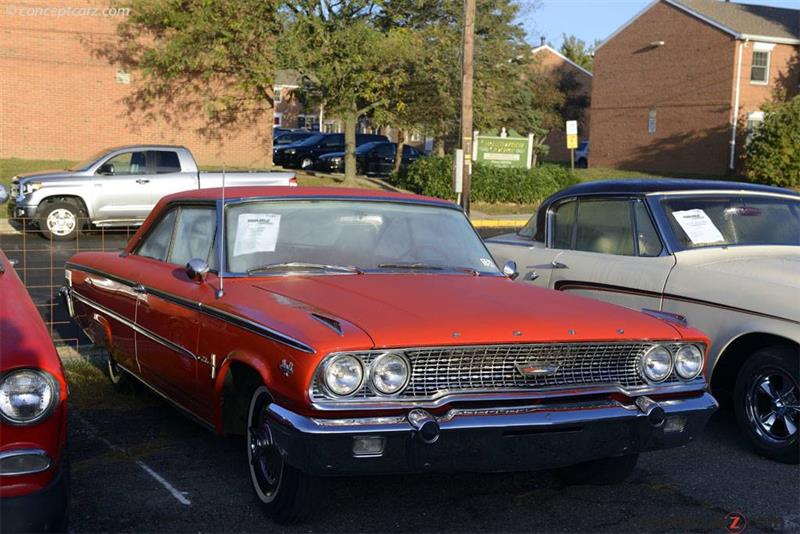
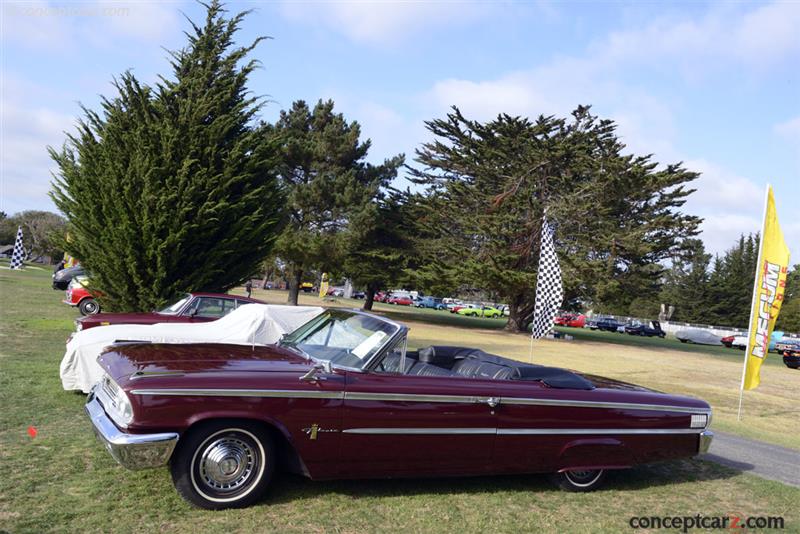
The 1963 Ford Galaxie was the intermediate trim level and was positioned above the entry-level Ford 300. It came with all the items found on the 300 Series plus a chrome strip running horizontally along the lower bodysides. Two chrome fender ornaments were located on each of the front fenders. Bodystyles included a two- and four-door sedan with prices beginning at $2,450 for the six-cylinder two-door sedan. This was roughly $75 more than the similarly equipped Ford 300 two-door. The 200 cubic-inch six-cylinder engine had a one-barrel carburetor and delivered 116 horsepower. The wheelbase measured 119 inches and had an overall length of 209 inches. The 1963 model was nearly unchanged when compared to the 1962 model year, except for some added trim and freshening. The windshields were reshaped and a four-door hardtop 500/XL was added. Mid-year, a lower, fastback roofline became available. This was the industry's first official '1/2 year' model and was called the 'sports hardtop' or 'fastback.' Galaxie 500
For buyers seeking more, Ford offered the Galaxie 500, the top trim level for 1963. Body styles included a two sedan, 2-door club sedan, town victoria, club victoria, fastback coupe, and a Sunliner convertible. They had additional chrome on the exterior including two horizontal chrome strips on the side, chrome 'A' pillar moldings, and chrome window moldings. Six- and 8-cylinder engines could be installed in the engine bay.The two-door sedan with six-cylinder power was priced at $2,450 and the four-door body style at $2,500. The addition of the base eight-cylinder engine boosted the factory base price by approximately $100. A total of 112,754 examples of the Galaxie were built in 1963 plus 440,526 units of the Galaxie 500 and 94,730 examples of the Galaxie 500XL. The Galaxie 500 series was available with either six- or eight-cylinder power, while the Galaxie 500XL was solely equipped with eight-cylinder power.The Galaxie 500 with six-cylinder power was priced at $2,615 for the club sedan, $2,670 for the town sedan, $2,675 for the club victoria and fastback coupe, $2,740 for the town victoria, and $2,925 for the sun convertible. The addition of the base eight-cylinder engine added approximately $100 to the base price. The most popular Galaxie 500 body style was the town sedan with 205,722 examples built, followed by 100,500 of the fastback coupe, 49,733 of the club victoria, 36,876 of the sun convertible, 26,558 of the town victoria, and 21,137 of the club sedan. Galaxie 500XL
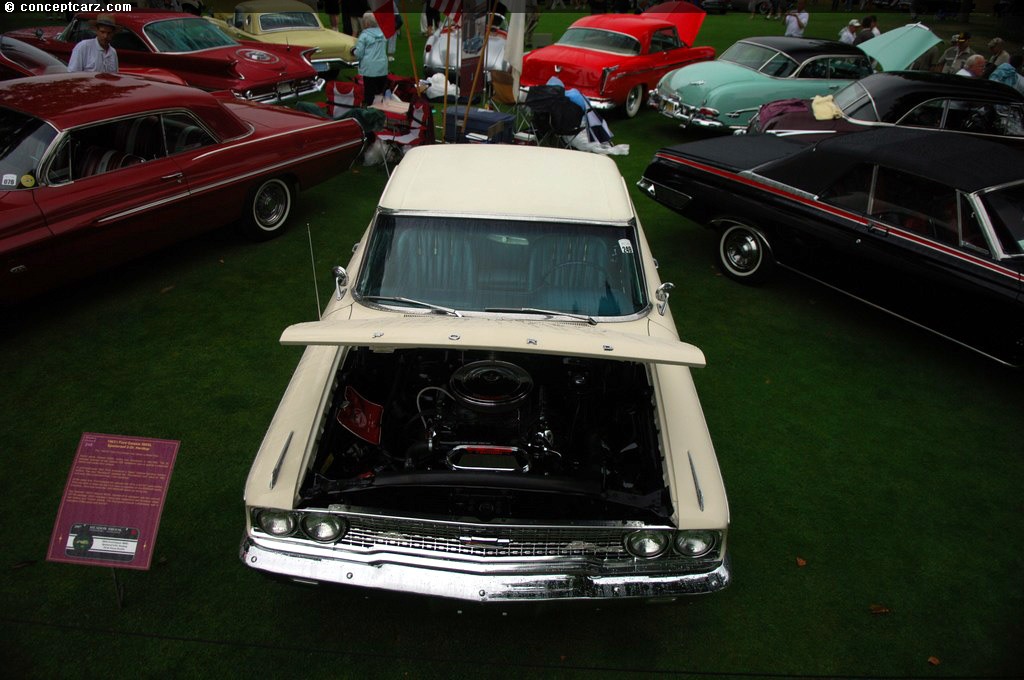
The Galaxie 500XL Series were V8 powered only, with body styles including the Sunliner convertible, town victoria, club Vicotria, and fastback coupe. The two-door club victoria was priced at $3,630 and 29,713 examples were built, and 33,870 were fastback coupes at a base price of $3,270. The sun convertible was priced at $3,520 and 18,551 examples were built, and 12,596 examples were town victories having a base price of $3,330. The 292 Y-block V8 was replaced as the base V8 with the Fairlane's new small block 260. The 260 proved to be underpowered and was replaced mid-year with the 289 V8, the largest of the 'small block series.' Five different transmissions were offered for 1963. A 3-speed manual column shift was standard on all models except the 406 V8, which required the heavier duty Borg-Warner 4-speed manual. A three-speed manual with overdrive was optional but rarely ordered. The two-speed Ford-O-Matic was common with the 6-cylinder and small block V-8s, while the majority of big blocks (352 and 390) were ordered with the 3-speed Cruise-O-Matic automatic transmission.Fastback Galaxie
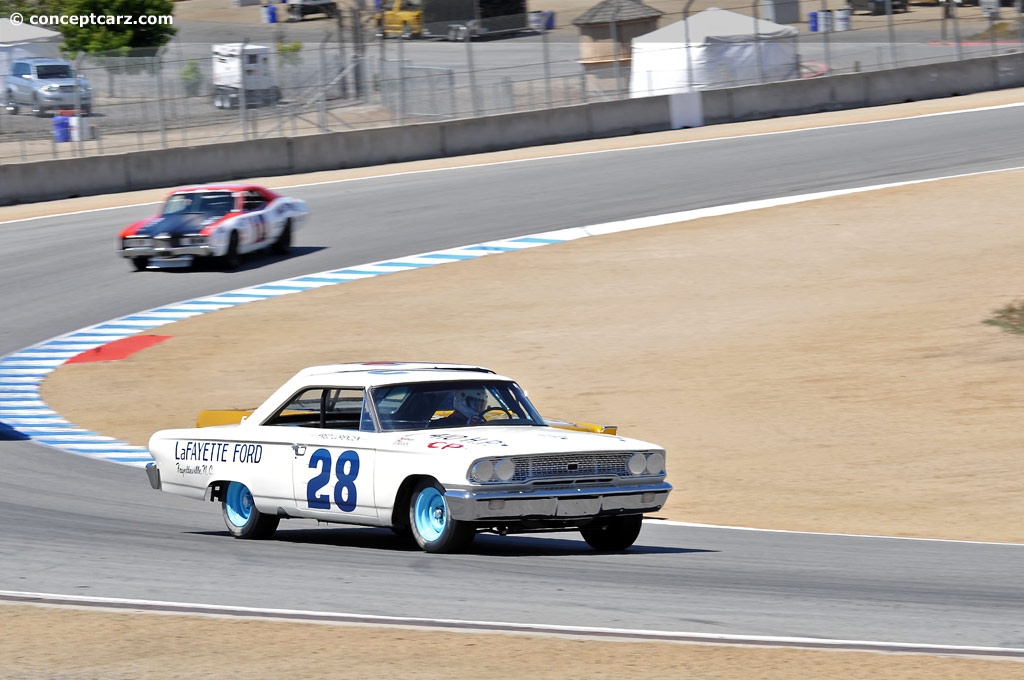
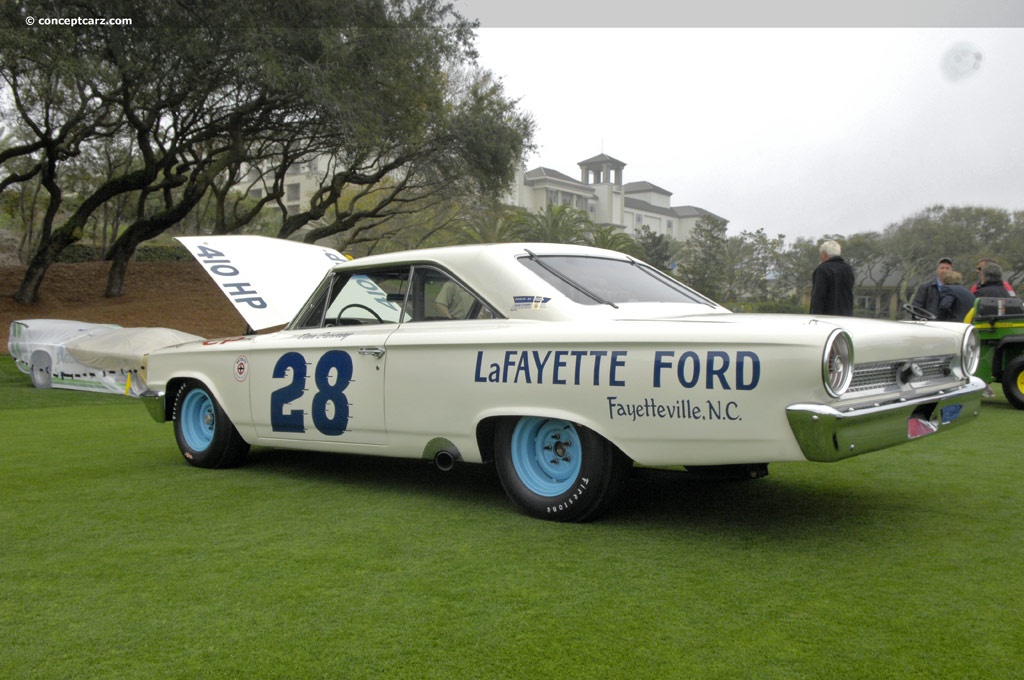
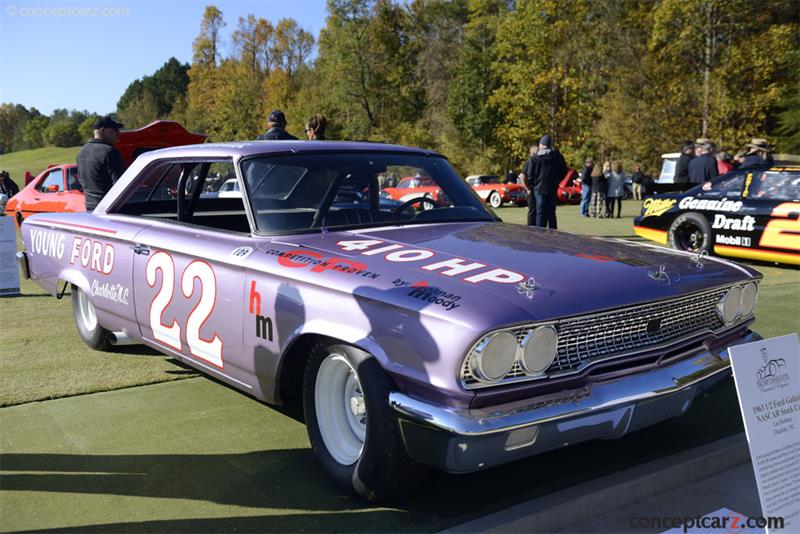
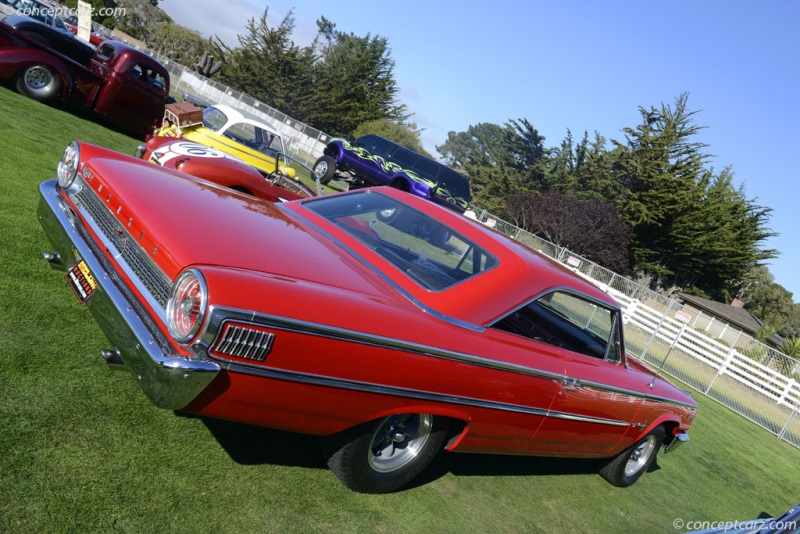
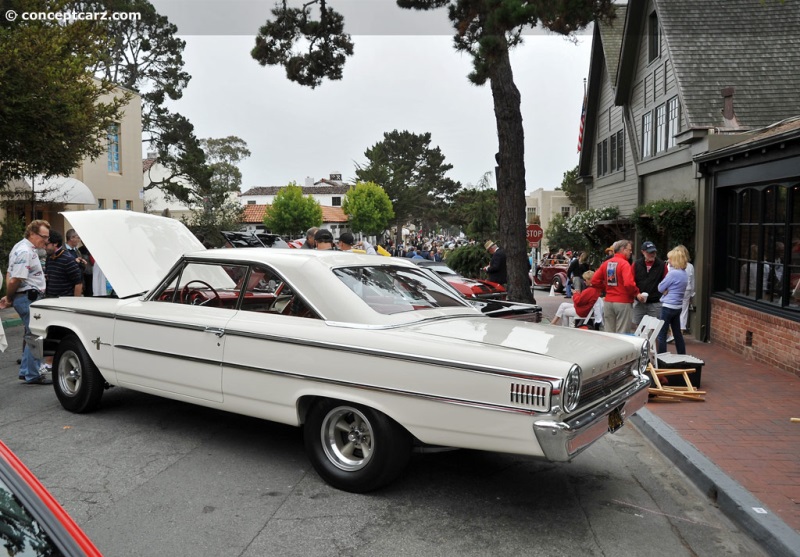
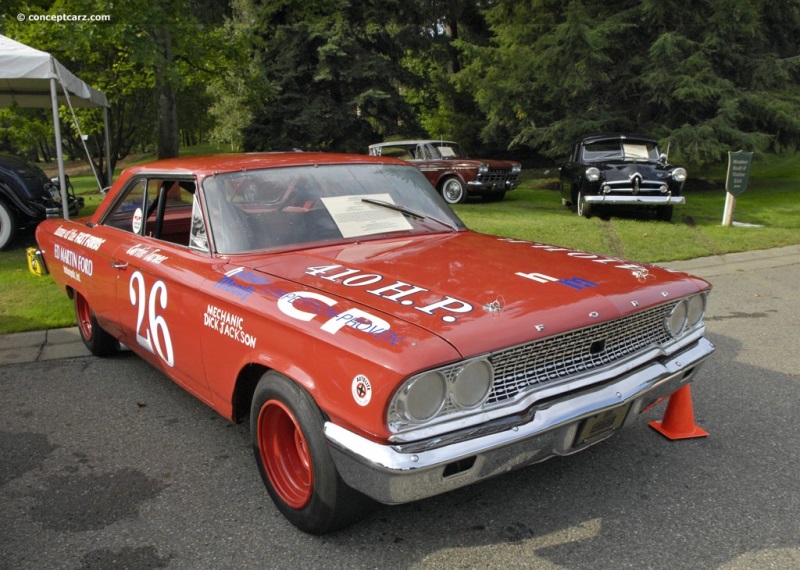
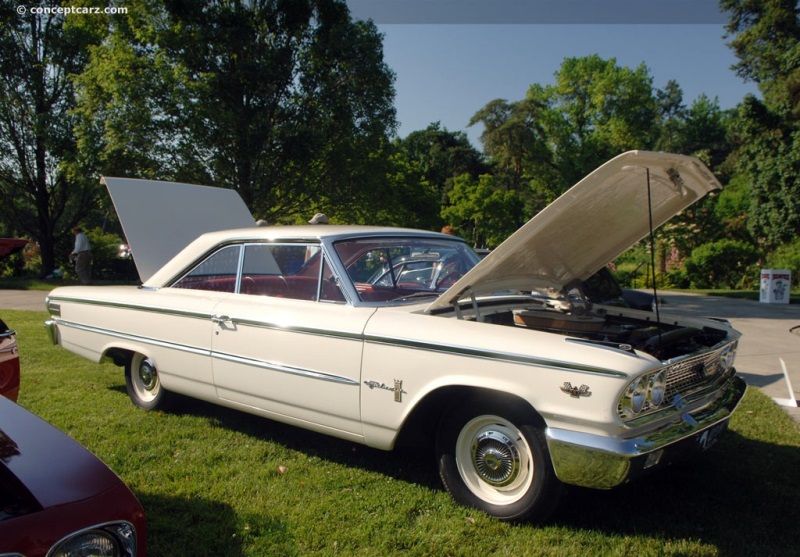
Sitting two inches lower than its 1962 forerunner, the 1963.5 'fastback' Galaxie was a reported 28 percent more aerodynamic - a fact that instantly translated into major success on NASCAR's superspeedways. Recognizing that the 'notchback' Galaxie profile was a veritable brick at high speeds, Ford's idea guys had tried to get away with attaching an optional 'Starlift' roof to the 1962 convertible to create a more swoopy shape for NASCAR competition. NASCAR rule moguls, however, didn't buy the idea, forcing Ford designers back to the drawing board. The result was this stylish, functional, mid-year bodystyle. To power the new fastback Galaxie, Ford engineers again beefed up the FE block, this time boring it out to 427 cubic inches- at least that's what they said. Actual displacement computed to 425 CID, but Dearborn's image-makers apparently didn't want Ford's top performance powerplant to take a back seat to rival offerings. Seven liters, or roughly 427 CID, was the established legal limit for stock-class racing, and with a flick of a public relations pen, the new 425 ci big-block was introduced to the public as being right at that limit. Triple carburetors were dropped for 1963 in favor of two big Holley four-barrels. Counting both the single-carb 410 hp and the dual-carb 425 hp versions, Ford sold 4,978 427-equipped models in 1963.1963 1/2 Ford Galaxie 500 Dealer Lightweight
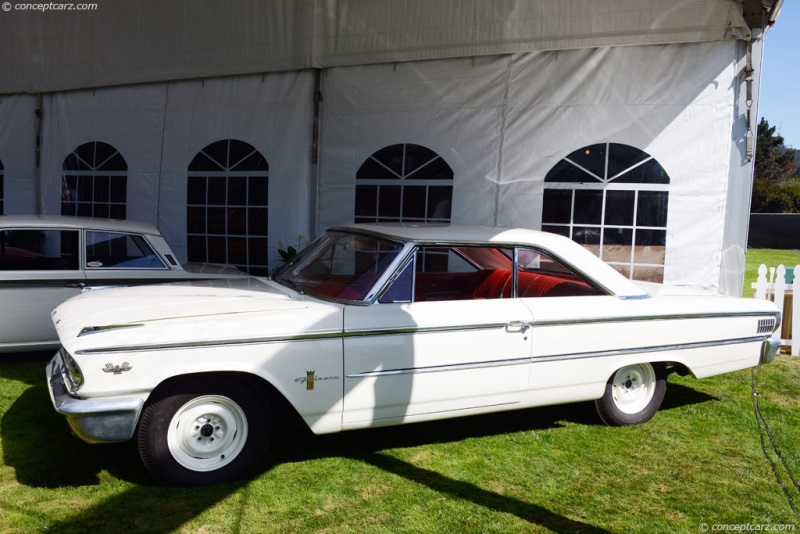
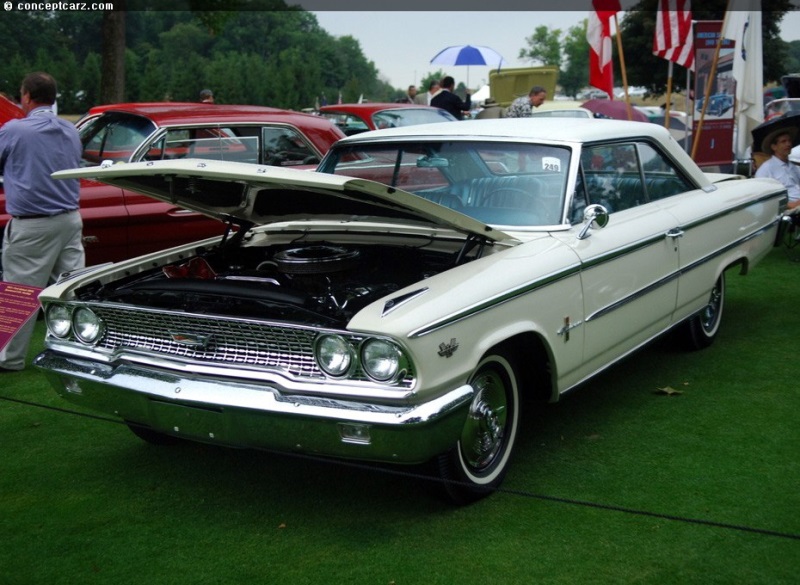
The successful mid-model release of the new Galaxie fastback for NASCAR racing encouraged the pursuit of Total Performance to continue to the drag racing scene. Considered the 'every man's, sport, drag racing was quickly gaining popularity, thanks in part to the NHRA's ongoing efforts to promote Detroit's latest contenders. To that end, Ford began construction of a lightweight version of the 1963.5 Galaxie and stuffing it with a higher-revving R-Code 427 cubic-inch V8 Medium Riser engine with dual Holley four-barrel carburetors underneath a cast-aluminum oval air cleaner, with reworked intake and exhaust components. It had cross-bolted mains, a solid-lifter cam, 11.6:1 compression, and cast-iron headers. The list of lightweight components included fiberglass front fenders, inner front fenders, trunk lid and hood. Aluminum was used for the front and rear bumpers and bumper brackets, radiator support, and fender-apron assemblies. The interior bench seats were removed and replaced with Bostrom bucket seats and a thin cross-grain rubber floor mat with the embossed Ford oval. 'Delete' items included all body sealers, clips, and interior accessories, including the heater, clock, dome light, armrests, trunk mat, spare tire and tools, carpeting, and radio. Even the sun visors were lightened by using stiffened cardboard
500XL Series Fastback Coupe
View info and historyThe engine was paired with a BorgWarner T-10 four-speed manual transmission with a 4.11:1-geared 9-inch rear axle. A total of 212 specially-built MX-code factory Lightweight Galaxies were built during 1963 specially for NHRA and AHRA Stock Class drag racing. These were Ford's answer to the Chevrolet Z11 Impalas that dominated the competition in 1962. All 212 lightweight Galaxies wore Corinthian White paint with a red interior. The lightweight package removed over 400 pounds from the full-size Ford.The Ford Galaxie
Ford introduced the 'Galaxie' nameplate late in 1958, displacing the Fairlane 500 for the top trim level position. Soon after its arrival, the Galaxie became its own model, offered in the same body styles as the Fairlane 500 (plus the Sunliner and Skyliner). Distinguishable features included Galaxie badging (along with Fairlane 500 badging) and Ford Thunderbird-style C pillar on all body styles (sedan and hardtop body styles) except the Sunliner.
Holman & Moody Fastback Coupe
Chassis #: C3HM10004
View info and historyThe Ford vehicles were totally redesigned in 1960 and were now lower, longer, and wider with more restrained use of chrome trim. In the front was a recessed mesh grille containing dual round headlights. The previous traditional pie-plate round taillights were replaced by 'half-moon' lenses turned downward. This generation of styling would continue to be used on the Galaxie through 1964. Additional styling revisions in 1961 nearly eliminated the tailfins, and for 1962, the Galaxie name was now applied to all full-size models. The Fairlane became the new intermediate model. The newly introduced Galaxie 500 added even more luxurious interiors, additional exterior chrome trim, and a higher level of standard amenities. The base Galaxie was offered as a two- and four-door sedan (and Ranch Wagon), while the Galaxie 500 could be purchased as a two-door sedan and hardtop, four-door sedan and hardtop, and 'Sunliner' convertible. 1964 was the final year of the styling first introduced in 1960, as 1965 would introduce an all-new design with vertically stacked dual headlights. These cars were bulkier and taller than previous designs, with sculpted body lines and restrained use of chrome trim. The interiors gained a new instrument panel, the previous leaf-spring rear suspension was replaced by a new three-link system, and a two-way key vehicle access system was introduced -with one key for valet parking with limited access (access only to doors and ignition), and another key that could open the trunk and glove compartment (along with the doors and ignition). The styling introduced in 1965 would continue through 1968.The carburetors were cleaned and rebuilt in 2014, an electric fuel pump installed in 2018,
by Daniel Vaughan | Jun 2019
For buyers seeking more, Ford offered the Galaxie 500, the top trim level for 1963. Body styles included a two sedan, 2-door club sedan, town victoria, club victoria, fastback coupe, and a Sunliner convertible. They had additional chrome on the exterior including two horizontal chrome strips on the side, chrome 'A' pillar moldings, and chrome window moldings. Six- and 8-cylinder engines could be installed in the engine bay.The two-door sedan with six-cylinder power was priced at $2,450 and the four-door body style at $2,500. The addition of the base eight-cylinder engine boosted the factory base price by approximately $100. A total of 112,754 examples of the Galaxie were built in 1963 plus 440,526 units of the Galaxie 500 and 94,730 examples of the Galaxie 500XL. The Galaxie 500 series was available with either six- or eight-cylinder power, while the Galaxie 500XL was solely equipped with eight-cylinder power.The Galaxie 500 with six-cylinder power was priced at $2,615 for the club sedan, $2,670 for the town sedan, $2,675 for the club victoria and fastback coupe, $2,740 for the town victoria, and $2,925 for the sun convertible. The addition of the base eight-cylinder engine added approximately $100 to the base price. The most popular Galaxie 500 body style was the town sedan with 205,722 examples built, followed by 100,500 of the fastback coupe, 49,733 of the club victoria, 36,876 of the sun convertible, 26,558 of the town victoria, and 21,137 of the club sedan. Galaxie 500XL
The Galaxie 500XL Series were V8 powered only, with body styles including the Sunliner convertible, town victoria, club Vicotria, and fastback coupe. The two-door club victoria was priced at $3,630 and 29,713 examples were built, and 33,870 were fastback coupes at a base price of $3,270. The sun convertible was priced at $3,520 and 18,551 examples were built, and 12,596 examples were town victories having a base price of $3,330. The 292 Y-block V8 was replaced as the base V8 with the Fairlane's new small block 260. The 260 proved to be underpowered and was replaced mid-year with the 289 V8, the largest of the 'small block series.' Five different transmissions were offered for 1963. A 3-speed manual column shift was standard on all models except the 406 V8, which required the heavier duty Borg-Warner 4-speed manual. A three-speed manual with overdrive was optional but rarely ordered. The two-speed Ford-O-Matic was common with the 6-cylinder and small block V-8s, while the majority of big blocks (352 and 390) were ordered with the 3-speed Cruise-O-Matic automatic transmission.Fastback Galaxie
Sitting two inches lower than its 1962 forerunner, the 1963.5 'fastback' Galaxie was a reported 28 percent more aerodynamic - a fact that instantly translated into major success on NASCAR's superspeedways. Recognizing that the 'notchback' Galaxie profile was a veritable brick at high speeds, Ford's idea guys had tried to get away with attaching an optional 'Starlift' roof to the 1962 convertible to create a more swoopy shape for NASCAR competition. NASCAR rule moguls, however, didn't buy the idea, forcing Ford designers back to the drawing board. The result was this stylish, functional, mid-year bodystyle. To power the new fastback Galaxie, Ford engineers again beefed up the FE block, this time boring it out to 427 cubic inches- at least that's what they said. Actual displacement computed to 425 CID, but Dearborn's image-makers apparently didn't want Ford's top performance powerplant to take a back seat to rival offerings. Seven liters, or roughly 427 CID, was the established legal limit for stock-class racing, and with a flick of a public relations pen, the new 425 ci big-block was introduced to the public as being right at that limit. Triple carburetors were dropped for 1963 in favor of two big Holley four-barrels. Counting both the single-carb 410 hp and the dual-carb 425 hp versions, Ford sold 4,978 427-equipped models in 1963.1963 1/2 Ford Galaxie 500 Dealer Lightweight
The successful mid-model release of the new Galaxie fastback for NASCAR racing encouraged the pursuit of Total Performance to continue to the drag racing scene. Considered the 'every man's, sport, drag racing was quickly gaining popularity, thanks in part to the NHRA's ongoing efforts to promote Detroit's latest contenders. To that end, Ford began construction of a lightweight version of the 1963.5 Galaxie and stuffing it with a higher-revving R-Code 427 cubic-inch V8 Medium Riser engine with dual Holley four-barrel carburetors underneath a cast-aluminum oval air cleaner, with reworked intake and exhaust components. It had cross-bolted mains, a solid-lifter cam, 11.6:1 compression, and cast-iron headers. The list of lightweight components included fiberglass front fenders, inner front fenders, trunk lid and hood. Aluminum was used for the front and rear bumpers and bumper brackets, radiator support, and fender-apron assemblies. The interior bench seats were removed and replaced with Bostrom bucket seats and a thin cross-grain rubber floor mat with the embossed Ford oval. 'Delete' items included all body sealers, clips, and interior accessories, including the heater, clock, dome light, armrests, trunk mat, spare tire and tools, carpeting, and radio. Even the sun visors were lightened by using stiffened cardboard
500XL Series Fastback Coupe
View info and history
Ford introduced the 'Galaxie' nameplate late in 1958, displacing the Fairlane 500 for the top trim level position. Soon after its arrival, the Galaxie became its own model, offered in the same body styles as the Fairlane 500 (plus the Sunliner and Skyliner). Distinguishable features included Galaxie badging (along with Fairlane 500 badging) and Ford Thunderbird-style C pillar on all body styles (sedan and hardtop body styles) except the Sunliner.
Holman & Moody Fastback Coupe
Chassis #: C3HM10004
View info and history
by Daniel Vaughan | Jun 2019
Related Reading : Ford Galaxie History
The Ford Galaxie entered the scene in 1959 and was offered in various configurations. The model line consisted of a Club Victoria, Town Victoria, Club Sedan, Town Sedan, Sunliner Convertible, and Skyliner Retractable. Similar to the Fairlane, they were distinguished by different ornamentation. The highlight of the 1959 model line was the Skyliner Retractable that had an all-steel hardtop that....
Continue Reading >>
Continue Reading >>
- 1963 Ford Galaxie Menu
- Article
- Image gallery
- Valuation
- Specifications
- Profiles
- Production figures
- Accessories
Ford
Similar Automakers
Similarly Sized Vehicles
from 1963
Similarly Priced Vehicles


1963 Ford Galaxie Vehicle Profiles








Recent Vehicle Additions


Performance and Specification Comparison
Price Comparison
$1,985 - $2,840
$2,115 - $2,835
$2,153 - $2,885
$2,325 - $2,435
$2,730 - $2,840
$4,450 - $5,560
$4,550 - $5,560
Galaxie Specification Comparison by Year
Year
Production
Wheelbase
Engine
Prices
289,268
119.00 in.
6 cyl., 223.00 CID., 145.00hp
8 cyl., 292.00 CID., 185.00hp
8 cyl., 292.00 CID., 185.00hp
$2,550 - $2,970
349,645
119.00 in.
6 cyl., 223.00 CID., 135.00hp
8 cyl., 292.00 CID., 175.00hp
8 cyl., 352.00 CID., 220.00hp
8 cyl., 390.00 CID., 300.00hp
8 cyl., 292.00 CID., 175.00hp
8 cyl., 352.00 CID., 220.00hp
8 cyl., 390.00 CID., 300.00hp
$2,540 - $2,965
575,124
119.00 in.
6 cyl., 223.00 CID., 138.00hp
8 cyl., 221.00 CID., 145.00hp
8 cyl., 292.00 CID., 170.00hp
8 cyl., 352.00 CID., 220.00hp
8 cyl., 390.00 CID., 300.00hp
8 cyl., 390.00 CID., 340.00hp
8 cyl., 406.00 CID., 385.00hp
8 cyl., 406.00 CID., 405.00hp
8 cyl., 221.00 CID., 145.00hp
8 cyl., 292.00 CID., 170.00hp
8 cyl., 352.00 CID., 220.00hp
8 cyl., 390.00 CID., 300.00hp
8 cyl., 390.00 CID., 340.00hp
8 cyl., 406.00 CID., 385.00hp
8 cyl., 406.00 CID., 405.00hp
$2,450 - $3,356
535,256
119.00 in.
6 cyl., 200.00 CID., 116.00hp
6 cyl., 223.00 CID., 138.00hp
8 cyl., 289.00 CID., 271.00hp
8 cyl., 390.00 CID., 300.00hp
8 cyl., 390.00 CID., 330.00hp
6 cyl., 223.00 CID., 138.00hp
8 cyl., 289.00 CID., 271.00hp
8 cyl., 390.00 CID., 300.00hp
8 cyl., 390.00 CID., 330.00hp
$2,610 - $3,625
591,531
119.00 in.
6 cyl., 223.00 CID., 138.00hp
8 cyl., 289.00 CID., 195.00hp
8 cyl., 289.00 CID., 225.00hp
8 cyl., 352.00 CID., 250.00hp
8 cyl., 289.00 CID., 271.00hp
8 cyl., 390.00 CID., 300.00hp
8 cyl., 390.00 CID., 330.00hp
8 cyl., 427.00 CID., 425.00hp
8 cyl., 289.00 CID., 195.00hp
8 cyl., 289.00 CID., 225.00hp
8 cyl., 352.00 CID., 250.00hp
8 cyl., 289.00 CID., 271.00hp
8 cyl., 390.00 CID., 300.00hp
8 cyl., 390.00 CID., 330.00hp
8 cyl., 427.00 CID., 425.00hp
$2,611 - $3,485
Related Automotive News

Ford Celebrates Diversity Of Road And Race Performance Line-Up Past And Present At Goodwood Festival Of Speed
Hermann Salenbauch from Ford Performance and Larry Holt from Multimatic to make a special Ford GT announcement, 0945 BST, July 4, at the Goodwood Festival of Speed
Ford Performance road car debuts at Goodwood include the all-new Focus ST in actio...

THE McLAREN F1
FOR THE DRIVER VITALLY – AS IN ONE OF McLARENS WORLD CHAMPION RACING CARS – DRIVER AND VEHICLE BECOME ENTIRELY AS ONE
The primary design consideration for the McLaren F1 has been to make it without reserve a drivers car, an extremely high-performance...

BEST IN THE DESERT: 2017 FORD F-150 RAPTOR PREPARES FOR GRUELING OFF-ROAD RACING SERIES
All-new 2017 F-150 Raptor race truck continues Fords tradition of demonstrating the toughness and durability of F-150 through off-road competition
Race truck based on Built Ford Tough production Raptor, including high-strength, military-grade, alu...

Lee Holman, Holman & Moody to be Honored at 2013 Pinehurst Concours d'Elegance
- Legendary North Carolina-based motorsports organization featured in special display, lifetime achievement award to Lee Holman -
Just saying the name of Charlotte, NC-based Holman %26 Moody conjures up some of the most exciting motorsports moments...

Limited-Edition Ford Racing History Artwork Unveiled at SEMA; Limited-Edition Print Sales to Benefit JDRF
Special limited-edition Ford Racing history artwork is unveiled at the annual SEMA show as part of the Ford press conference
Famed automotive artist Sam Bass created the artwork at the request of Edsel B. Ford II, with proceeds from sales of limit...