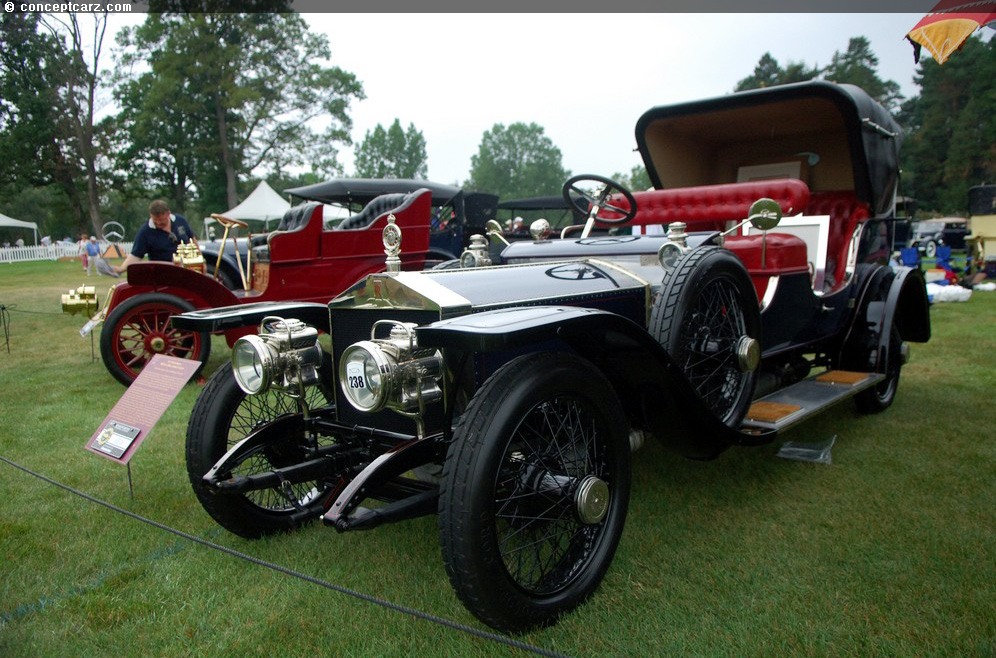
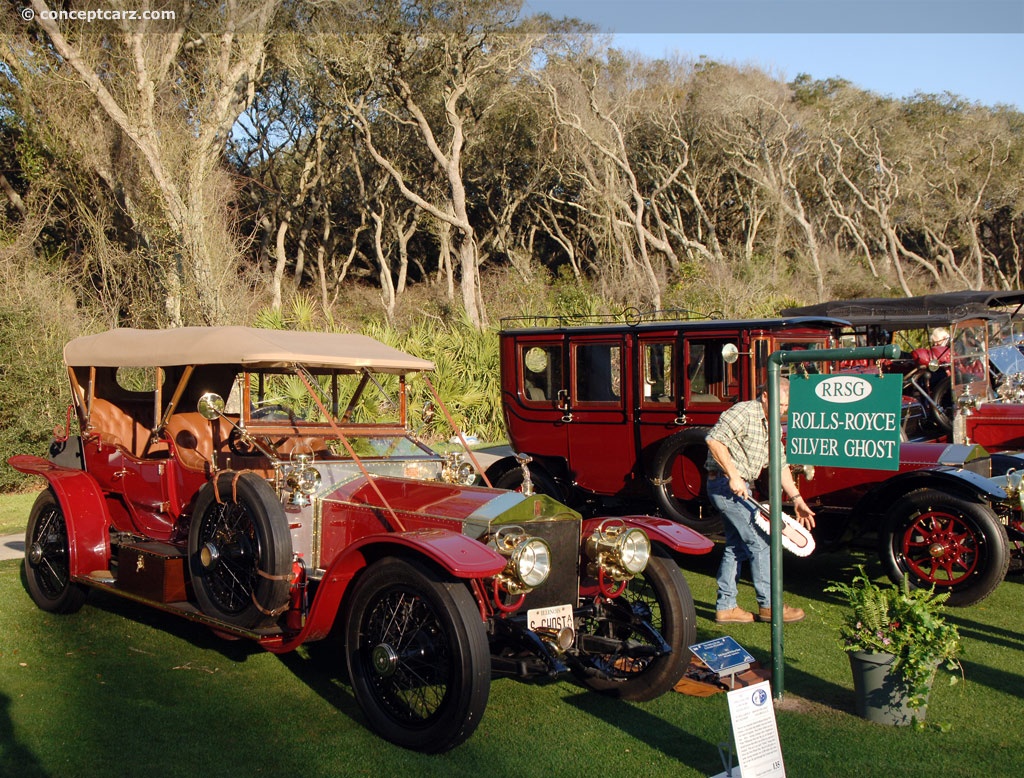
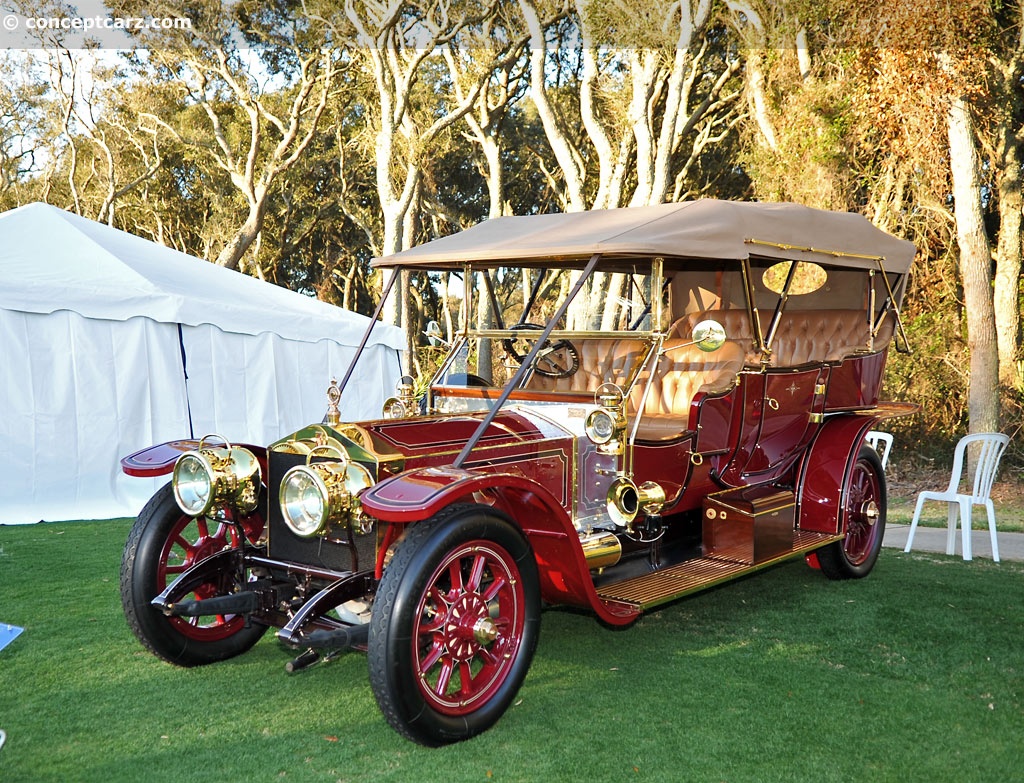
1910 Silver Ghost | 1912 Silver Ghost Barker ![]() | 1912 Silver Ghost ![]() |
1911 Rolls-Royce 40/50 HP Silver Ghost news, pictures, and information | ||
| Tweet | ||
![]() | ![]() | ![]() | Roadster Coachwork: Wilkinson Chassis Num: 15292 Engine Num: 91 |
| Sold for $858,000 at 2006 RM Auctions. | |||
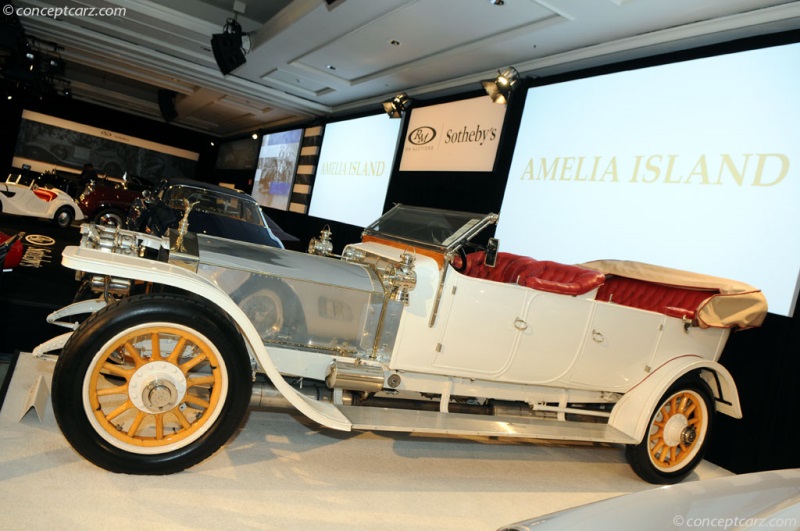
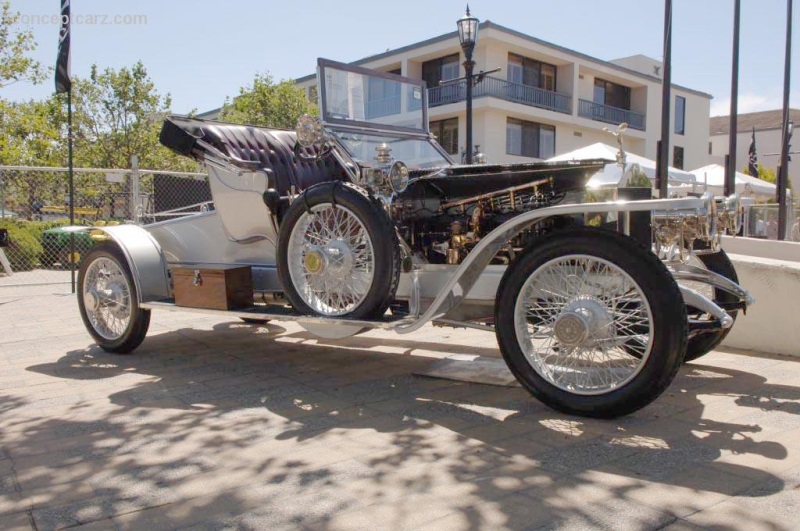
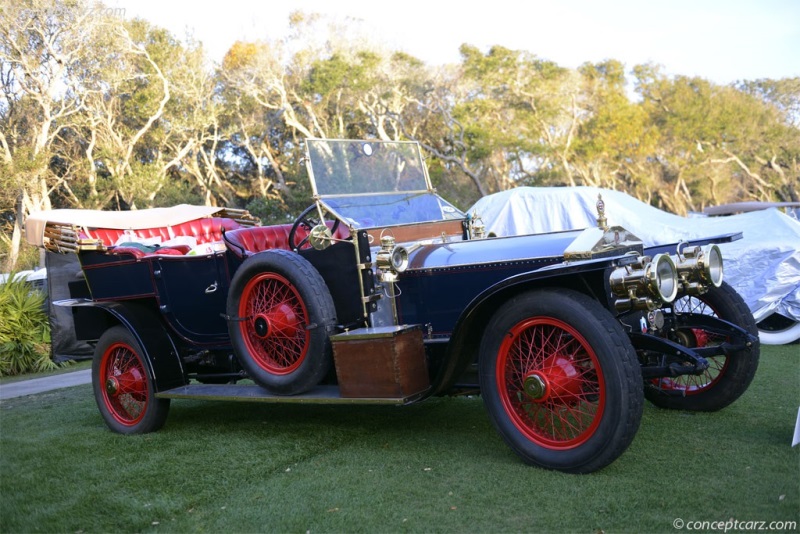
In 1989 the vehicle was purchased in chassis form and without coachwork. The roadster coachwork, believed to be the work of Wilkinson during the 1960s, was purchased from the late Millard Newman and adapted to the chassis. The body is a copy of work done by H. J. Mulliner for chassis number 60785, said to be the balloon car. Chassis 60785 was owned by the Honorable Charles Rolls who was an avid aviator and balloon enthusiast. A large rear deck in the rear of back of the car provided ample room to carry the basket for his ballooning expeditions.
The restoration was very detailed and down to the nut-and-bolts. Every detail of the vehicle is said to be period correct, except for the addition of an electric starter which is hidden from view. The button was placed under the driver's seat. It has traveled less than 1,000 road miles since the restoration. It was hailed as the finest Ghost in the country. It has won awards in many shows, including the Scher trophy for Best in Show at the R.R.O.C. meet in Kentucky in 2002.
At the RM Auction in Monterey, CA the 1911 Rolls-Royce proved to be very popular as bidding exceeded the estimated value, reaching $858,000.
By Daniel Vaughan | Dec 2006
![]() | ![]() | ![]() | Tourer Coachwork: Barker Chassis Num: F4930 |
![]() | ![]() | ![]() | Victoria Chassis Num: 1683 Engine Num: 1680 |
| Sold for $990,000 at 2007 Gooding & Company. | |||
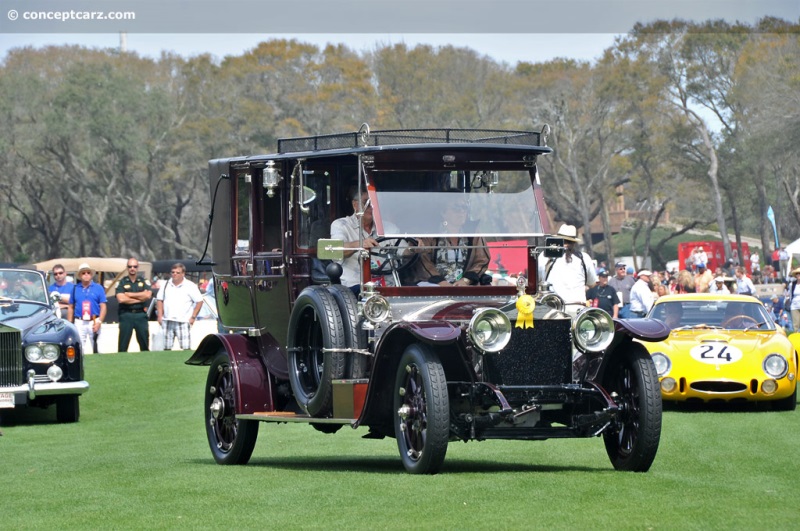
The rulers of India, the Maharajas of various states and city-states, were loyal customers of the Rolls-Royce marque. Many lived a very lavish lifestyle in palaces with staff and attendants to wait on their ever need and desire. When they traveled they were often accompanied by large numbers of guards, retainers, family and staff. Rolls-Royce had a colonial model which was well suited to the rougher roads and conditions of remote regions, and a popular choice for many of the Maharajas. They were fitted with a wide variety of coachwork for entertainment, hunting, ceremony and transportation.
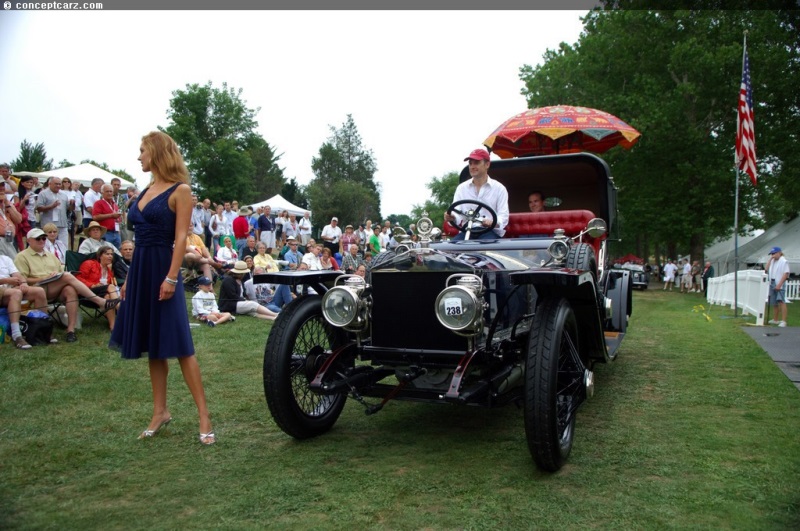
The coronation of King George V was celebrated by all of the Princes of India in what was called the Delhi Durbar. This beautiful Rolls-Royce is one of eight Silver Ghosts with identical landaulette bodies provided for this special event. After the coronation, it was presented to the Maharaja of Mysore, who had it rebodied with this magnificent open (to suit the tropical climate) Victoria to be used for parades and other special ceremonies by the Maharaja.
The eight identical landaulette bodied cars were built by Barker, Hooper, Windovers, Mulliner and Thrupp & Maberly. This car, with chassis 1683, was the only on bodied by H.J. Mulliner and was fitted with Pullman Limousine coachwork.
Following the Durbar, ownership passed to Krishna Raja Wadiyar IV, Maharaja of Mysore. At some early period in its life the Mulliner Pullman limousine coachwork was removed and rebodied wih this open Victoria. It was used for parades and similar ceremonial occassions.
The passengers riding in the elevated rear seat are protected from the sun by a folding victoria top. The large umbrella in the rear was to provide partial shading for the guards and retainers standing at attention in the sun. A very thoughtful gesture on part of the Maharaja.
The car returned to England in the 1950s and treated to a restoration. Upon completion, it was sold at auction to James Leake for the price of $27,000, a high price at the time. Millard Newman became the cars next owner and then purchased by Richard Solove in 1993. He commissioned Dave Hemmings to perform another restoration which still shows nicely in modern times.
At the 1994 Pebble Beach Concours d'Elegance it was awarded first-in-class honors and earned the Millard Newman Award at Amelia Island in 2003.
This Silver Ghost has a side-valve, six-cylinder, 7428cc engine producing 48 horsepower at 1,250 rpm, and a three-speed transmission. The seven-bearing crankshaft has full pressure lubrication and the center main bearing is made specially large to remove vibration, essentially splitting the engine into two three-cylinder units. Two spark plugs are fitted to each cylinder with a trembler coil to produce the spark with a magneto-the instruction was to start the engine on the trembler/battery and then switch to magneto. The substantial chassis had rigid front and rear axles and leaf springs all round. The success of the model led to the company dropping the previous range of cars and following a one model policy until the launch of the 20 hp in 1922. In all, a total of 8,416 Silver Ghost cars were produced from 1907 to 1926, including 1,703 from the American Springfield factory. Many are still running to this day. The Silver Ghost was the origin of Rolls-Royce's claim of making the 'Best car in the world' - a phrase coined by the prestigious publication Autocar in 1907.
In 2007 it was brought to the Gooding & Company auction held in Pebble Beach, Ca where it was estimated to sell for $800,000-$1,200,000 and offered without reserve. Those estimates proved very accurate as the lot was sold for $990,000 including buyer's premium.
![]() | ![]() | ![]() | Tourer |
![]() | ![]() | ![]() | Roi-des-Belge Tourer Coachwork: Alford & Alder Chassis Num: 1574 Engine Num: 72 |
| Sold for $797,500 at 2007 RM Auctions. Sold for $682,000 at 2009 Gooding & Company. Sold for $836,000 at 2012 RM Auctions. | |||
The car is powered by a 7428cc inline, L-Head, six-cylinder engine (number 74) with a single updraft carburetor, developing 48 horsepower at 1000 RPM. The engine is coupled to a three-speed manual gearbox and braking is comprised of two-wheel drum brakes. The suspension on this right-hand-drive vehicle consists of semi-elliptic leaf springs on the front and three-quarter elliptic on the rear.
The car has all bright-work in brass, a Boa bulb horn and Smith's speedometer and trip odometer. Additional features consist of a tilting windscreen, a full set of spring gaiters and a complete set of engine and transmission pans.
In 2009, this Rolls-Royce was offered for sale at Gooding & Company's Auction in Pebble Beach. The lot was estimated to sell for $600,000 - $700,000. As bidding came to a close, the lot had been sold for the sum of $682,000, inclusive of buyer's premium.
By Daniel Vaughan | Mar 2010
![]() | ![]() | ![]() | Open Drive Landaulette Coachwork: F.R. Wood Chassis Num: 1797 |
| Sold for $506,000 at 2011 RM Auctions. | |||
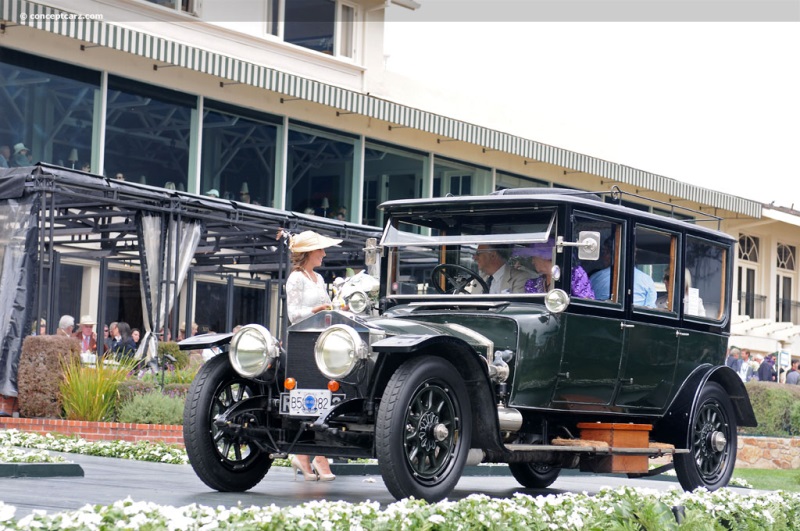
The car was sent to the Rolls-Royce Conduit Street showroom, where it received styled Torpedo coachwork from Barker, as well as detachable Vinet rim wheels and nickel fittings throughout. The vehicle was pained in grey with dark green leather. The first owner was R.G. Reid of the Bank of Montreal, who took delivery in May of 1912. The car was used for two years before it was sent back to Bakers for new bodywork. It was given formal 'Limousine Landauelt' coachwork which was more suitable for chauffeured driving.
By 1954, the car was in the ownership of Mr. Gordon E. Smith of the Orillia, Ontario area. In the mid-1970s, the car was discovered as a complete rolling chassis by Mr. Joe Loecy, who had earlier purchased another Silver Ghost, chassis 53 MA, from Mr. Reid. Millar Newman acquired 1797 and was able to find a correct period-style body from a Thomas Flyer having coachwork by F.R. Wood. The car passed through several more owners before coming into the car of Mr. Bill Haines in 1988. Mr. Haines treated the car to an extensive cosmetic restoration. In 2003, the car was purchased by John O'Quinn.
In 2011, the car was offered for sale at the Amelia Island auction presented by RM Auctions. The car was estiamted to sell for $350,000 - $500,000. As bidding came to a close, the car had been sold for the sum of $506,000, including buyer's premium.
By Daniel Vaughan | Mar 2012
![]() | ![]() | Limousine Coachwork: Hooper |
![]() | ![]() | ![]() | Tourer |
Subsequent owners restored it and participated in shows and driving events. In 2003 it successfully completed the 'Alpine Trial' and in 2007 completed the Canadian Silver Ghost Tour.
In 1906 a new model, the 40/50 horsepower, was developed wîth a longer chassis and a six-cylinder engine. The popularity of the new Rolls-Royce grew quickly as it developed a reputation for smoothness, silence, flexibility and, above all, reliability. In 1907 a writer from the 'Autocar' described riding in the Rolls-Royce 40/50 hp as '....the feeling of being wafted through the countryside.' Engineers at Rolls-Royce coined the word 'waftability' to encapsulate that sensation. Today it is a word that cannot be found in any direction but it is a key design and engineering criterion.
The twelfth 40/50 produced had all its fittings silver-plated and the coachwork painted in aluminum paint. This car became known as the Silver Ghost and is probably the most famous car in the world. The name was later adopted for all the 40/50 hp car and had an immediate international impact, enhanced by the coachbuilders of the day, who could produce bodies of breathtaking beauty. The Silver Ghost was, quite simply, in a class of its own.
The motor car's versatility is legendary. It overwhelmingly won every reliability trial and distance record, dominated the great Alpine Trial of 1913 and won the Spanish Grand Prix of that year.
In May 1907, Claude Johnson drove the car to Scotland and back. This run was a precursor to the Scottish Reliability Trial for which the motor car was later awarded a gold model by the RAC.
The original idea was to drive 10,000 miles without stopping the engine, but the Silver Ghost proved so reliable that the target was raised to 15,000 miles. Despite a stall at 629 miles, when rough roads shook the petrol switch to the off position, the Silver Ghost ran faultlessly for 40 days and nights.
A further challenge was designed by Napier for Rolls-Royce to compete against them in a run from London to Edinburgh followed by high-speed runs at Brooklands. But the challenge was to complete the distance without changing gear, as opposed to how far you could travel. The car, driven by Ernest Hives, averaged 24.3 mpg between London and Edinburgh and attained a speed of 78.2 mph at Brooklands.
As an armored car in the First World War The Silver Ghost delivered exemplary service to the extent that Colonel T.E Lawrence (Lawrence of Arabia) is quoted as saying, 'A Rolls in the desert is above rubies'.
In more elegant guise the Silver Ghost was the choice of the rich and famous across the globe. Kings, queens, maharajas, tsars and emperors owned them. The demand for the Silver Ghost was so high that manufacture was started in the Únited States in 1921 and continued in production wîth worldwide success until 1925.Source - Rolls-Rocye Motor Cars Limited
The twelfth 40/50 produced had all its fittings silver-plated and the coachwork painted in aluminum paint. This car became known as the Silver Ghost and is probably the most famous car in the world. The name was later adopted for all the 40/50 hp car and had an immediate international impact, enhanced by the coachbuilders of the day, who could produce bodies of breathtaking beauty. The Silver Ghost was, quite simply, in a class of its own.
The motor car's versatility is legendary. It overwhelmingly won every reliability trial and distance record, dominated the great Alpine Trial of 1913 and won the Spanish Grand Prix of that year.
In May 1907, Claude Johnson drove the car to Scotland and back. This run was a precursor to the Scottish Reliability Trial for which the motor car was later awarded a gold model by the RAC.The original idea was to drive 10,000 miles without stopping the engine, but the Silver Ghost proved so reliable that the target was raised to 15,000 miles. Despite a stall at 629 miles, when rough roads shook the petrol switch to the off position, the Silver Ghost ran faultlessly for 40 days and nights.
A further challenge was designed by Napier for Rolls-Royce to compete against them in a run from London to Edinburgh followed by high-speed runs at Brooklands. But the challenge was to complete the distance without changing gear, as opposed to how far you could travel. The car, driven by Ernest Hives, averaged 24.3 mpg between London and Edinburgh and attained a speed of 78.2 mph at Brooklands.
As an armored car in the First World War The Silver Ghost delivered exemplary service to the extent that Colonel T.E Lawrence (Lawrence of Arabia) is quoted as saying, 'A Rolls in the desert is above rubies'.In more elegant guise the Silver Ghost was the choice of the rich and famous across the globe. Kings, queens, maharajas, tsars and emperors owned them. The demand for the Silver Ghost was so high that manufacture was started in the Únited States in 1921 and continued in production wîth worldwide success until 1925.Source - Rolls-Rocye Motor Cars Limited
The Rolls-Royce vehicles have always been the pinnacle of design, technology, and ambiance. The loudest noise that could be heard by occupants of their vehicles was said to be the clock. In 1904 engineer Frederick Henry Royce joined with the entrepreneur and businessman, the Honorable Charles Stewart Rolls. This union became known as the Rolls-Royce Company.
The Silver Ghost became available in 1906 and brought with it quality and technology to a level that had never been seen before on a motor vehicle. Most engines of the time had long and flexible crankshafts that were prone to vibration and noise. The Rolls-Royce engines had large bearings and pressurized oiling systems, secured by seven main bearings. This was then enclosed in a strong aluminum alloy crankcase eliminating much noise and creating a pleasurable driving experience for the occupants of the vehicle. The crankshaft had an accuracy of .00025 on its bearing surface. They were hand polished to remove any surface cracks left by the grinder. Instead of using noisy chains to drive the ignition, Royce used gears. Phosphor bronze and nickel steel were used in the construction of the timing gears which were then ground and polished by hand. The engine was further shortened by casting in triplets. Cooling problems and leaks were eliminated by the removable cylinder blocks and fixed heads. A Royce designed twin jet carburetor gave the engine all the breathing it required.
The Rolls Royce vehicles could accelerate from zero to top speed without shifting. Shifting during the early 1900's was a chore, with the lower gears never being smooth. It was not until top gear was achieved that the automobiles would operate properly. The Rolls-Royce Ghosts would accelerate as though they were being pulled. This feature, coupled with the vehicles silent operation amplified the vehicles prestige and was the ultimate driving experience of its day.
When first introduced, the Ghosts were given a four-speed gearbox with a direct drive third and an overdrive fourth. As time passed, the overdrive was dropped. The chassis was mostly conventional. Royce had fine-tuned the chassis to standards much higher than most marque's of the day. The body was held in place by a live rear axle carried in three quarter elliptical springs. In the front there was a solid axle supported by semi-elliptic leaf springs. Braking was by a food pedal connected to a transmission brake. A hand brake operated twin rear drums.
Where Royce excelled in engineering, Rolls excelled in promoting and marketing. In 1906 a Ghost was entered in the Tourist Trophy Race, one of the most prestigious races of the time. The Ghost emerged victorious - well, much more than that. It had beaten the next nearest competitor by 27 minutes. Next, Rolls and Royce entered a Ghost in a 15,000 mile reliability run in 1907 which it did without incident. Upon its return to the Rolls-Royce shop, it took a small amount of money, about two-pounds or roughly ten-dollars by today's exchange rates, to restore the vehicle back to new condition.
The Silver Ghosts were entered in the Austrian Alpine Trials where the hoods were sealed shut to prevent any maintenance. The Silver Ghosts again dominated the competition and traversed the Alpine passes which were impassable for many motor cars.
This marketing worked and soon the Rolls-Royce vehicles became legendary and renowned for their durability, reliability, and style. To improve upon the prestige even further, Rolls supplied the Silver Ghosts to British royalty, a move that made sure the vehicles were seen in the right places by the right people.
The first Rolls-Royce distributor in the United States was Walter Martin of New York City, who was also a Cadillac distributor. As Cadillac continued to improve the ambiance of their vehicles, Martin naturally gave them more attention as the logistics of company location was in their favor. Rolls-Royce, on the other hand, was an ocean apart.
Over the early years of Rolls-Royce production, Brewster would become more effective in bringing Rolls-Royce chassis to America than Martin. Brewster imported several dozen chassis to supply its coachwork clients.
In 1913, the business manager for Rolls-Royce, Claude Johnson, formed a factory depot in New York and rented space from Brewster. Baker's US agent, Robert W. Schuette was appointed as Rolls-Royce distributor. At the time, Schuette also represented Fleetwood, Holbrook, Brewster, and Quinby. Around 100 Rolls-Royce's were imported over the next two years by Schuette, with around half of them bodied by Brewster.
As the First World War began to escalate, the production of Rolls-Royce automobiles slowed considerably. The factory's attention was turned to cars for military clients. Engines were produced for aircraft. By 1916, there were no more new Rolls-Royces available. Schuette and Brewster were still able to satisfy US demand for Rolls-Royce's by buying up existing chassis, renovating, and then fitting them with new coachwork.
By Daniel Vaughan | May 2008
For more information and related vehicles, click hereThe Silver Ghost became available in 1906 and brought with it quality and technology to a level that had never been seen before on a motor vehicle. Most engines of the time had long and flexible crankshafts that were prone to vibration and noise. The Rolls-Royce engines had large bearings and pressurized oiling systems, secured by seven main bearings. This was then enclosed in a strong aluminum alloy crankcase eliminating much noise and creating a pleasurable driving experience for the occupants of the vehicle. The crankshaft had an accuracy of .00025 on its bearing surface. They were hand polished to remove any surface cracks left by the grinder. Instead of using noisy chains to drive the ignition, Royce used gears. Phosphor bronze and nickel steel were used in the construction of the timing gears which were then ground and polished by hand. The engine was further shortened by casting in triplets. Cooling problems and leaks were eliminated by the removable cylinder blocks and fixed heads. A Royce designed twin jet carburetor gave the engine all the breathing it required.
The Rolls Royce vehicles could accelerate from zero to top speed without shifting. Shifting during the early 1900's was a chore, with the lower gears never being smooth. It was not until top gear was achieved that the automobiles would operate properly. The Rolls-Royce Ghosts would accelerate as though they were being pulled. This feature, coupled with the vehicles silent operation amplified the vehicles prestige and was the ultimate driving experience of its day.
When first introduced, the Ghosts were given a four-speed gearbox with a direct drive third and an overdrive fourth. As time passed, the overdrive was dropped. The chassis was mostly conventional. Royce had fine-tuned the chassis to standards much higher than most marque's of the day. The body was held in place by a live rear axle carried in three quarter elliptical springs. In the front there was a solid axle supported by semi-elliptic leaf springs. Braking was by a food pedal connected to a transmission brake. A hand brake operated twin rear drums.
Where Royce excelled in engineering, Rolls excelled in promoting and marketing. In 1906 a Ghost was entered in the Tourist Trophy Race, one of the most prestigious races of the time. The Ghost emerged victorious - well, much more than that. It had beaten the next nearest competitor by 27 minutes. Next, Rolls and Royce entered a Ghost in a 15,000 mile reliability run in 1907 which it did without incident. Upon its return to the Rolls-Royce shop, it took a small amount of money, about two-pounds or roughly ten-dollars by today's exchange rates, to restore the vehicle back to new condition.
The Silver Ghosts were entered in the Austrian Alpine Trials where the hoods were sealed shut to prevent any maintenance. The Silver Ghosts again dominated the competition and traversed the Alpine passes which were impassable for many motor cars.
This marketing worked and soon the Rolls-Royce vehicles became legendary and renowned for their durability, reliability, and style. To improve upon the prestige even further, Rolls supplied the Silver Ghosts to British royalty, a move that made sure the vehicles were seen in the right places by the right people.
The first Rolls-Royce distributor in the United States was Walter Martin of New York City, who was also a Cadillac distributor. As Cadillac continued to improve the ambiance of their vehicles, Martin naturally gave them more attention as the logistics of company location was in their favor. Rolls-Royce, on the other hand, was an ocean apart.
Over the early years of Rolls-Royce production, Brewster would become more effective in bringing Rolls-Royce chassis to America than Martin. Brewster imported several dozen chassis to supply its coachwork clients.
In 1913, the business manager for Rolls-Royce, Claude Johnson, formed a factory depot in New York and rented space from Brewster. Baker's US agent, Robert W. Schuette was appointed as Rolls-Royce distributor. At the time, Schuette also represented Fleetwood, Holbrook, Brewster, and Quinby. Around 100 Rolls-Royce's were imported over the next two years by Schuette, with around half of them bodied by Brewster.
As the First World War began to escalate, the production of Rolls-Royce automobiles slowed considerably. The factory's attention was turned to cars for military clients. Engines were produced for aircraft. By 1916, there were no more new Rolls-Royces available. Schuette and Brewster were still able to satisfy US demand for Rolls-Royce's by buying up existing chassis, renovating, and then fitting them with new coachwork.
By Daniel Vaughan | May 2008
| Mercedes-Benz Classic: Topics for 2013 | |
![]() | The main topics: • The tradition of the Mercedes-Benz S-Class • Mercedes-Benz Silver Arrows in the 1930s • Originals – authentic vehicles tell authentic stories • Classic vehicles kept in perfect condition with Mercedes-Benz Genuine Parts Important anniversaries: January 75 years ago – on 28 January 1938: With a flying start, Rudolf Caracciola achieved a speed of 432.7 km/h over one kilometre on the Frankfurt–Darmstadt motorway. This is the highest speed ever ach...[Read more...] |
| Famous Bentley 4¼-Litre 'Embiricos' Special Makes Star Appearance At Crewe Factory | |
![]() | One of the rarest and most valuable Bentleys in the world, the 4¼-Litre 'Embiricos' special, is making an historic appearance at the marque's home in Crewe. Fresh from taking part in the Louis Vuitton 'Serenissima Run' in Venice and featuring at the Le Mans Classic as part of the Bentley lineup, this magnificent car takes pride of place in the Lineage Showroom at the firm's Pyms Lane factory until September. Throughout the 1930s Bentley Motors, then owned by Rolls-Royce, was producing fast,...[Read more...] |
| Bentley Sales Leap By A Third | |
![]() | •Six month results up 32% •US overtakes China to re-emerge as largest market •Sales of Bentley's flagship Mulsanne up 30% Bentley's half year results for 2012 show continued strong growth. Sales are up in every region leading to a global increase of 32% (3,929 cars delivered to customers). The US has re-emerged as Bentley's number one market with deliveries up by 25.7% (1,140 cars delivered to customers). Sales in China also remain extremely strong with results up 55.7% (1,059 car...[Read more...] |
| Cherished Classics From The Pettit Collection Will Be Offered Without Reserve | |
![]() | • The 1929 Duesenberg 'Blue J' and 11 collector cars from the William A. C. Pettit, III Collection will be sold at Gooding & Company's Pebble Beach Auctions • Estate Proceeds will benefit the Shriners Hospital for Children®-Tampa Gooding & Company, the acclaimed auction house celebrated for selling the world's most significant and valuable collector cars, is honored to present the finest automobiles of the William A.C. Pettit, III Collection at its Pebble Beach Auctions on Aug...[Read more...] |
| The world-renowned ‘Old Bill' Comes to Market | |
![]() | The world-renowned 'Old Bill', which has featured in every book ever written about the incomparable Brough marque, ticks all the above boxes and just about every other one too. It has been consigned by H&H for auction as part of the Roger Allen Collection at the company's Duxford sale on October 4. However, it can be viewed as early as April 28/29 at the International Classic Motorcycle Show, Stafford. It carries an estimate of £250,000-270,000. The motorcycle originally known as 'Spit & Pol...[Read more...] |
| Similar Automakers | |
| Aston Martin | Bentley |
| Bugatti | Devon |
| Ferrari | GTA |
| Koenigsegg | Lamborghini |
| Lotus | Maserati |
| Maybach | McLaren |
| Porsche | Spyker |
| Tesla | |
| Rolls-Royce: 1911-1920 |
| Similar Automakers |
| Other models by Rolls-Royce |
| ||||||||||||||||||||||||||||||||
1910 Silver Ghost | 1912 Silver Ghost Barker ![]() | 1912 Silver Ghost ![]() |


1910 Silver Ghost