1970 Lotus Elan
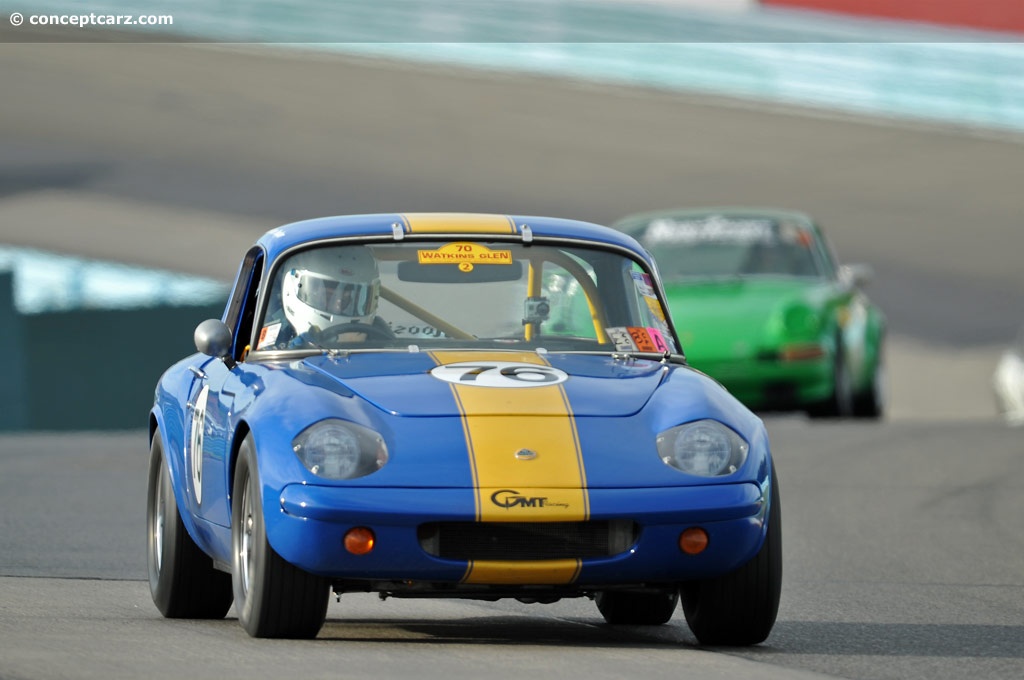
1970 Lotus Elan Navigation
History
Recalling Sixties spy-fi show The Avengers, the first thing men of a certain age remember is Mrs Peel's black leather cat suit. But the character's object of desire was her cute-as-a-button Lotus Elan.
The Elan was launched in October 1962 at the British Motorshow, just as the Sixties started swinging. Jaguar had launched the E-Type the previous year, and AC had the Cobra and Ferrari the GTO. Big, expensive, powerful muscles cars. The Elan was very different, and typically Lotus - ultra modern, lightweight, rapid and huge fun.
It summed up the Sixties: a playful topless two-seat ticket to freedom, it was technically innovative with the first backbone tube chassis of any road car, a fiberglass body, four-wheel independent suspension, 670kg with a peachy power-to-weight ratio, bang up-to-date styling beloved by Kings Road cruisers, and a liberating, rock n' roll attitude.
It came with luxuries that were a rarity at the time, like electric windows, carpets, a heater, and in vogue wooden fascia, but it was still light enough on the scales to outrun other automotive competition – not to mention groupies.
The Elan Sprint, a more powerful 1973 alternative, could hit 60mph in 6.6 seconds, which even now would be considered respectably fast. Back then it was Neil Armstrong territory.
Its pop-up headlights could wink at admirers. It turned heads on Carnaby Street, where the Swinging Sixties embraced cool new design. As well as its turn on TV, defeating baddies and complimenting Diana Rigg's risqué wardrobe, it found its way onto a magazine cover with Jimi Hendrix posing on the bonnet, and even inspired the lyrics to The Beatles' A Day In The Life.
The Elan was Lotus' biggest commercial success to that point, reviving a company stretched thin by the more exotic but in turn more costly to produce Elite. Four different series were produced up until 1973, including a coupe version. Seventeen thousand original examples, including the Elan +2, were produced.
The car was designed by Ron Hickman, who went on to make millions when he patented the Black & Decker WorkMate. He died last year, having earned an OBE for services to industrial innovation.
The Elan was the design inspiration for the Mazda MX-5, which was one of the biggest selling sports cars of the 1990s, and it's clearly the mother of the Lotus Elise, which has been a staple of the Lotus line-up since 1996 and is on its third evolution.
The late motoring journalist LKJ Setright summed up the Elan when, in the early 1960s, he wrote poetically, 'The package that results may not appeal to those conditioned to judge a car by the shut of the door, the depth of the upholstery or the weight of the paint; but to those whose sensual and cerebral appreciations of motoring offer more relevant criteria, the Lotus is as much a machine for driving as a house by Le Corbusier is a machine for living.'
Fifty years on, the Elan has never gone out of style.
A little more Elan history
First introduced in 1962 as a roadster (Drop Head), an optional hardtop was offered in 1963 and a coupé (Fixed Head) version in 1965. It was the first Lotus road car to use the a steel backbone chassis, a technology that continued until 1995 on all Lotus road cars including the Europa, Excel and the Esprit supercar, when it was replaced by the Elise's amazing extruded and bonded Aluminium chassis sub frame with a glass reinforced composite body.
It was also available as a kit to be assembled by the customer. Although a kit was not really the best description of these cars – they could easily be assembled in a weekend, as only a few key components had to be mated together.
The Elan was technologically advanced with a twin-cam 1558cc engine (early Elans in 1962 came with a 1.5 litre engine), 4-wheel disc brakes, and 4-wheel independent suspension.
Mirroring the changing lifestyle of Lotus founder, Colin Chapman, an Elan +2 was introduced in 1967 with two rear seats. These rear seats were compact but by no means occasional and it's not coincidence that it perfectly accommodated Colin's growing family – a car boss has to be able to use his own cars after all!
Elan production finished in 1972 and the +2 ended two years later. With a production run of 17,392 cars, the Elan family was one of the most successful in Lotus' history, surpassed only by the Elise. In the 1970s with Lotus' unprecedented success on the racetrack, especially in F1, Colin Chapman introduced the now legendary Lotus Esprit, Elite and Eclat ranges, taking Lotus into the higher value market and introducing the brand to the glamour and sophistication of supercar territory.Source - Lotus
The Elan was launched in October 1962 at the British Motorshow, just as the Sixties started swinging. Jaguar had launched the E-Type the previous year, and AC had the Cobra and Ferrari the GTO. Big, expensive, powerful muscles cars. The Elan was very different, and typically Lotus - ultra modern, lightweight, rapid and huge fun.
It summed up the Sixties: a playful topless two-seat ticket to freedom, it was technically innovative with the first backbone tube chassis of any road car, a fiberglass body, four-wheel independent suspension, 670kg with a peachy power-to-weight ratio, bang up-to-date styling beloved by Kings Road cruisers, and a liberating, rock n' roll attitude.
It came with luxuries that were a rarity at the time, like electric windows, carpets, a heater, and in vogue wooden fascia, but it was still light enough on the scales to outrun other automotive competition – not to mention groupies.
The Elan Sprint, a more powerful 1973 alternative, could hit 60mph in 6.6 seconds, which even now would be considered respectably fast. Back then it was Neil Armstrong territory.
Its pop-up headlights could wink at admirers. It turned heads on Carnaby Street, where the Swinging Sixties embraced cool new design. As well as its turn on TV, defeating baddies and complimenting Diana Rigg's risqué wardrobe, it found its way onto a magazine cover with Jimi Hendrix posing on the bonnet, and even inspired the lyrics to The Beatles' A Day In The Life.
The Elan was Lotus' biggest commercial success to that point, reviving a company stretched thin by the more exotic but in turn more costly to produce Elite. Four different series were produced up until 1973, including a coupe version. Seventeen thousand original examples, including the Elan +2, were produced.
The car was designed by Ron Hickman, who went on to make millions when he patented the Black & Decker WorkMate. He died last year, having earned an OBE for services to industrial innovation.
The Elan was the design inspiration for the Mazda MX-5, which was one of the biggest selling sports cars of the 1990s, and it's clearly the mother of the Lotus Elise, which has been a staple of the Lotus line-up since 1996 and is on its third evolution.
The late motoring journalist LKJ Setright summed up the Elan when, in the early 1960s, he wrote poetically, 'The package that results may not appeal to those conditioned to judge a car by the shut of the door, the depth of the upholstery or the weight of the paint; but to those whose sensual and cerebral appreciations of motoring offer more relevant criteria, the Lotus is as much a machine for driving as a house by Le Corbusier is a machine for living.'
Fifty years on, the Elan has never gone out of style.
A little more Elan history
First introduced in 1962 as a roadster (Drop Head), an optional hardtop was offered in 1963 and a coupé (Fixed Head) version in 1965. It was the first Lotus road car to use the a steel backbone chassis, a technology that continued until 1995 on all Lotus road cars including the Europa, Excel and the Esprit supercar, when it was replaced by the Elise's amazing extruded and bonded Aluminium chassis sub frame with a glass reinforced composite body.
It was also available as a kit to be assembled by the customer. Although a kit was not really the best description of these cars – they could easily be assembled in a weekend, as only a few key components had to be mated together.
The Elan was technologically advanced with a twin-cam 1558cc engine (early Elans in 1962 came with a 1.5 litre engine), 4-wheel disc brakes, and 4-wheel independent suspension.
Mirroring the changing lifestyle of Lotus founder, Colin Chapman, an Elan +2 was introduced in 1967 with two rear seats. These rear seats were compact but by no means occasional and it's not coincidence that it perfectly accommodated Colin's growing family – a car boss has to be able to use his own cars after all!
Elan production finished in 1972 and the +2 ended two years later. With a production run of 17,392 cars, the Elan family was one of the most successful in Lotus' history, surpassed only by the Elise. In the 1970s with Lotus' unprecedented success on the racetrack, especially in F1, Colin Chapman introduced the now legendary Lotus Esprit, Elite and Eclat ranges, taking Lotus into the higher value market and introducing the brand to the glamour and sophistication of supercar territory.Source - Lotus
The Lotus Elan was the first modern roadster. That may sound like quite a claim, especially considering that novel cars like the MGB were also around for 1962. The Elan, though, had something no other cars of its time had, or rather it had a combination of traits that none of its contemporaries could match. The Elan was purposeful and cohesive. While a car like the MGB used advanced unitary construction, it also used ancient and out-of-date mechanicals that may have left people wondering why MG had to stop short of breakthrough innovation. When Lotus introduced the Elan, there were no such compromises made.
Lotus endowed the Elan with an advanced body construction. Its aerodynamically-shaped fiberglass shell was draped over a rigid steel backbone chassis. Before production began, Lotus wanted to build Elans using a fiberglass monocoque, an exceptionally modern building style that had been used on the incredible Lotus Elite (1957-1963). When Lotus began initial tests of the Elan, though, they used a separate chassis for manufacturing ease.
This separate chassis proved to suit the car so well during early testing that Lotus changed it plans and decided to build the Elan with its more traditional steel chassis instead of the proposed unitary construction. The Elan was likely the best handling car ever to be built with a separate chassis, and during its time it out-handled the overwhelming majority of unit-bodied cars. It continued the Lotus reputation for building the best handling sports cars in the world.
Housed within the Elan's fiberglass shell was a thoroughly modern take on traditional sports car mechanicals. Beneath the low hood line sat a bristling engine. In its final and most capable form, the Lotus twin-cam four displaced a mere 1,558cc. Its power output, though, was at an incredible 126bhp. Wringing over 80bhp per liter out of a naturally aspirated power plant is no easy task today, and the fact that Lotus was able to do so several decades ago stands as time-tested proof of the company's ingenuity.
That thoroughly impressive engine was used in the 1970-1973 Elan Sprint, the highest performing incarnation of the long-lived Elan. The Sprint's weight, as on other Elans, was incredibly slim. At barely 1,500lbs, the Sprint offered a power-to-weight ratio rivaling contemporary Ferraris.
After reviewing all these impressive features, it's easy to recognize the Elan as the grandfather of the modern sports car. Evidence of this claim can be seen every time a Mazda Miata drives by. The Miata, the first of a new generation of sports cars, borrowed heavily from the Lotus Elan's design. Both cars used peppy twin-cam fours of similar displacement, both had simple, uncluttered interiors to declare their simple, uncluttered messages, and both had a light weight and an endearing character.
Perhaps the most obvious connection between the two, though, was the Miata's stylistic homage to the 2-seater Elan. The Miata borrowed the well-integrated bumpers, sleek and simple lines, and great proportions of the Lotus. New cars like the Pontiac Solstice and Saturn Sky, in borrowing from the Miata before them, have all brought the excellent features of the Elan into today's automotive spotlight through transitive presence. Looking back, it's clear that the Elan's design and engineering were absolutely timeless.
Sources Used:
Wilson, Quentin. The Ultimate Classic Car Book. First. London: Dorling Kindersley Limited, 1995.
Cheetham, Craig. Hot Cars of the '60s. San Diego : Thunder Bay Press, 2004. By Evan Acuña
Lotus endowed the Elan with an advanced body construction. Its aerodynamically-shaped fiberglass shell was draped over a rigid steel backbone chassis. Before production began, Lotus wanted to build Elans using a fiberglass monocoque, an exceptionally modern building style that had been used on the incredible Lotus Elite (1957-1963). When Lotus began initial tests of the Elan, though, they used a separate chassis for manufacturing ease.
This separate chassis proved to suit the car so well during early testing that Lotus changed it plans and decided to build the Elan with its more traditional steel chassis instead of the proposed unitary construction. The Elan was likely the best handling car ever to be built with a separate chassis, and during its time it out-handled the overwhelming majority of unit-bodied cars. It continued the Lotus reputation for building the best handling sports cars in the world.
Housed within the Elan's fiberglass shell was a thoroughly modern take on traditional sports car mechanicals. Beneath the low hood line sat a bristling engine. In its final and most capable form, the Lotus twin-cam four displaced a mere 1,558cc. Its power output, though, was at an incredible 126bhp. Wringing over 80bhp per liter out of a naturally aspirated power plant is no easy task today, and the fact that Lotus was able to do so several decades ago stands as time-tested proof of the company's ingenuity.
That thoroughly impressive engine was used in the 1970-1973 Elan Sprint, the highest performing incarnation of the long-lived Elan. The Sprint's weight, as on other Elans, was incredibly slim. At barely 1,500lbs, the Sprint offered a power-to-weight ratio rivaling contemporary Ferraris.
After reviewing all these impressive features, it's easy to recognize the Elan as the grandfather of the modern sports car. Evidence of this claim can be seen every time a Mazda Miata drives by. The Miata, the first of a new generation of sports cars, borrowed heavily from the Lotus Elan's design. Both cars used peppy twin-cam fours of similar displacement, both had simple, uncluttered interiors to declare their simple, uncluttered messages, and both had a light weight and an endearing character.
Perhaps the most obvious connection between the two, though, was the Miata's stylistic homage to the 2-seater Elan. The Miata borrowed the well-integrated bumpers, sleek and simple lines, and great proportions of the Lotus. New cars like the Pontiac Solstice and Saturn Sky, in borrowing from the Miata before them, have all brought the excellent features of the Elan into today's automotive spotlight through transitive presence. Looking back, it's clear that the Elan's design and engineering were absolutely timeless.
Sources Used:
Wilson, Quentin. The Ultimate Classic Car Book. First. London: Dorling Kindersley Limited, 1995.
Cheetham, Craig. Hot Cars of the '60s. San Diego : Thunder Bay Press, 2004. By Evan Acuña
- 1970 Lotus Elan Menu
- Article
- Image gallery
- Valuation
- Specifications
- Profiles
Lotus
Similar Automakers
Similarly Sized Vehicles
from 1970
Similarly Priced Vehicles


1970 Lotus Elan Vehicle Profiles
Recent Vehicle Additions


Performance and Specification Comparison
Price Comparison
$4,295
Elan Specification Comparison by Year
Year
Production
Wheelbase
Engine
Prices
84.00 in.
4 cyl., 95.08 CID., 105.00hp
4 cyl., 95.08 CID., 118.00hp
4 cyl., 95.08 CID., 118.00hp
4 cyl., 95.08 CID., 118.00hp
4 cyl., 95.08 CID., 118.00hp
$4,800 - $6,000
84.00 in., 96.00 in.
4 cyl., 95.08 CID., 105.00hp
4 cyl., 95.08 CID., 118.00hp
4 cyl., 95.08 CID., 118.00hp
4 cyl., 95.08 CID., 118.00hp
4 cyl., 95.08 CID., 118.00hp
$4,800 - $5,990
Related Automotive News

Andy Warhol's exclusive 'Cars' series now open at the Petersen Automotive Museum
The Pop art icons unique Cars series of automotive art and the exceptionally rare Mercedes-Benz vehicles that were its subjects appear in public in the US for the first time in over three decades
Appearing for the first time in North America...

Andy Warhol's 'Cars' series to go on display for the first time in North America in over 30 years at the Petersen Automotive Museum
The Pop art icons unique Cars series of automotive art and the exceptionally rare Mercedes-Benz vehicles that were its subjects appear in public in the US for the first time in over three decades
Appearing for the first time in North America...

Iconic Ex-Briggs Cunningham Corvette Le Mans Headed to Amelia Island Auction
ICONIC EX-BRIGGS CUNNINGHAM 1960 CHEVROLET CORVETTE LE MANS RACE CAR LEADS A LINEUP OF BANNER SPORTS AND RACING CARS FOR THE AMELIA ISLAND AUCTION
MORE THAN 80 OUTSTANDING MOTORS CARS SET FOR THE 22 MAY AUCTION
RM Sothebys announces exci...

1964 Nurburgring 1000 Kilometers: Survive for One Last Victory
During the late 1950s, Richie Ginther would begin a relationship with John von Neumann and this partnership would result in one of the most dominant periods of American sportscar racing in which Ginther and Porsche would be virtually unbeatable. Nearly...

1967 Can-Am Road America: The Beginning of the 'Bruce and Denny Show'
While Formula One will be forever considered the pinnacle of motorsport, from a period between 1966 and 1986 there existed a series that would likely be the closest to anything goes as any motor racing series could truly get. Based upon the FIA Group...