1935 Type 57 |
1936 Bugatti Type 57 news, pictures, and information | ||
| Tweet | ||
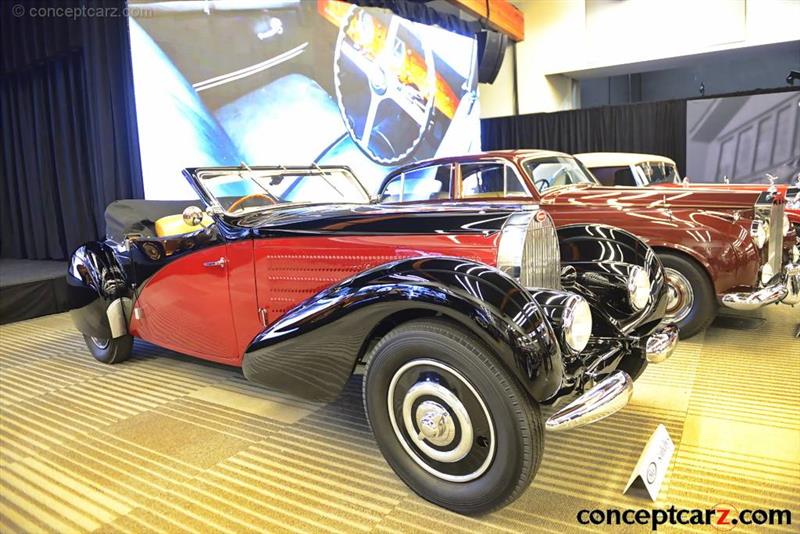
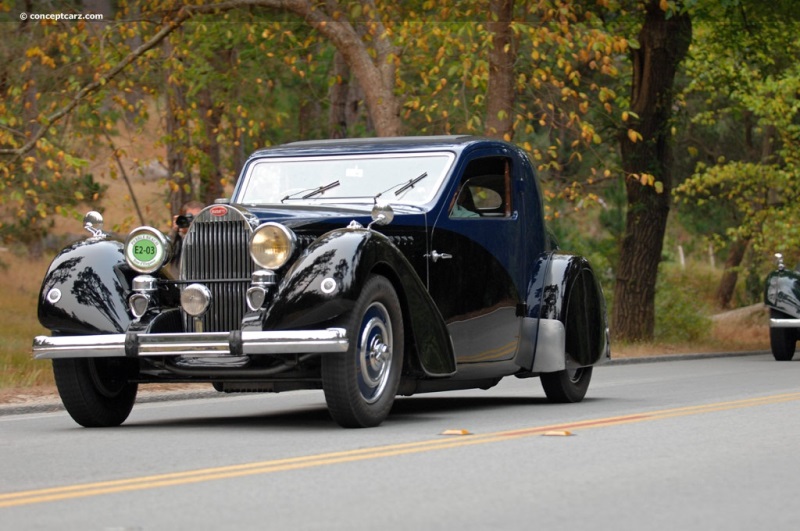
![]() | ![]() | ![]() | Pillarless Coupe Coachwork: Paul Nee Designer: Jean Bugatti Chassis Num: 57397 Engine Num: 276 |
| Sold for $396,000 at 2009 Gooding & Company. | |||
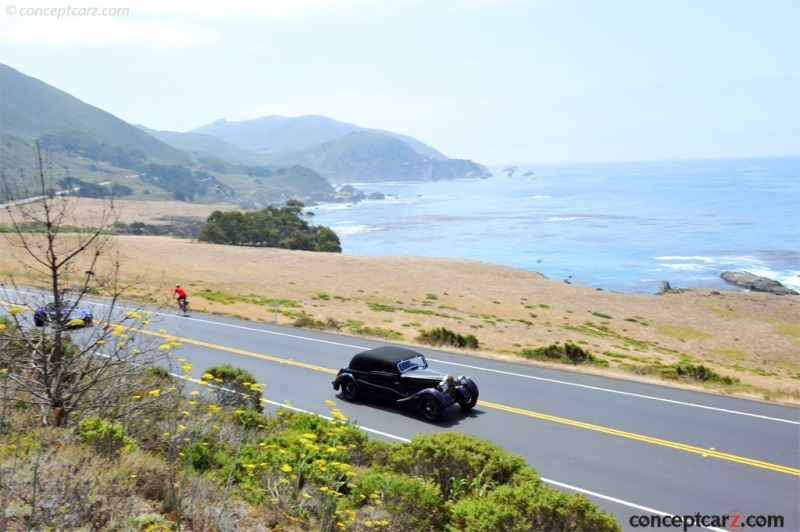
This car was originally delivered in Paris, on March 4, 1936, with Faux Cabriolet Coach Work by Fernand. In 1947, a custom body was designed and built by Paul Nee of Levallois, Paris. The car arrived stateside in 1962.
A frame-off restoration began in 1968 by 'Bunny' Phillips, the noted Bugatti restorer, in Pasadena, CA. After spending 32 years disassembled, it was completed by Jim Stranberg of Colorado, perhaps today's most respected Bugatti restorer. It was acquired by the present owner in 2005.
The first owner of this vehicle, Mr. Paul Worth of the famed French perfume family, took possession on March 4th of 1936. It was originally configured as a faux cabriolet with coachwork by Fernandez & Darrin. After the Second World War, a new body by Paul Nee was installed for its owner Monsieur Lescure. The Pillarless Coupe bodystyle features a distinctive ridge on the trunk, Marchal lights, rear-hinged doors, a sunroof, chrome fender flashing, and a well-hidden spare.
The car was sold in 1954 to Monsieur Jean Contat in France who retained the car for the next seven years. It was sent to the United States on June 14th of 1962 and arrived on July 10th of that year. It was the new property of a well-known Bugatti collector Dr. Milton Roth. Soon after taking delivery of the car, Mr. Roth passed away. Dr. A.J. Nelson of Lon Beach, CA purchased the car from the estate. While in Mr. Nelson's care, the car was treated to a frame-off restoration. The restoration process took over three decades to complete, as it lay disassembled for many years with work progressing very slowly. It was side-lined while other projects took priority. In the 1990s, another restorer adopted the project. The work was completed just before its debut at the 1999 Pebble Beach Concours d'Elegance. It won a class award in the Closed European Classic, 1925-1939 category.
In November of 2005, the car was purchased by its present owner. The newest owner has actively campaigned the car at several shows and events throughout the country. It won a succession of prestigious awards in 2006, including the Breitling Award for The Car of Timeless Elegance at Amelia Island, Best in Class at the Keels and Wheels Concours d'Elegance in Houston and class awards at the Pebble Beach Concours d'Elegance and the Los Angeles Concours d'Elegance. It also won the Most Elegant Car at the Palos Verdes Concours.
In 2009, this car was brought to Gooding & Company's Scottsdale Auction where it had an estimated value of $500,000 - $600,000. The lot was sold for $396,000 including buyer's premium.
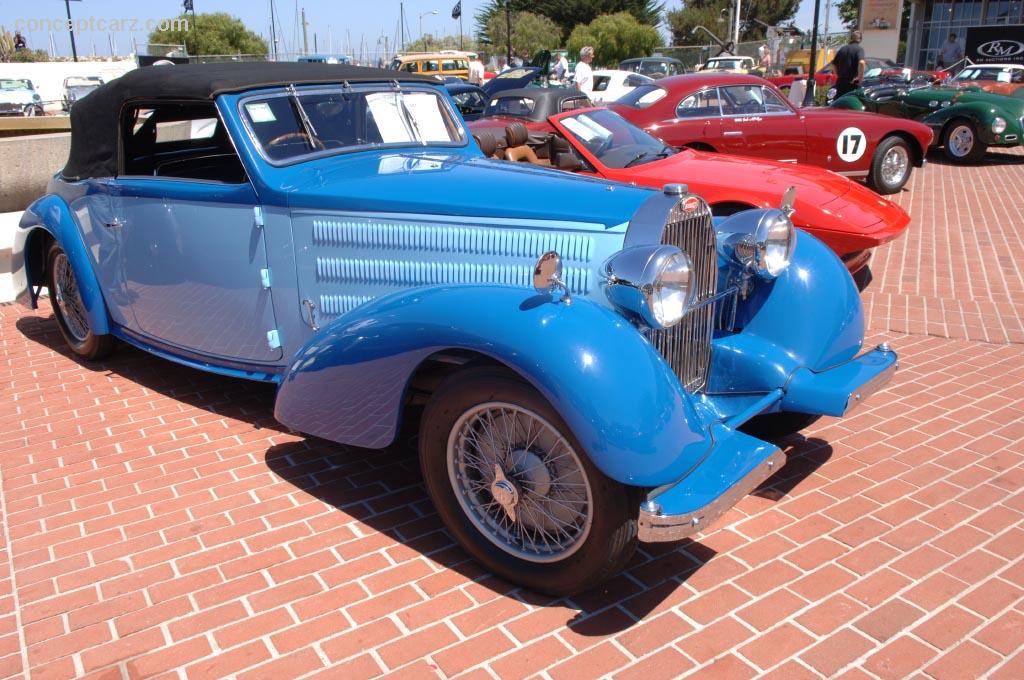
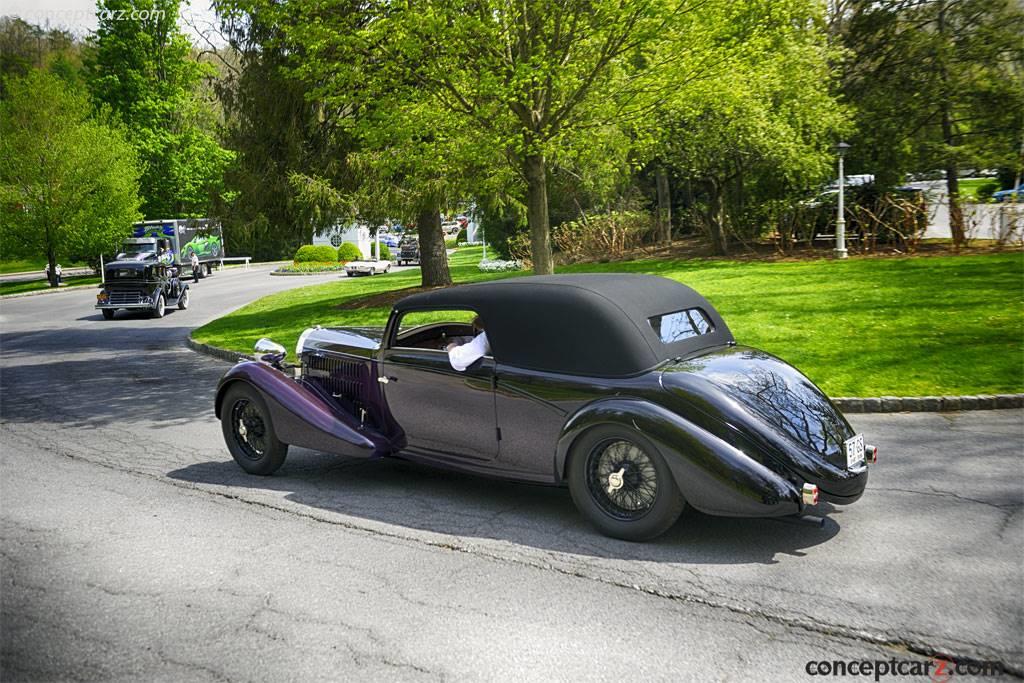
![]() | ![]() | ![]() | Stelvio Coachwork: Gangloff Chassis Num: 57395 Engine Num: 57395 |
| Sold for $396,000 at 2006 RM Auctions. High bid of $325,000 at 2008 RM Auctions. (did not sell) High bid of $240,000 at 2009 RM Auctions. (did not sell) | |||
The 3257 cc (3-liter) engine was new featuring five-bearing camshafts. Helical gears drove the twin overhead camshafts. The single symmetrical casting provided hemispherical combustion chambers. The gearbox was also new and mounted directly to the engine by a conventional bell-housing containing a normal single-plate clutch.
Bugatti's chief designer was Joseph Walter and Jean Bugatti worked closely with him. The first vehicle to wear coachwork by Jean was in 1931 on the Type 55 Roadster. Prior to 1927 most, if not all, of the coachwork was outsourced to custom coachbuilders. From the early 1930's the coachbuilding process was brought in-house. The Type 57 was offered as a Galibier four-door saloon, Ventoux two-door coupe, and the Stelvio cabriolet. The Stelvio body-style was constructed by coachbuilders Gangloff of Colmar. If requested by clients, Bugatti did offer a rolling chassis which could be finished by custom coachbuilders of their choosing and constructed to their own tastes and requirements.
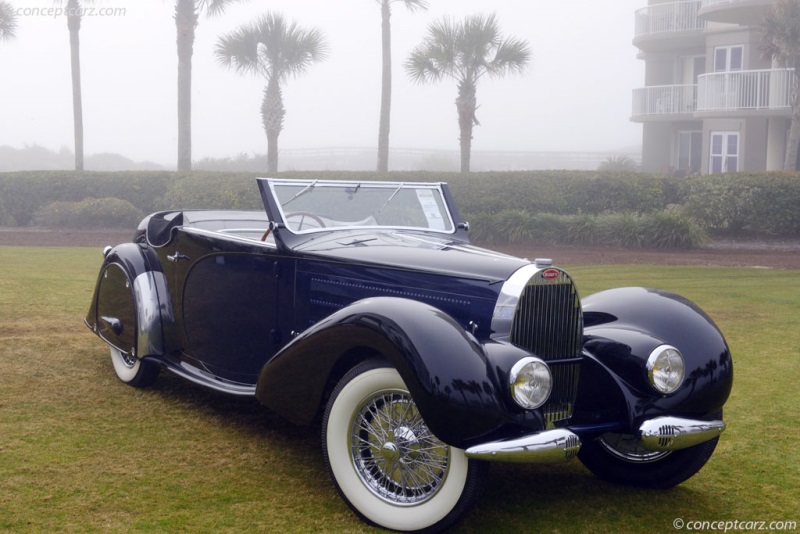
The 1936 Bugatti Type 57 Stelvio finished in two-tone blue and coachwork by Gangloff was offered for sale at the 2006 RM Auction in Monterey, CA where it was expected to sell between $450,000-$525,000. It's first owner, M. Soler, purchased the car in February of 1936. The 'B' on the back of the vehicle signifies its nationality for European roads.
It has been in the posession of several well known collections such as the DeDobbeleer, Gene Cesari and Juli Santo to name but a few.
Since new the vehicle has been treated to a body-off restoration. It has a gray leather interior with a wood dash and a full set of Jaeger gauges. The top is black cloth. At auction the vehicle was sold, netting $396,000.
In 2008, Type 57 Stelvio with coachwork by Gangloff returned to the 'Sports & Classics of Monterey' presented by RM Auctions. It was estimated to sell for $500,000 - $600,000 and carried a reserve. A high bid of $325,000 was not enough to satisfy the vehicles reserve. The lot was left unsold.
In 2009, it was offered for sale at the Automobiles of Amelia Island Auction presented by RM Auctions. It was estimated to sell for $350,000-$450,000. The lot failed to sell after achieving a high bid of $240,000. Bidding had begun at $100,000, then increased by amounts of $20,000 until it reached $200,000. Bidding then rose by increments of $10,000 until it reached $230,000. From here, bidding increased by increments of $5,000, until it had reached its pinnacle of $240,000. The lot was not sold.
By Daniel Vaughan | Feb 2010
![]() | ![]() | ![]() | Racer |
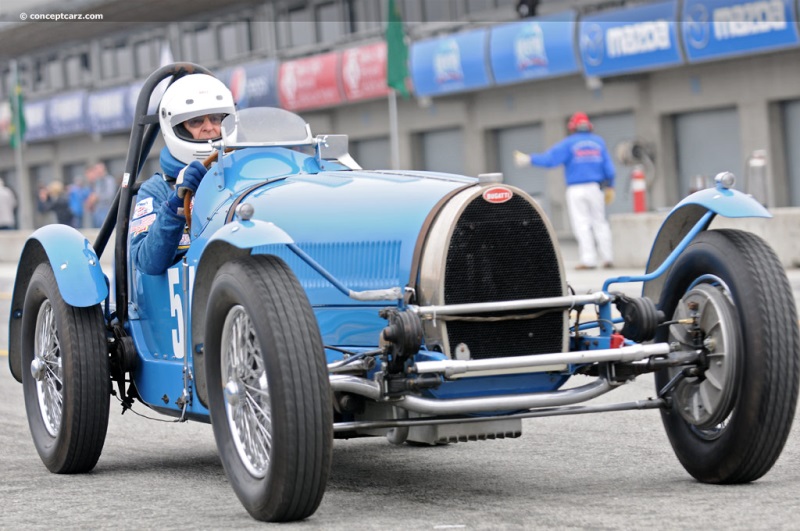
In 1964 it ws sitting in a cornfield in Ohio, having been partly disassembled for parts. The present owner purchased it at that time. Since the Galibier body was now beyond repair it ws removed and the present GP sports body installed. This is its thirteenth anniversary, as it has been racing at the Monterey Historic's since 1977.
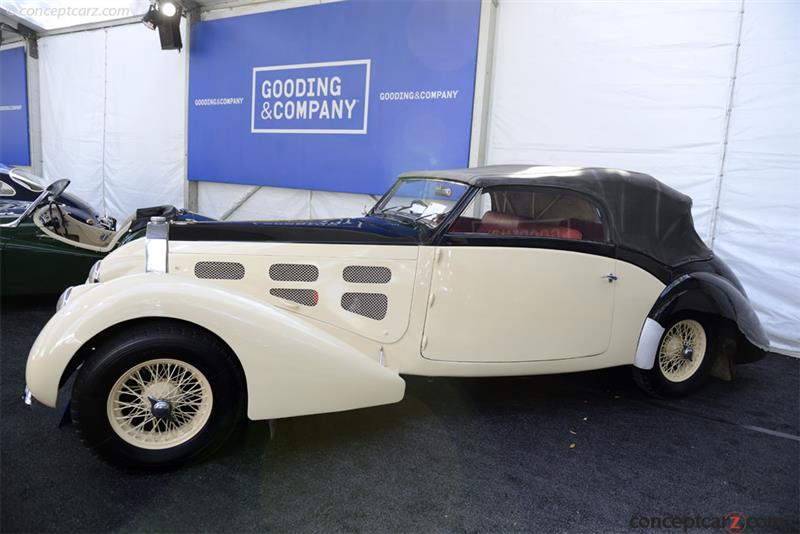
![]() | ![]() | ![]() | Cabriolet Designer: Graber |
![]() | ![]() | ![]() | Atlantic |
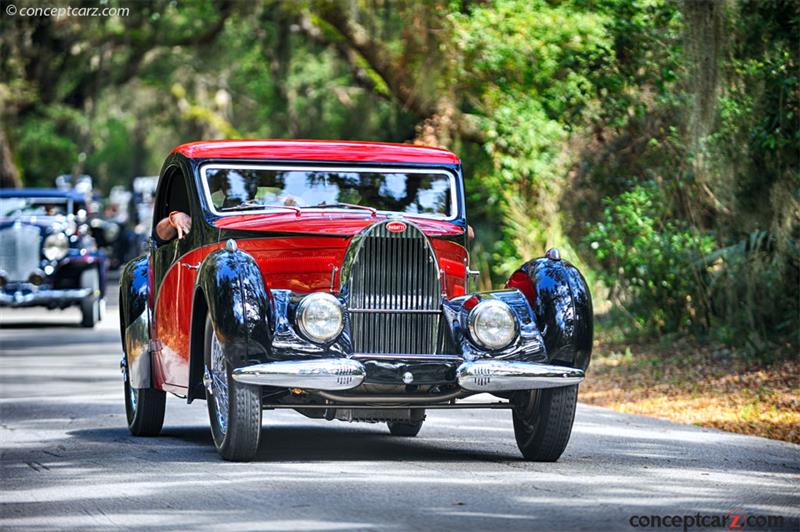
![]() | ![]() | ![]() | Atalante Chassis Num: 57401 Engine Num: 54C |
| Sold for $1,485,000 at 2012 Gooding & Company. | |||
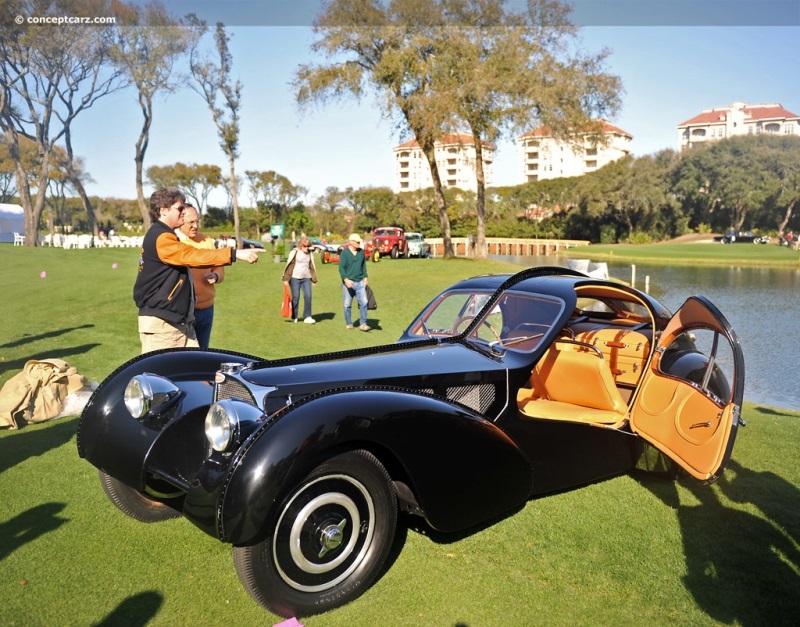
This example completed assembly on April 30th of 1936, finished in NoirlJaune paint (black with yellow accents) with an interior in Havana leather upholstery. It has several unique features such as the rear wheel spats, low-clearance windscreen, Art Deco-styled door handles and freestanding rather than faired-in headlamps.
The car was invoiced on May 1st to E.C. George Rand of New York City, the official Bugatti agent of the Eastern United States. He was also one of the first Americans to compete at the 24 Horus of LeMans.
Chassis number 57401 is also one of just two Type 57 Atalantes that were originally delivered to the United States. Acquired circa 1945 by Walter Gerner of New York, it was soon after purchased by Dr. Sam Scher. Dr. Scher retained Dick Simonek to rebuild the Atalante for him. During Dr. Scher's ownership, the car earned Best in Show at a concours d'elegance staged at Watkins Glen, held during of the racetracks's first years of existence.
Around 1949, the car was sold via dealer Quentin Craft to Dr. Ivan Hartwell of Sandwich, Massachusetts, who used the car mostly for house calls. Soon after, the car received a Type 57C supercharged engine and receiving distinctive horizontal slots to the rear spats. The motor is an original factory engine and was installed early in 57401's life, thus the modification should be considered authentic.
After Dr. Hartwell's passing in 1954, this Bugatti went to R. Lewis in Houston, Texas, and was subsequently acquired in the 1960s by Andre Surmain. In 1969, the car passed to Vittorio Serventi, a resident of Rome who imported this car to Italy. During a period of over 20 years of ownership, Mr. Serventi retained Salvatore Diomante of Turin to conduct some cosmetic work while expert Gianni Torelli of Reggio Emilia addressed mechanical maintenance. In 1980, the car was displayed at the Turin Motor Show.
In the early 1990s, the car was traded to Alfredo Celli of Forli. Rare appearances during Mr. Celli's ownership included winning its class at the Louis Vuitton Classic Concurs in the Parc de Bagatelle, France, in the late 1990s. It participated in the 2001 Mille Miglia and was exhibited on the Bugatti S.A.S. stand during the 2009 Concorso d'Eleganza Villa d'Este.
The current owner acquired the car in April 2010. This Atalante has since been treated to a thorough mechanical 'going through' by a British Bugatti expert. The work included rebuilding the gearbox and rear axle, and installing a light-pressure clutch mechanism and a switch-activated overdrive. The magneto has been rebuilt and new wheels were sourced from Borrani. The modified fender skirts have been replaced with original-type ones and the driver's seat cushion has been lowered to accommodate taller drivers.
In February 2012, the car was featured in the British magazine Octane.
The dual overhead am 8-cylinder engine is fitted with a Roots supercharger and Stromberg Updraft carburetor. The powerplant produces 180 horsepower and there is a four-speed manual gearbox with overdrive.
In 2012, this car was offered for sale at the Pebble Beach, CA auction presented by Gooding & Company. It was estimated to sell for $1,500,000 - $2,000,000. As bidding came to a close, the car had been sold for the sum of $1,485,000, inclusive of buyer's premium.
By Daniel Vaughan | Nov 2012
Many manufacturers during this time produced multi-purpose vehicles that could be driven to a race track, raced, and then driven home. The Bugatti Type 57, however, was solely a road-going vehicle and is considered the most celebrated of all non-racing Bugattis. Even though the Type 57 was strictly a road-going vehicle, a racing version was created for the 1937 24-Hours of Le Mans race. This vehicle, based on the Type 57S chassis and named the 57G, won the race. A supercharged version was created for the 1939 Le Mans race and also was victorious. This is the legacy of the Bugatti heritage and the quality and innovative designs that were truly masterpieces in all respects.
In 1934, the Type 57C entered the scene, a project headed by Jean Bugatti, the son of Ettore Bugatti. The vehicle centered around refinement while focusing on the values that had made Bugatti successful.
Three 'factory' bodies were available and consisted of the Ventoux, a two-window and four window version, the Stelvio, and the Atalante. All of the Atalante bodies were produced and all were done in-house. The Atalante was named after peaks in the Alps and is one of the most exclusive bodystyles ever produced by Bugatti.
The Type 57 could also be ordered with Galibier four-door bodies. Ealier versions of the Galibier bodies had suicide-opening front doors with no pillar. Later versions had suicide-opening front doors and rear doors hung in the traditional fashion. The front and rear doors would share a common pillar.
Jean designed an indepenent front suspension to aide in the handling of the vehicle. This was not popular with Ettore Bugatti and had the traditional Bugatti front axle installed.
A 3.3 liter, twin-cam, straight-eight engine was used to power this vehicle. Even with the heavy saloon bodies, the engine could propel the vehicle to a speed of around 95 mph. A Roots-type supercharger was later added and the vehicle was given the designation 57C. The supercharger was quiet and provided between three to four pounds of boost pressure. The addition of the supercharger increased the horsepower rating to 175.
The Type 57S version was a 'sportier' version of the Type 57. The chassis was shorter, with the rear axle running through the frame. A slightly tuned engine with higher compression and a dry sump lubrication helped increase the performance of the car. The front and rear axles received de Ram shock aborbers, replacing the Hartford Friction dampers.
The Type 57SC was a combination of the 57C and 57S. The engine produced between 200 and 220 horsepower.
On August 11, 1939 while testing a Type 57C tank-bodied racer near Molsheim, Jean Bugatti was killed. This was the same day as the start of the 2nd World War, which inevitably meant that the race Jean was preparing the vehicle for would never be run.
By Daniel Vaughan | Aug 2006
In 1934, the Type 57C entered the scene, a project headed by Jean Bugatti, the son of Ettore Bugatti. The vehicle centered around refinement while focusing on the values that had made Bugatti successful.
Three 'factory' bodies were available and consisted of the Ventoux, a two-window and four window version, the Stelvio, and the Atalante. All of the Atalante bodies were produced and all were done in-house. The Atalante was named after peaks in the Alps and is one of the most exclusive bodystyles ever produced by Bugatti.
The Type 57 could also be ordered with Galibier four-door bodies. Ealier versions of the Galibier bodies had suicide-opening front doors with no pillar. Later versions had suicide-opening front doors and rear doors hung in the traditional fashion. The front and rear doors would share a common pillar.
Jean designed an indepenent front suspension to aide in the handling of the vehicle. This was not popular with Ettore Bugatti and had the traditional Bugatti front axle installed.
A 3.3 liter, twin-cam, straight-eight engine was used to power this vehicle. Even with the heavy saloon bodies, the engine could propel the vehicle to a speed of around 95 mph. A Roots-type supercharger was later added and the vehicle was given the designation 57C. The supercharger was quiet and provided between three to four pounds of boost pressure. The addition of the supercharger increased the horsepower rating to 175.
The Type 57S version was a 'sportier' version of the Type 57. The chassis was shorter, with the rear axle running through the frame. A slightly tuned engine with higher compression and a dry sump lubrication helped increase the performance of the car. The front and rear axles received de Ram shock aborbers, replacing the Hartford Friction dampers.
The Type 57SC was a combination of the 57C and 57S. The engine produced between 200 and 220 horsepower.
On August 11, 1939 while testing a Type 57C tank-bodied racer near Molsheim, Jean Bugatti was killed. This was the same day as the start of the 2nd World War, which inevitably meant that the race Jean was preparing the vehicle for would never be run.
By Daniel Vaughan | Aug 2006
Ettore Arco Isidoro Bugatti was born in Milan, Italy in 1881. His father, Carlo, was a furniture designer of some fame. The father's brother, Rembrandt, was a gifted sculptor of animals. When he was old enough, Ettore attended the Brera Academy of Art where he studied sculpture. Soon, he turned his attention to mechanical endeavors.
The first Bugatti motor car was built in 1899 though the first vehicle to bear his name was the Type 13 of 1910. Power came from a four-cylinder, eight-valve engine. The 1913 the radiators became more rounded and in the shape of a horse shoe.
The company's first eight-cylinder engine production car was introduced in 1922 and dubbed the Type 30. The engine had a single overhead camshaft and displaced two liters. The car had a drum brakes, solid axles and leaf springs on all four corners.
The Type 35 in all sequences, the A, B, C, and T, were some of Bugatti's early examples that made the marque famous. The Type 57 introduced in 1934 and continued in production until 1940. They were powered by a 3257cc straight-eight engine with double overhead camshafts that produced between 130 and 140 horsepower. There were four road-going versions of the 57 and these were the Type 57, Type 57C, Type 57S, and Type 57SC. The Type 57C was a supercharged version while the Type 57S was a sporty version based on a short and lower wheelbase. The Type 57SC was a combination of the 57S and 57C. A variety of body-styles were offered throughout the years.
The engine rested in a ladder-type frame and matted to a four-speed manual gearbox. The front had a tubular axle with the suspension comprised of longitudinally mounted semi-elliptic leaf springs. The rear axle was suspended in place by a pair of quarter-elliptic leaf springs. The early versions of the vehicle had cable-operated drums on all four wheels. Later versions were upgraded with Lockheed hydraulic brakes with twin master cylinder, which first appeared in 1938.
The Type 57 and its variants were intended for road going use. However, many made their way onto the racing circuit. Lord Howe drove a Type 57 to a third place finish in the 1935 Tourist Trophy. A Type 57G won the Monthlhery and Reims race in 1936. In 1937, Jean-Pierre Wimille and Robert Benoist drove a Bugatti to victory at LeMans.
Many of the cars were clothed by prominent coachbuilders such as Figoni, Van Vooren, Corsica, and James Young. Most of the chassis were bodied by the factory with coachwork in the style of Jean Buggatti. The catalog bodies included two versions of the Ventoux Coupe, the Galibier four-door sedan, the Stelvio cabriolet, Atalante, and Atlantic. The Atlantic and Atalante were constructed in two-door coupe configuration. Gangloff, a Swiss coachbuilder, was tasked with clothing most of the factory bodies.
By Daniel Vaughan | Feb 2007
For more information and related vehicles, click hereThe first Bugatti motor car was built in 1899 though the first vehicle to bear his name was the Type 13 of 1910. Power came from a four-cylinder, eight-valve engine. The 1913 the radiators became more rounded and in the shape of a horse shoe.
The company's first eight-cylinder engine production car was introduced in 1922 and dubbed the Type 30. The engine had a single overhead camshaft and displaced two liters. The car had a drum brakes, solid axles and leaf springs on all four corners.
The Type 35 in all sequences, the A, B, C, and T, were some of Bugatti's early examples that made the marque famous. The Type 57 introduced in 1934 and continued in production until 1940. They were powered by a 3257cc straight-eight engine with double overhead camshafts that produced between 130 and 140 horsepower. There were four road-going versions of the 57 and these were the Type 57, Type 57C, Type 57S, and Type 57SC. The Type 57C was a supercharged version while the Type 57S was a sporty version based on a short and lower wheelbase. The Type 57SC was a combination of the 57S and 57C. A variety of body-styles were offered throughout the years.
The engine rested in a ladder-type frame and matted to a four-speed manual gearbox. The front had a tubular axle with the suspension comprised of longitudinally mounted semi-elliptic leaf springs. The rear axle was suspended in place by a pair of quarter-elliptic leaf springs. The early versions of the vehicle had cable-operated drums on all four wheels. Later versions were upgraded with Lockheed hydraulic brakes with twin master cylinder, which first appeared in 1938.
The Type 57 and its variants were intended for road going use. However, many made their way onto the racing circuit. Lord Howe drove a Type 57 to a third place finish in the 1935 Tourist Trophy. A Type 57G won the Monthlhery and Reims race in 1936. In 1937, Jean-Pierre Wimille and Robert Benoist drove a Bugatti to victory at LeMans.
Many of the cars were clothed by prominent coachbuilders such as Figoni, Van Vooren, Corsica, and James Young. Most of the chassis were bodied by the factory with coachwork in the style of Jean Buggatti. The catalog bodies included two versions of the Ventoux Coupe, the Galibier four-door sedan, the Stelvio cabriolet, Atalante, and Atlantic. The Atlantic and Atalante were constructed in two-door coupe configuration. Gangloff, a Swiss coachbuilder, was tasked with clothing most of the factory bodies.
By Daniel Vaughan | Feb 2007
| Raw Power Has a Stamp of Its Own Muscle Cars Roar at Spring Classic Auction | |
![]() | What do you get when you bring the U.S. Postal Service and Dana Mecum's Original Spring Classic Auction together at the State Fairgrounds — a Muscle Car Extravaganza! Since it began 26 years ago, Mecum's Spring Classic auction in Indianapolis has featured the largest auction of muscle cars in the world. This year, the Postal Service will celebrate the raw power of the performance vehicle at the Spring Classic event by dedicating five, limited edition stamps featuring iconic muscle cars...[Read more...] |
| RM To Sell Magnificent 1905 Fiat 60HP | |
![]() | MAGNIFICENT 1905 FIAT 60HP HEADS LIST OF INCREDIBLE NEW ENTRIES FOR RM'S SALE DURING THE CONCORSO D'ELEGANZA VILLA D'ESTE WEEKEND • RM Auctions announces additional stunning consignments for its forthcoming sale during the Concorso d'Eleganza Villa d'Este weekend, 25th May • Offered for sale publicly for the first time in 108 years, this thundering and unique early 60HP FIAT presents collectors with the rarest of opportunities to buy a piece of motoring history • A simply exquisite and...[Read more...] |
| RM Announces Early Highlights For Sale During the Concorso D'Eleganza Villa D'Este Weekend | |
![]() | • RM Auctions returns to Cernobbio on Lake Como, Italy, on the 25th of May, for its biennial sale during the Concorso d'Eleganza Villa d'Este • Exclusive evening sale to a featured, elite, handpicked selection of approximately 40 blue-chip automobiles • Early attractions include a superb 1962 Ferrari 400 Superamerica Coupe, a historically significant 1947 Cisitalia 202 MM 'Nuvolari' Spider, a delectable 1930 Bugatti Type 46 Superprofile Coupe, and a 1929 Rolls-Royce Phantom I Open Tourer wit...[Read more...] |
| Magnificent Series of Coachbuilt Classics To Grace RM's Amelia Island Concours D'Elegance Sale | |
![]() | • RM Auctions returns as the official auction house of the Amelia Island Concours d'Elegance, March 9, 2013 • Single-day sale features breathtaking roster of more than 80 investment-quality collector cars • Notable highlights include an outstanding series of coachbuilt classics headlined by a multi-million-dollar 1935 Duesenberg Model SJ Walker-LaGrande Convertible Coupe and a trio of Cords from the personal collection of Jim Fasnacht • Frequently updated list of entries available online at r...[Read more...] |
| Corvette Shines in the Big Apple | |
![]() | All-new Corvette Stingray comes to New York City 60 years to the day after Motorama debut 2013-01-16 Sixty years ago tomorrow, spectators lined New York City's posh Park Avenue, waiting to get a glimpse of the ground-breaking Chevrolet Corvette on display at the General Motors' Motorama show. On Thursday, the Corvette will be back in The Big Apple, marking the historic milestone with the all-new 2014 Chevrolet Corvette Stingray. The all-new Corvette Stingray debuted earlier...[Read more...] |
1936
Bugatti
models |
| Bugatti 57G |
| Bugatti Type 57C |
| Bugatti Type 57SC |
| Similar Automakers | |
| Aston Martin | Bentley |
| Devon | Ferrari |
| GTA | Koenigsegg |
| Lamborghini | Lotus |
| Maserati | Maybach |
| McLaren | Porsche |
| Rolls-Royce | Spyker |
| Tesla | |
| Similarly Sized Vehicles from 1936 |
| Bentley 4¼ Liter |
| Bentley 4½ Litre LeMans RC Series |
| BMW 326 |
| Bugatti Type 57C |
| Bugatti Type 57SC |
| Cadillac Series 70 |
| Mercedes-Benz 290K |
| Bugatti: 1931-1940 |
| Similar Automakers |
| Bugatti History |
| Other models by Bugatti |
| Manufacturer Website |
| 8-Liter EB110 Royale | Type 101 Type 13 Type 23 | Type 35 Type 37 Type 38 | Type 39 and Type 39A Type 40 Type 46 | Type 50 Type 51 Type 55 | Type 57 Type 59 Veyron |
1935 Type 57 |


1935 Type 57


1936