1976 Tyrrell P34
1976 Tyrrell P34 Navigation
History
The evolution of Formula One cars evolved at an extremely quick pace during the 1960s and 1970s as mid-engine placement and aerodynamic aids revolutionized the sport. March Engineering began offering customer cars in the early 1970s, another 'first' for the sport. Many different suspension setups, engine and transmission placement, body configurations, and weight-saving techniques were explored. Other racing leagues were taped for their innovation in an effort to find an edge and increase performance.
In the late 1960s, Derek Gardner had worked on a four-wheel-drive transmission for the Lotus 56 Gas-Turbine Indy Car. A year later, he was working on the system at Matra, trying to solve the shortcomings of the four-wheel-drive setup. In 1969, Lotus ran a four-wheel-drive Gas-Turbine car in Formula One, though it had the same handling issues as the Indy car.
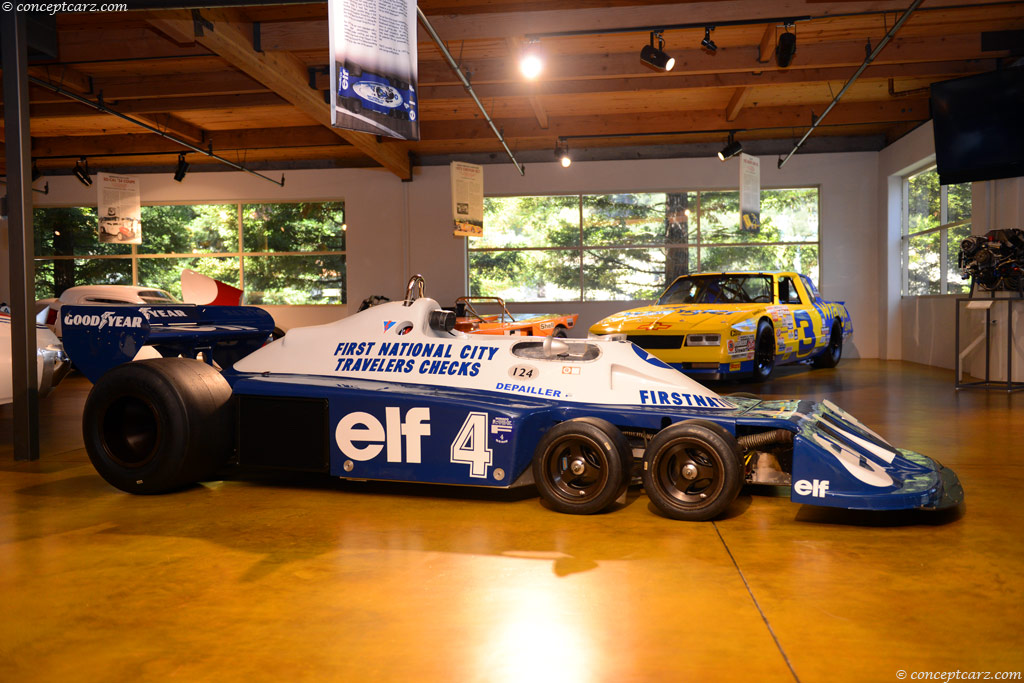
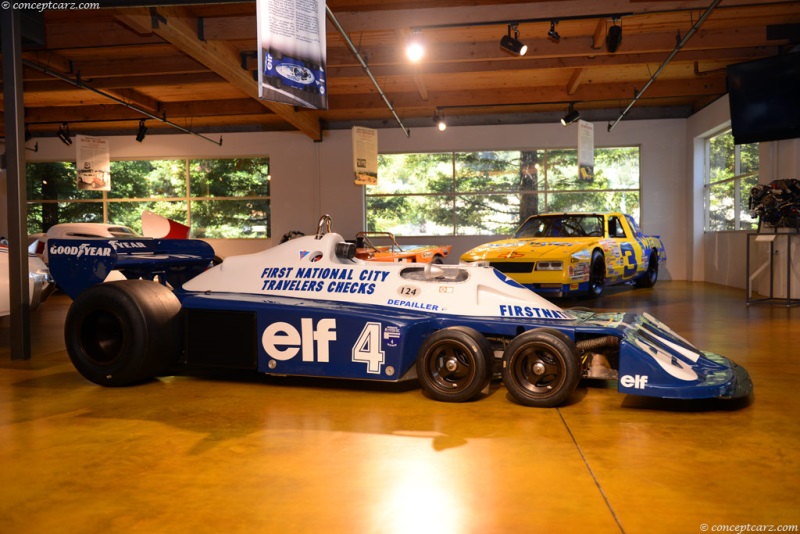
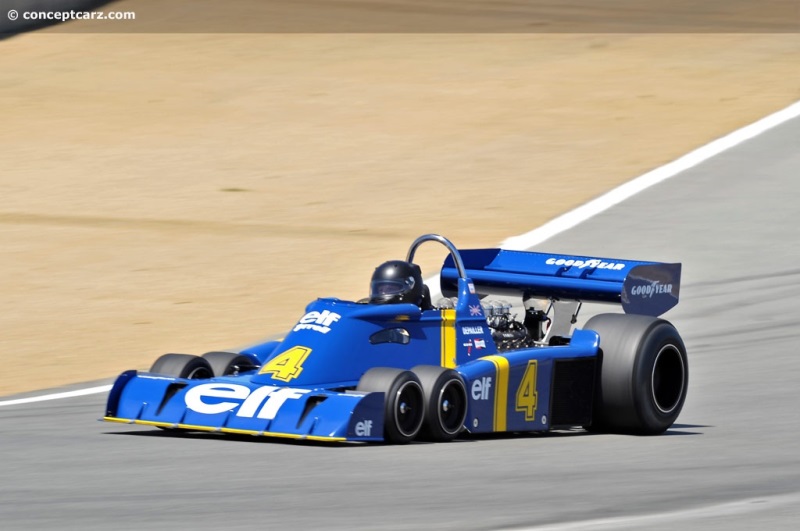
One of the issues with open-wheeled race cars was that they produced additional drag compared to a car with a fully enclosed body. Using smaller wheels was one way to limit the drag, though it did mean there would be less rubber on the track and decreased the grip significantly. When Ken Tyrrell and his chief designer Derek Gardner began working on a new F1 car for 1976, Gardner drew about his past for inspiration. Gardner's idea was to use small, 10-inch wheels supplied by Goodyear in the front to reduce drag. To maintain grip, four wheels would be in the front, making their new F1 car - the Project 34 or P34 - a six-wheeler.
At the time, the popular engine choice was the Ford/Cosworth V8 DFV and the only F1 tire manufacturer was Goodyear. Nearly every F1 team was using the same gearbox meaning that creativity, consistency, and a bit of luck were the keys to success.
The prototype P34 car was nothing more than Tyrrell 007 with modifications from the cockpit forward. The project was done in complete secrecy with only journalist Denis Jenkinson knowing about the project two weeks prior to its official debut at the Heathrow Hilton Hotel on September 22nd of 1975.
As would be expected, this radical design had several unforeseen problems that required attention prior to it being used in serious competition. These teething problems delayed its racing debut, which was made at the fourth round of the 1976 season.
One of the immediate problems was the size of the front tires compared with those of the rear. Since they were significantly small, they came in contact with the tarmac more frequently than the rears. In effect, the front tires were traveling nearly twice as fast as the rear tires. Another concern was braking - more specifically, what would happen to the car's wheelbase is the front tires locked up versus what might happen if a lockup occurred on the rear tires.
Due to the monocoque tub design, the P34 sat very low. The driver, rather than sitting in the car, would sit 'on' the car. A large wrap-around cockpit protected the driver from the elements with two small windows (portholes) later added to protect the driver's view on the front wheels.
The sole P34 that raced at the Jarama, Spain event was driven by Patrick Depailler. He qualified the car third while his teammate Jody Scheckter in a 007 managed 14th position. During the race, the P34 proved to be very quick, remaining in third place for 26 laps, when the brakes failed. This was not the first time this problem had occurred; during testing at Silverstone, the brakes overheated making them ineffective.
The tires and the lack of cooling to the brakes would be the cars Achille's heal for the remainder of the season. Tyrrell devoted all of their resources to solving these problems but was never able to alleviate them. The P34 remained as the two factory driver's team cars for the remainder of the season with the highlight being the Swedish Grand Prix at Anderstorp, where a one-two victory was scored with Scheckter taking the overall victory. They would finish the season third and fourth in the driver's Championship. Tyrrell finished third in the constructor's Championship.
For the 1977 season, the livery was changed and the cockpit area was slightly reshaped to improve aerodynamics. A fiberglass body was used during the early part of the 1977 season but it was too heavy and later switched for a Kevlar version. One problem with the new bodyshell layout was that it reduced the airflow to the oil radiators which were located under the rear wing. To solve this problem, the oil radiators were moved to the front of the car.
A big boost in sponsorship came for Tyrrell in 1977 from Fist National City Travelers Checks which allowed Tyrrell to establish a new Research & Development facility. This, along with new personnel, the team continued to explore the benefits of six wheels and how to make them effective.
Despite the extra effort, 1977 would be the first year Tyrrell would end the season without a win since the beginning of their team involvement in F1 competition.
For 1978, Tyrrell introduced their four-wheeled 008, having totally abandoned the six-wheel concept. A few teams would continue to test and develop the idea - some even tried four wheels in the rear. It is hard to envision the P34 as a failure. It had raced two years in F1 using the design with one of those years being rather successful. The car attracted more attention than most of the other cars circling the course, which greatly boosted the sponsorship spotlight.
In total, there were seven (or eight) examples created.
By Daniel Vaughan | Feb 2009
In the late 1960s, Derek Gardner had worked on a four-wheel-drive transmission for the Lotus 56 Gas-Turbine Indy Car. A year later, he was working on the system at Matra, trying to solve the shortcomings of the four-wheel-drive setup. In 1969, Lotus ran a four-wheel-drive Gas-Turbine car in Formula One, though it had the same handling issues as the Indy car.
One of the issues with open-wheeled race cars was that they produced additional drag compared to a car with a fully enclosed body. Using smaller wheels was one way to limit the drag, though it did mean there would be less rubber on the track and decreased the grip significantly. When Ken Tyrrell and his chief designer Derek Gardner began working on a new F1 car for 1976, Gardner drew about his past for inspiration. Gardner's idea was to use small, 10-inch wheels supplied by Goodyear in the front to reduce drag. To maintain grip, four wheels would be in the front, making their new F1 car - the Project 34 or P34 - a six-wheeler.
At the time, the popular engine choice was the Ford/Cosworth V8 DFV and the only F1 tire manufacturer was Goodyear. Nearly every F1 team was using the same gearbox meaning that creativity, consistency, and a bit of luck were the keys to success.
The prototype P34 car was nothing more than Tyrrell 007 with modifications from the cockpit forward. The project was done in complete secrecy with only journalist Denis Jenkinson knowing about the project two weeks prior to its official debut at the Heathrow Hilton Hotel on September 22nd of 1975.
As would be expected, this radical design had several unforeseen problems that required attention prior to it being used in serious competition. These teething problems delayed its racing debut, which was made at the fourth round of the 1976 season.
One of the immediate problems was the size of the front tires compared with those of the rear. Since they were significantly small, they came in contact with the tarmac more frequently than the rears. In effect, the front tires were traveling nearly twice as fast as the rear tires. Another concern was braking - more specifically, what would happen to the car's wheelbase is the front tires locked up versus what might happen if a lockup occurred on the rear tires.
Due to the monocoque tub design, the P34 sat very low. The driver, rather than sitting in the car, would sit 'on' the car. A large wrap-around cockpit protected the driver from the elements with two small windows (portholes) later added to protect the driver's view on the front wheels.
The sole P34 that raced at the Jarama, Spain event was driven by Patrick Depailler. He qualified the car third while his teammate Jody Scheckter in a 007 managed 14th position. During the race, the P34 proved to be very quick, remaining in third place for 26 laps, when the brakes failed. This was not the first time this problem had occurred; during testing at Silverstone, the brakes overheated making them ineffective.
The tires and the lack of cooling to the brakes would be the cars Achille's heal for the remainder of the season. Tyrrell devoted all of their resources to solving these problems but was never able to alleviate them. The P34 remained as the two factory driver's team cars for the remainder of the season with the highlight being the Swedish Grand Prix at Anderstorp, where a one-two victory was scored with Scheckter taking the overall victory. They would finish the season third and fourth in the driver's Championship. Tyrrell finished third in the constructor's Championship.
For the 1977 season, the livery was changed and the cockpit area was slightly reshaped to improve aerodynamics. A fiberglass body was used during the early part of the 1977 season but it was too heavy and later switched for a Kevlar version. One problem with the new bodyshell layout was that it reduced the airflow to the oil radiators which were located under the rear wing. To solve this problem, the oil radiators were moved to the front of the car.
A big boost in sponsorship came for Tyrrell in 1977 from Fist National City Travelers Checks which allowed Tyrrell to establish a new Research & Development facility. This, along with new personnel, the team continued to explore the benefits of six wheels and how to make them effective.
Despite the extra effort, 1977 would be the first year Tyrrell would end the season without a win since the beginning of their team involvement in F1 competition.
For 1978, Tyrrell introduced their four-wheeled 008, having totally abandoned the six-wheel concept. A few teams would continue to test and develop the idea - some even tried four wheels in the rear. It is hard to envision the P34 as a failure. It had raced two years in F1 using the design with one of those years being rather successful. The car attracted more attention than most of the other cars circling the course, which greatly boosted the sponsorship spotlight.
In total, there were seven (or eight) examples created.
By Daniel Vaughan | Feb 2009
- 1976 Tyrrell P34 Menu
- Article
- Image gallery
- Specifications
Tyrrell
Similar Vehicles

Similar Automakers
Related Drivers
 Patrick André Eugène Joseph Depailler
 Bengt Ronnie Peterson
 Jody David Scheckter
Related Teams
 Elf Team Tyrrell


1976 Tyrrell P34 Vehicle Profiles
Chassis #: P34/2
Chassis #: P34/7
Recent Vehicle Additions


Related Automotive News

Monaco Grand Prix Winning Tyrrell-Cosworth 008 Driven By Patrick Depailler Returns To Monte Carlo
Monte Carlo, Monaco – The 1978 Tyrrell-Cosworth 008 as driven by French star Patrick Depailler to win the 1978 Monaco Grand Prix will be offered at The BonhamsCars Monaco Sale, Les Grandes Marques à Monaco on 10 May. Estimated to fetch between...

Legendary First-Ever Formula 1 Lotus To Star At The Bonhams|Cars Monaco Sale
Monte Carlo, Monaco – One of the most historically significant of all British Formula 1 Grand Prix cars will be offered at The BonhamsCars Monaco Sale, Les Grandes Marques à Monaco, on 10 May. The 1957-58 Lotus-Climax Type 12 chassis 353,...

1982 Austrian Grand Prix: de Angelis Flying Through the Thin Air
It is almost impossible to predict events and just how momentous they just might be. This would certainly be the case with the 1982 Austrian Grand Prix, a truly special and memorable moment in Formula One history.
Heading into the Austrian Grand Prix...

TMC Launches Redesigned Corolla Series in Japan
Toyota Motor Corporation (TMC) announces the launch in Japan today of the redesigned Corolla Axio sedan and Corolla Fielder*1 station wagon. The vehicles will be sold across Japan through Toyota Corolla dealers.
Since its debut in 1966, the...

1956 24 Hours of Le Mans: The Rise of Two Counts
The 1955 24 Hours of Le Mans would end up being the darkest day in all of motorsport when Pierre Levegh launched off the back of Lance Macklins Austin-Healey and crashed into a barrier sending large portions of the car flying through the air acting...


