1968 Camaro RS ![]() | 1968 Camaro Z28 ![]() | 1968 Camaro Series ![]() | 1968 Camaro SS396 ![]() |
Image credits: © Chevrolet. GM Corp
1967 Chevrolet Camaro Series news, pictures, and information | ||
| Tweet | ||
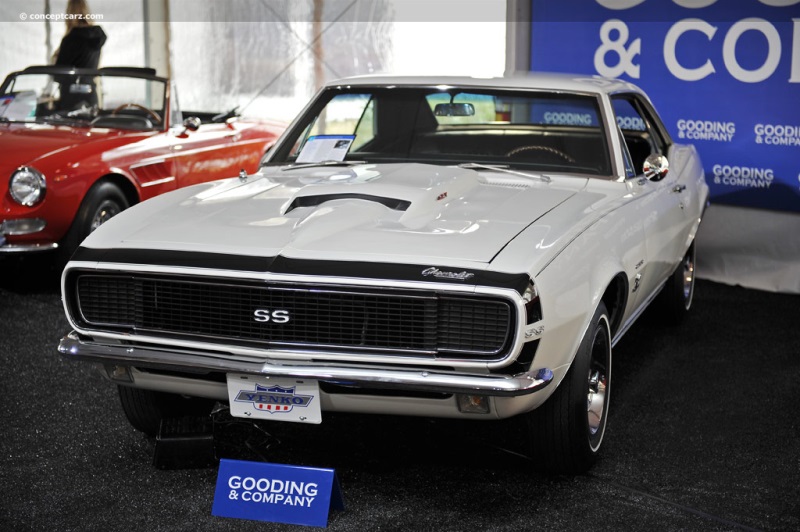
![]() | ![]() | ![]() | Yenko Super Camaro 450 Chassis Num: 124377N229158 |
| Sold for $350,000 at 2013 Gooding & Company. | |||
Yenko Chevrolet was first founded all the way back in 1934 under Donald's father. By 1957, Don Yenko was already a regular on the racing scene and would decide to set up his own performance shop specifically intended for Chevrolet vehicles. At the shop, customers could either order high performance parts and install them themselves, or, could employ Yenko's own mechanics to make performance improvements.
Yenko would soon begin to produce his own modified versions of Chevrolet cars. His first would be 'The Stinger' and it would be a modified version of the Corvair. Around 185 would be believed to be sold over a two year period between 1965 and 1967. And then Chevrolet introduced the Camaro.
The Camaro certainly looked the part of a muscle car but had a problem. The Corvette was Chevrolet's flagship sportscar and it did the company no good to have another car boasting of the same kind of power and performance. Therefore, the company would set limits on the Camaro. One of those limits would include no engine greater than 400 cu.in. ever being placed inside of the Camaro. Unfortunately for Chevrolet, the Camaro was to compete with the Ford Mustang, Plymouth Barracuda and Dodge Dart. Neither one of these would have such a restriction placed upon them. So, the Camaro was at a disadvantage. Yenko would therefore determine to rectify the situation.
As he had with the Corvairs that become the 'Stinger', Yenko would begin taking first generation Camaros and would start the process of turning them into ultra-muscle cars. The starting point for Yenko and his crew would be where Chevrolet wanted to end things. He would take delivery of the same 7.0-liter L-72 V-8 that powered the Corvette and would begin placing them inside the Camaro. The changes would just begin there.
Besides the engine, Yenko would have a fiberglass hood fitted to the Camaro and would have a 4-speed Muncie M21 Close-Ratio manual gearbox placed inside the car's chassis in order to deliver all of the 450 hp to the wheels. Finally, Yenko would re-work the suspension on the car. An independent double-wishbone front suspension would be used while a live rear axle with Semi-Elliptical Leaf Springs would be used at the rear.
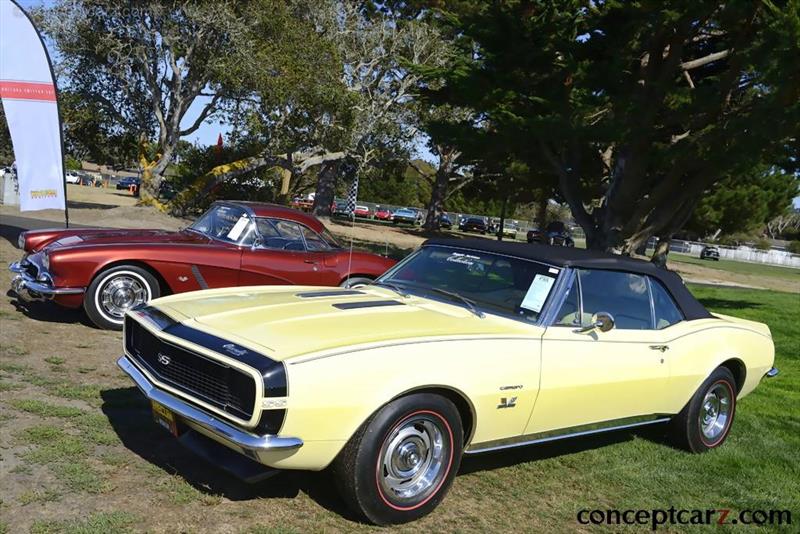
Called the Yenko Super Camaro, the first examples would roll out the same year as the Camaro would be made public in 1967. In all, there would be only 54 examples of the Yenko Super Camaro built. While there would be just 54 examples ever built, even fewer, just about 10, still remain.
One of those ten, chassis 124377N229158, would be made available for purchase at the Gooding & Company auction held in Amelia Island in March of 2013. Heading to auction, this particular Yenko Super Camaro would be drawing estimates ranging from $375,000 and $450,000, and there would be good reason.
Delivered as an Ermine White L78 SS, the car would be immediately sent to the Dick Harrell Peformance Center in St. Louis, Missouri where it would become a Super Camaro. It would be transformed into a Super Camaro 450, the most powerful model offered during the first year of production.
Throwing in the L72 engine wasn't a straight-forward matter, and therefore, required the addition of the Muncie M21 gearbox, a heavy-duty clutch, larger radiator and a 12-bolt Posi-Traction rear end. Besides these rather necessary updates, the Camaro would also receive disc brakes on the front and tuned exhaust headers. The car would even get an NHRA-approved scatter shield.
Completed with the desirable Rally Sport trim, center console, push-button AM radio and walnut grained steering wheel, this particular Yanko Super Camaro would be highly-desirable for looks, comfort and performance.
By August of 1967, this Super Camaro would be one of a group of six Yenko Camaros that would be headed to Jay Kline Chevrolet of Minneapolis, Minnesota. In the last couple of decades four well-respected owners have cared for and preserved the car. One such owner of this particular Yenko Camaro is Kevin Suyadam. Suyadam is well-known as having one of the finest collections of factory and dealer-prepared muscle cars.
Having had a restoration performed by the famed Dave Tinnell of Dave's Auto Service of Edmonton, Kentucky, the Yenko Camaro remains faithful to its original specifications and has since been invited to many exclusive Camaro and Yenko gatherings. Bob McClurg would also feature this very Camaro very prominently in his work Yenko: The Man, the Machines, the Legend.
Boasting of numerous documents including original work orders, shipping order and numerous other invoices, this Camaro comes about as complete as one would ever find. Combine all of this with the fact that the car still retains its numerous and rare high-performances options, Rally Sport trim, and the fact there are only about 10 still remaining and this 1967 Super Camaro 450 just might have to be considered the finest example of the first generation Camaro known to still exist.
Sure enough, as the car rolled across the block on March 8th, its distinctive qualities would be recognized and the car would end up going for the price of $350,000.
Sources:
'Lot No. 14: 1967 Chevrolet Yenko Super Camaro 450', (http://www.goodingco.com/car/1967-chevrolet-yenko-super-camaro-427450). Gooding & Company. http://www.goodingco.com/car/1967-chevrolet-yenko-super-camaro-427450. Retrieved 12 March 2013.
'The Yenko S/C: Don Yenko Creates a ¼ Mile Beast', (http://www.firstgencamaro.com/yenko.html). Firstgencamaro.com: Only 1967, 1968 and 1969 Camaros. http://www.firstgencamaro.com/yenko.html. Retrieved 12 March 2013.
Wikipedia contributors, 'Yenko Camaro', Wikipedia, The Free Encyclopedia, 7 March 2013, 02:36 UTC, http://en.wikipedia.org/w/index.php?title=Yenko_Camaro&oldid=542497435 accessed 12 March 2013
Wikipedia contributors, 'Don Yenko', Wikipedia, The Free Encyclopedia, 20 February 2013, 03:30 UTC, http://en.wikipedia.org/w/index.php?title=Don_Yenko&oldid=539165607 accessed 12 March 2013By Jeremy McMullen
![]() | ![]() | ![]() | Series 24 V8 Coupe Chassis Num: 124377N220997 |
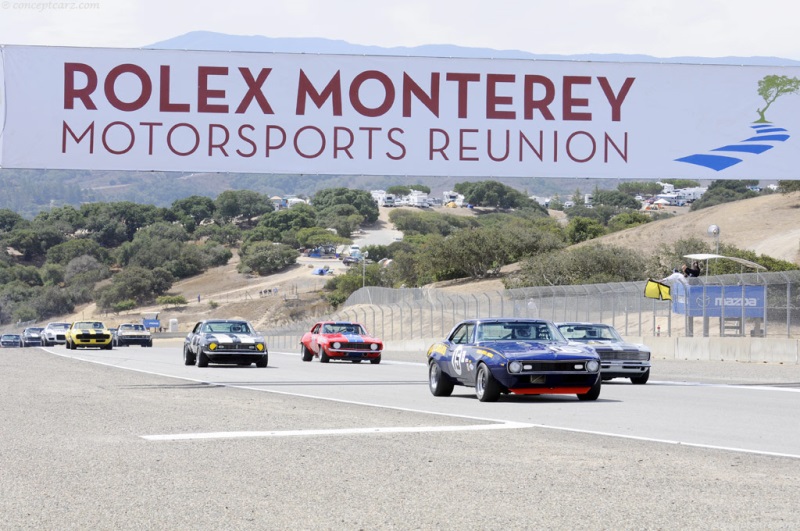
In early 1970, Warren Fairbanks, Reed Sinclair, and Ed May formed FSM Enterprises, purchased the car, and modified it to 1970 rules. Interesting modifications from 1967 rules include a notched front subframe, which lowers the engine in the chassis, a roll cage designed on a computer at International Harvest Corp., fender flares and fuel filler location. Jack Douglass Chevrolet helped with parts and sponsorship for the team.
Three years after the project was started, Warren ran the car for the first time at Mid-Ohio on June 7 and finished 11th. Warren, a former Shelby Cobra racer, fitted the Camaro with a seat out of a Cobra. John Greenwood, of Corvette fame, built motors for the car. Warren drove the car in a total of six Trans-Am races during the 1970-1972 seasons.
By Daniel Vaughan | Jan 2007
![]() | ![]() | Series 24 V8 Coupe Chassis Num: 124377N163228 |
| High bid of $160,000 at 2007 RM Auctions. (did not sell) | ||
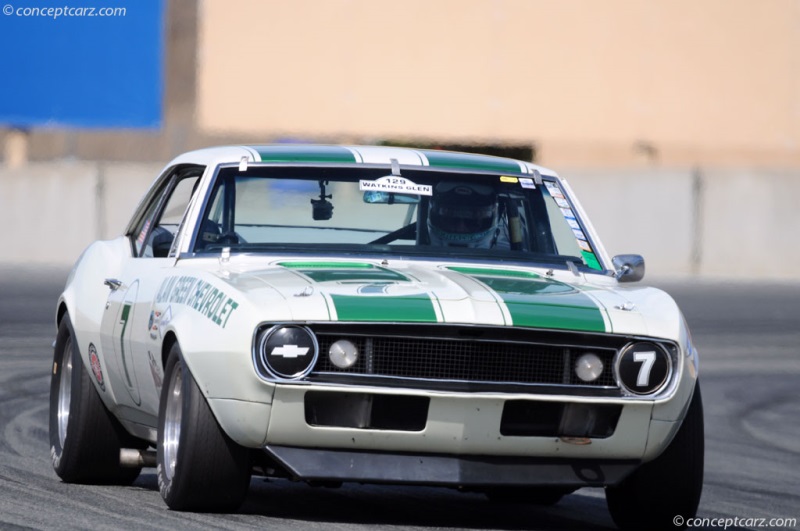
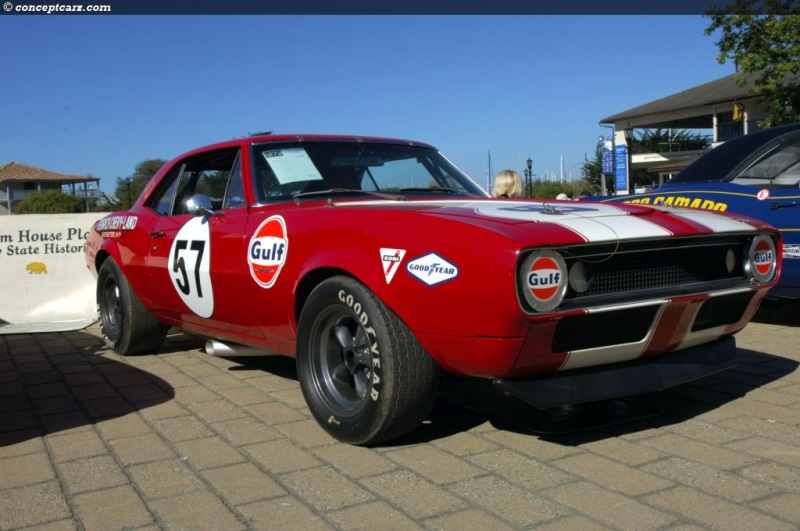
In 2007 this 1967 Chevrolet Camaro Z/28 Trans-Am Race Car was brought to the Monterey Sports & Classic Car Auction presented by RM Auctions, where it had an estimated value of $200,000 - $260,000. It is powered by a 302 cubic-inch V8 engine with a Muncie M-22 H.D. close-ratio four-speed manual transmission and four wheel disc brakes. It is finished in its correct period livery and is the 17th car built from the initial run of 25 pre-production prototypes destined for dealers participating in the Chevrolet racing program. It was sent to Heinrich Chevy-Land in Rochester New York and wore the number 57 on its side. It was campaigned with dealer sponsorship and driven by Gary Morgan in the SCCA Trans Am Series. Morgan raced the car from 1967 through 1969 and amassed 11 first places, two second places and numerous track records in his class. In 1969 the car finished fourth for the season in the Finger Lakes Region of the SCCA Northeast Division.
This car was featured in the Gulf TV commercials from 1967 through 1969, including the political conventions and was seen seven times during the Lunar Landing.
This car was one of the first to be equipped with factory 'Cross-Ram' intake manifolds and the ultra rare cowl plenum induction system. There is an original 12-bolt rear end with factory disc brakes and its original suspension. The car has been restored in the early 1990's to the original Trans Am racing specifications.
Bidding at auction reached $160,000 but was not enough to satisfy the vehicles reserve. The lot left the auction unsold.
By Daniel Vaughan | Dec 2007
![]() | ![]() | Series 24 V8 Coupe |
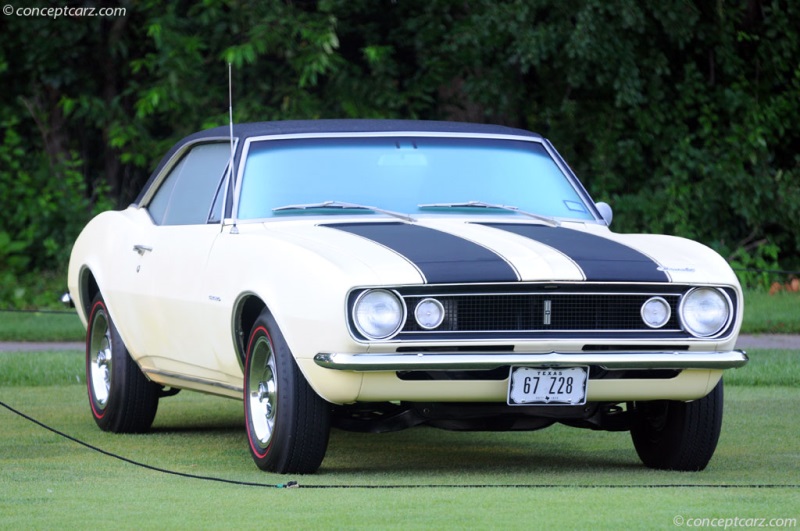
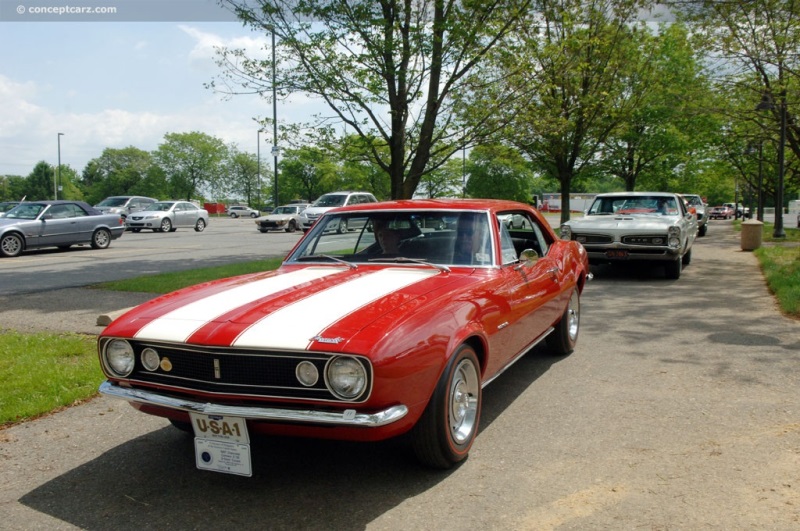
Chevrolet produced 602 Camaro's with the Z/28 option in 1967. The horsepower produced from the 302 was 300, but that may have been understated.
![]() | ![]() | ![]() | Series 24 V8 Coupe Chassis Num: 72TA23 |
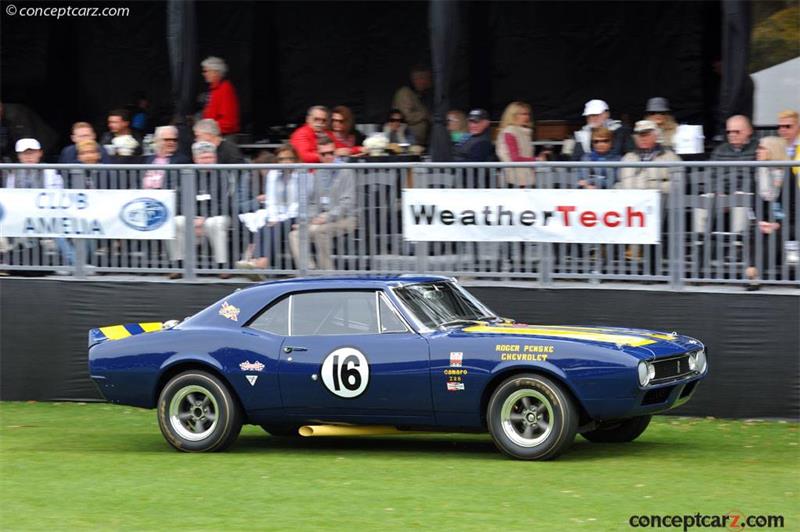
This 1967 Camaro was raced by Mark Donohue for Penske Racing in 1967 and 1968 - winning at Marlboro, MD; Stardust Raceway, Las Vegas, NY; and Kent, Washington. Currently it is powered by a 302 cubic-inch Chevy V-8 engine prepared by Traco Engineering and produces 450 horsepower.
By Daniel Vaughan | Aug 2012
![]() | ![]() | ![]() | Yenko Super Camaro 450 Chassis Num: 124377N229158 |
| Sold for $350,000 at 2013 Gooding & Company. | |||
This Yenko Camaro was originally delivered as an Ermine White L78 SS and immediately shipped to the Dick Harrell Performance Center in St. Louis, Missouri. From there, the stock Camaro was transformed into a Super Camaro 450. The original 396 SS engine was replaced with a 450 horsepower L72 mechanical-lifter 427 that had 11:1 compression, a 780 cfm Holley four-barrel carburetor, an aluminum dual-plane intake, and free-flowing dual exhausts. A Muncie M21 close-ratio gearbox, heavy-duty clutch, larger-capacity radiator, custom-designed suspension, metallic brakes, and a 12-bolt Posi-Traction rear end with a 3.73:1 rear axle were also installed.
This Super Camaro 450 was also given front disc brakes, tuned exhaust headers, traction bars, 15-inch steel wheels, and an NHRA-approved scatter shield. It is also one of the few examples that had the Rally Sport trim, which included a center console, walnut grained steering wheel, and push-button AM radio.
On August 1 of 1967 the completed Super Camaro 450 was sold in a group of six Yenko Camaros to Jay Kline Chevrolet of Minneapolis, Minnesota.
This first-year Yenko Camaro has had four caretakers over the past two decades. Kevin Suyadam has a collection of cars that includes the finest factory- and dealer-prepared muscle cars, and this car was once part of that collection. Noted Yenko collectors Gary Holub and Wayne Schmeeckle also owned this vehicle.
The car was given a restoration by Dave Tinnell of Dave's Auto Service in Edmonton, Kentucky. Since the work was completed, the car has been invited to many exclusive Camaro and Yenko gatherings and was featured in Bob McClurg's Yenko: The Man, the Machines, the Legend.
By Daniel Vaughan | May 2013
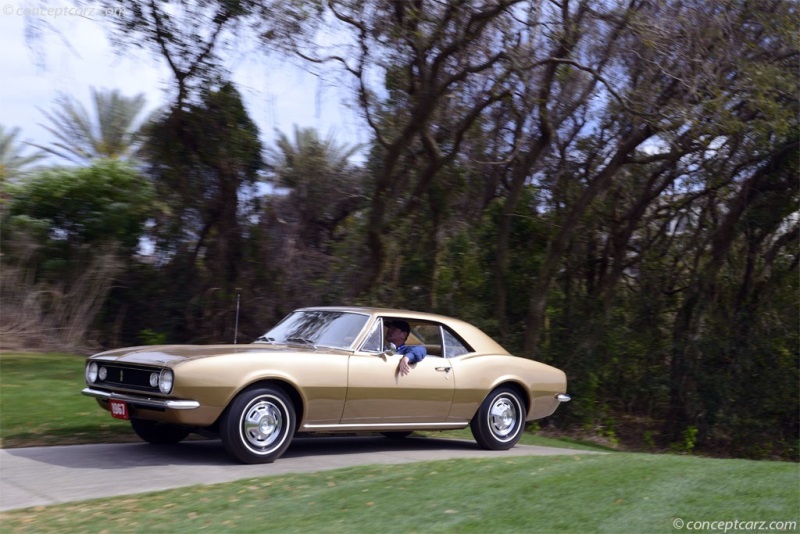
The Chevrolet Camaro was introduced in 1967 as a compact car specifically built to provide competition for the highly popular Ford Mustang. This pony car was built atop of the same F-Body platform as the Pontiac Firebird, which had a similar production lifespan of 1967 through 2002.
During the preproduction stages of the Chevrolet Camaro, General Motors codenamed the vehicle 'Panther'. The name 'Camaro' was decided upon before production began. The word 'Camaro' in French is slang for 'friend' but in pony-car slang, the name means 'Mustang killer'.
During its production lifespan, there were four generations produced. The first generation lasted from 1967 through 1969. The second generation lasted from 1972 through 1981. The third generation lasted from 1982 through 1992. The fourth generation lasted from 1993 through 2002. The fifth generation is believed to begin production in 2007; a concept was shown at the 2006 Detroit Auto Show.
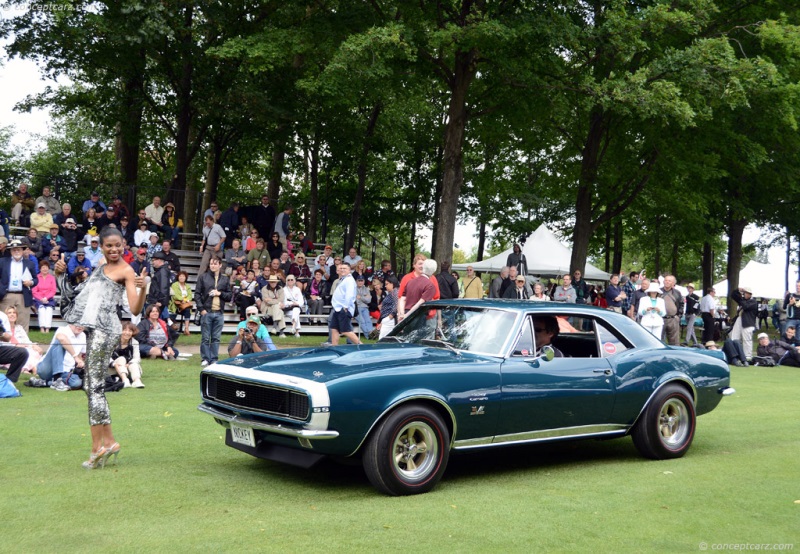
When the car was introduced in 1967, it was available in two bodystyles, a coupe and convertible. It shared many mechanics with the Chevrolet Nova and built atop a unibody chassis. The base engine was a 3.7 liter inline-six cylinder capable of producing 140 horsepower. Power was sent to the rear wheels courtesy of a Saginaw three-speed manual gearbox. A Muncie four-speed manual and a two-speed PowerGlide automatic were offered as optional equipment. Near the end of 1967, a Turbo Hydra-Matic 350 became available on the SS396. In 1969 the TH350 was offered on the Camaro as optional equipment, in place of the PowerGlide which was no longer offered. 14 inch wheels were standard.
To compete in the pony-car arena, General Motors offered a 5.7 liter eight-cylinder engine in 1967 that produced nearly 300 horsepower.
The Camaro was highly customizable, with over seventy factory and forty dealer options available. the z28 option was not mentioned in the sales literature so many buyers were unaware of its existence. Due to the lack of press about the Z28 option, only 602 examples were produced. The package included many performance enhancements such as a 4.9 liter small-block engine, front disc brakes, Muncie 4-speed gearbox, suspension improvements, 15 inch Rallye wheels, and power steering. The aesthetics of the vehicle were segregated from the other Camaro's with racing stripes being placed on the hood. The Z28 package was offered by GM specifically to comply with the Sports Car Club of America (SCCA) Trans Am racing series that required an engine size of five-liters or less. Also, the vehicle must be sold to the general public.
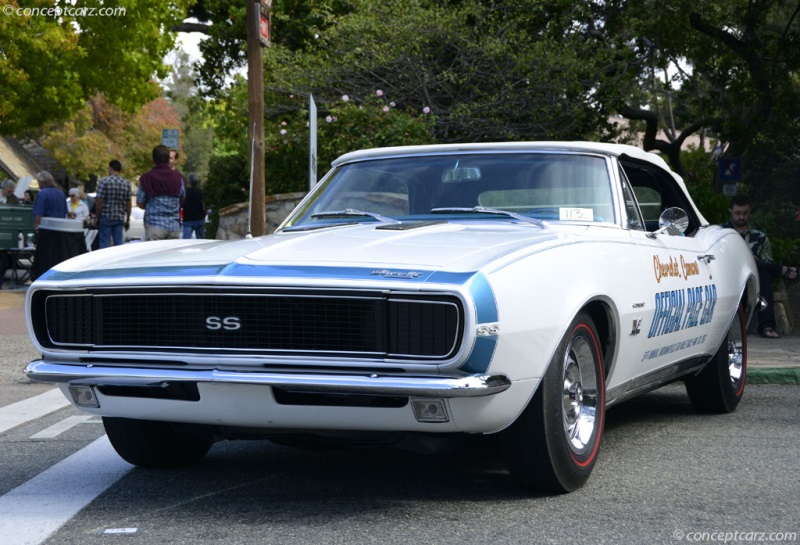
The SS (Super Sport) package included many performance and aesthetic upgrades and was popular with more than 34400 examples created. Under the hood was a 5.7 liter eight-cylinder engine with a 6.5 liter big-block offered as optional equipment in 1968. On the grille, horn button, and gas cap were SS badging. Non-functional air-inlets adorned the front hood.
The RS (Rally Sport) package was basically a cosmetic upgrade. The headlights were hidden, the taillights received minor alterations, and the exterior rocker trim was revised. RS badging could be seen throughout the vehicle. This was the most popular option ordered in 1967 with over 64840 examples produced.
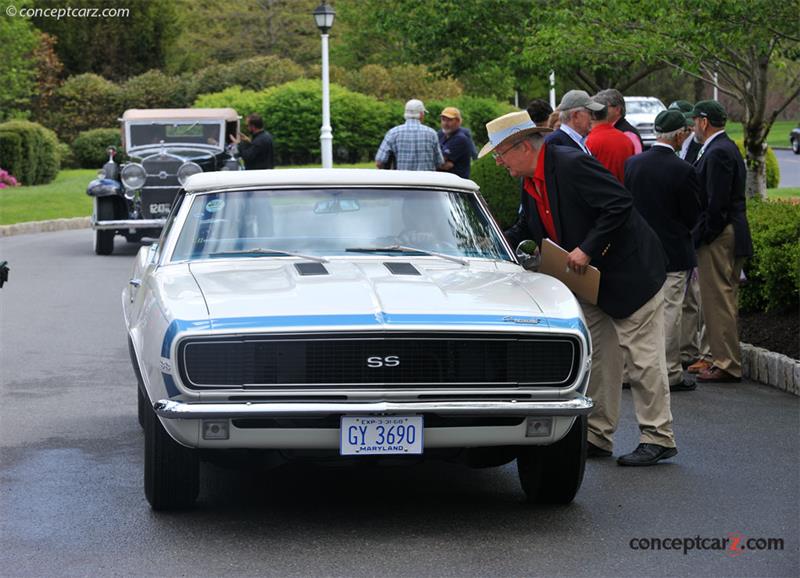
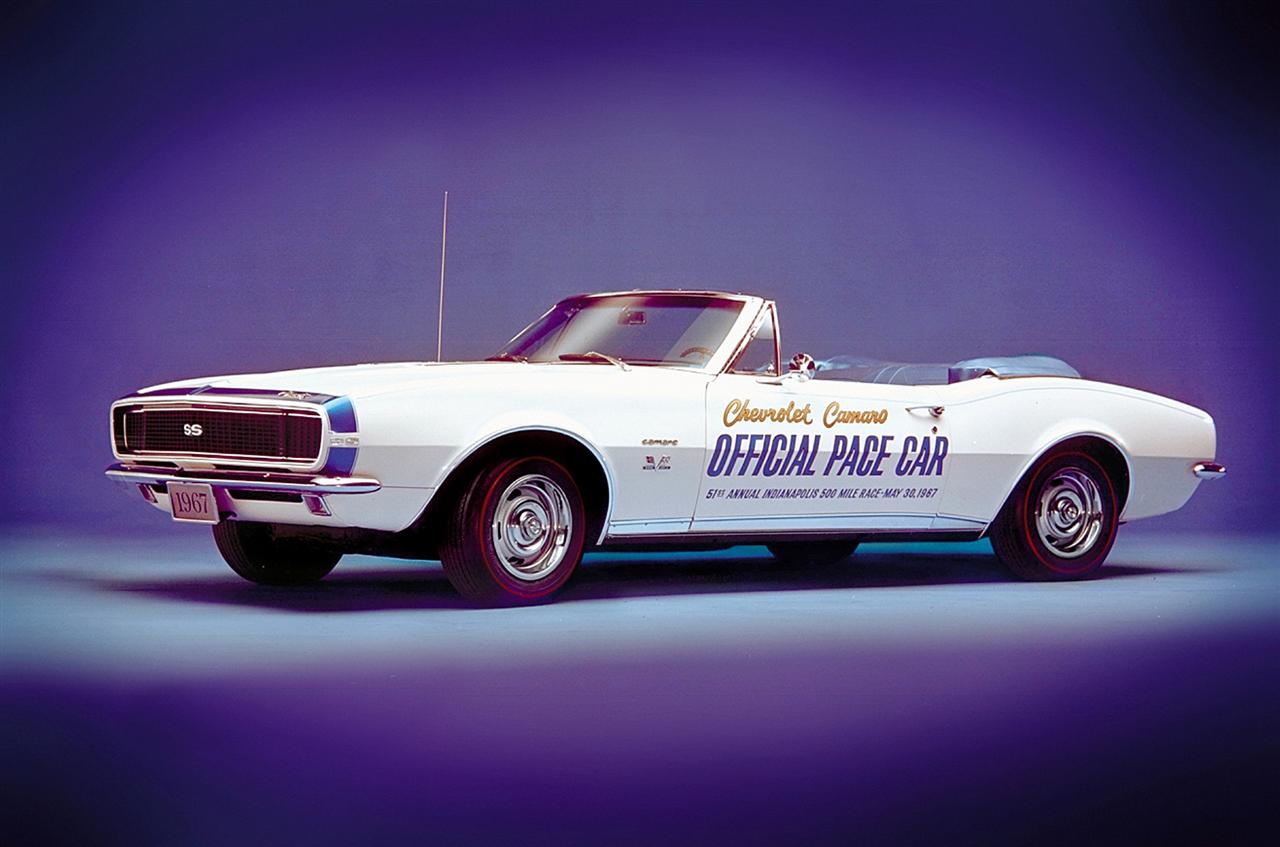
The RS and SS packages could be ordered together, creating the RS/SS Camaro. The combination included both the aesthetics of the RS and the performance of the SS. A Camaro RS/SS convertible with a 6.5 liter engine paced the Indianapolis 500 race in 1967.
With over 220900 examples produced in 1967, the Camaro proved to General Motors that the public was starved for small, performance, pony-cars.
In 1968 the Camaro received minor aesthetic and mechanical improvements. Side market lights were added, the grille became more pointed, and the taillights were now segregated. The side vent windows were removed. Performance was improved slightly by the staggering of the shock absorbers. On some of the models, the single-leafs were replaced by multi-leaf springs.
Buyers became aware of the Z28 package in 1968 and ordered nearly 7200 examples. The RS continued to be the most popular option with 40977 examples produced. The SS accounted for 27884 of the 235147 total Camaro's produced in 1968.
For 1969 the Camaro became safer and faster. General Motors mandated that the Camaro could not come from the factory with engines larger than 6.6 liters. To bypass this rule dealerships such as Yenko Chevrolet, Dana Chevrolet, and Nickey Chevrolet offered the Camaro with the 7 liter, big-block, L-27 corvette engine producing 425 horsepower. These performance options became so popular that in 1969 Chevrolet began offering two Central Office Production Orders (COPO) options, numbers 9560 and 9561. The COPO 9561 option included the L-72 Corvette engine. In total, there were 1015 Camaros equipped with the L-72 Corvette engine.
The COPO 9560 option included a 7-liter, big-block, ZL-1 engine. The engine was constructed of aluminum to help reduce the overall weight. The engine was reported to have produced around 430 gross horsepower but in reality it was closer to 550. With only 69 examples produced it is one of the rarest and fastest of all Chevrolet Camaros.
Most of the 1969 Chevrolet Camaro mechanics remained unchanged. The aesthetics was a different story. The grille was redesigned and the headlights now sat farther back adding to the aggressive features of the car. Newly reshaped door, rear quarter panel, and rear valence gave the 1969 Camaro a smooth, low, and wide stance. The production of the 1969 Camaro, which continued into December of 1969, was the final year for the first generation Camaro.
The second generation Camaro began production near the middle of 1970. The body had been redesigned and the suspension was greatly improved. The rest of the mechanics remained mostly unchanged from the prior years. The biggest change was the base engine, which was now a 4.1 liter inline-six capable of producing 155 horsepower. There was no convertible option offered, only a 2+2 coupe configuration.
The big-block eight-cylinder had been bored to 402 cubic-inches but still retained its 396 badging. The Rally Sport, Super Sport, and Z28 packages were still available. The Z28 now featured a 5.7 liter engine that produced 360 horsepower.
1972 was not a good year for the Camaro. For 174 days production ceased at GM's assembly plant in Ohio due to a UAW strike. This resulted in 1100 Camaro's failing to meet 1973 Federal bumper safety standards. In total, only 68,656 examples were production. Less than a thousand were the SS package so General Motors decided to no longer offer the package after 1972. This meant the big-block 396 cubic-inch engine was no longer offered.
The Camaro, much like the rest of the industry, had to adapt to new government and insurance safety and emission regulations. This meant new safety features like larger bumpers needed to be affixed to the car that could protect the vehicle and its occupants at certain speeds. Engines were detuned to comply with safety and emission concerns. The cars became safer but their performance was seriously crippled. This was true for the Camaro in 1973 when its highest producing engine was a 350 cubic-inch V-8 that produced 245 horsepower.
New for 1973 was an LT option which included impact-absorbing bumpers. The Camaro grew in size in 1974 due to a forward sloping grille and new aluminum bumpers. Rectangular bumpers replaced the round taillight designs. Sales of the Z28 package continued to decline so the decision was made to discontinue the option after 1974.
Horsepower was measured in NET rather than gross rating beginning in 1975. This meant that the reported horsepower was much lower than in prior years. The 350 cubic-inch V8 was now rated at about 155 horsepower.
In 1977 the Z28 was re-introduced in an effort to revitalize the muscle-car persona of the Camaro. The base Camaro's were outfitted with air-conditioning and an automatic transmission. A Borg-Warner Super T-10 four-speed manual gearbox could be ordered as optional equipment.
1978 marked the first year for the T-top option on a Camaro. The Camaro was given larger taillights and new bumpers.
As vehicles became safer, they became slower. The public shifted from wanting performance to luxury. Oil embargos and rising fuel costs had made the engines smaller but more fuel efficient. For 1979 the LT package was replaced with a luxurious Berlinetta that included special wheels, paint, emblems, and interior.
1979 was a very strong year for Camaro sales with 282,571 examples being sold.
1980 and 1981 saw very few changes. The hood scope on the Z-28 was revised to help siphon air to the engine.
In 1981 sales were down considerable to just over 126,000. This would be the final year for the second generation Camaro.
In 1982 General Motors introduced the third generation of the Camaro. The vehicle was stylish and versatile, earning the coveted Motor Trend magazine's Car of the Year. Both aesthetically and mechanically, the vehicle was improved. The suspension was upgraded making it more capable in the corners and at speed.
This was the first year the Camaro was equipped with a factory fuel-injected engine. A four-speed automatic gearbox replaced the three-speed unit. A five-speed manual gearbox was also available. Due to rising concerns of oil shortage, a four-cylinder engine was offered for part of 1982.
6000 examples of the Z28 Camaro were sold to commemorate the return of the pony-car to the Indianapolis 500. The special-edition vehicles were painted in two-tone silver and blue paint with orange pin-striping.
To honor the International Race of Champions, Chevrolet introduced the IROC-Z in 1985. The package included an improved suspension, decal package, and a 305 cubic-inch L98 Tuned Port Injection system borrowed from the Corvette. The IROC-Z was featured on Car and Driver magazine's Ten Best List for 1985.
The L69 small-block engine was offered from 1983 through 1986. The LB9 small-block was introduced in 1985; the L98 small-block was introduced in 1987; the LO3 was introduced in 1988. The LB9, L98, and LO3 stayed in production until 1992.
1992 was the final year for the third generation Camaro. 1993 marked the beginning of the fourth generation which persisted until 2002.
New technology and material made the fourth generation greatly improved over the prior years. Weight was reduced with the use of plastic body panels sitting atop a steel space frame. Performance was increased thanks in part to a better suspension system. In 1993 Chevrolet offered the LT1 eight-cylinder engine, which had been in production for a year on the Corvette, on the Camaro. A six-speed manual gearbox was offered with the LT1 engine.
The Camaro returned to the Indianapolis 500 as the honorary pace car in 1993. To commemorate this historic accomplishment, Chevrolet offered a limited quantity of special edition Camaro's, painted in a black and white color scheme.
The design and mechanics remained mostly unchanged over the next few years. Minor revisions were made to comply with newly introduced emission standards. Mechanical changes were made to correct problems that had been found throughout the years.
In 1996 the RS package and the SS package were re-introduced. The RS was an appearance option for the six-cylinder Camaro's while the SS was both an appearance and performance package for the eight-cylinder cars.
1997 marked the 30th anniversary of the Camaro. A 30th Anniversary Package was offered to honor this accomplishment. The vehicles were painted white with orange stripes. 100 of the Anniversary Camaros were given the LT4 engine with 330 horsepower; a thirty-eight thousand dollar price tag accompanied the vehicle.
The interior of the Camaro was modernized in 1997 and again in 1998, although the 1998 improvements were minor in comparison to what transpired the prior year.
The body design was drastically changed in 1998, mainly in the front. Round headlights replaced the square design. The headlights were flush, inline with the rest of the body. A new grille and bumper were used, both positioned a little differently to mimic the headlight changes. A new powerful, lightweight, all-aluminum LS1 power-plant retired the LT1 unit. The OHV LS1 was borrowed from the Corvette and slightly detuned to produce just over 300 horsepower. To handle this extra power, the disc brakes were enlarged and the suspension was upgraded.
Total production for 1998 was 48490. This was disappointing for General Motors, especially with the newly revised body and powerful options. The lowest production year for the Camaro occurred in 2001 with just over 29000 examples being produced. This was due to low sales and production ceasing early to begin work on the 35th Anniversary 2002 cars.
2002 marked the final year for production of the fifth generation Camaro. The styling and mechanics were unmodified, carrying the same design from 1999.
A special 35th Anniversary Edition was offered and could be ordered on all trim levels and packages. The 35th Anniversary SS Camaro could only be ordered as a convertible or with T-Tops. Around 3000 examples of the 35th Anniversary Edition were created. Total production for the year was just over 42,000.
On August 27th, 2002 production ceased. The Camaro had accomplished its goal, to provide competition for the Ford Mustang and other compact, low-priced, sports cars. Outfitted with large, Corvette engines, matted to effective gearboxes and given great suspension and brakes, the Camaro was truly a performance machine that was capable and fun to drive. It was fairly practical with room for more than two passengers. It was economical with sticker-prices in the range that many could afford. The production of the Camaro has ceased, but its future has not yet been written. Expect to see this legendary vehicle on the roadways in the near future.
By Daniel Vaughan | Jan 2011
During the preproduction stages of the Chevrolet Camaro, General Motors codenamed the vehicle 'Panther'. The name 'Camaro' was decided upon before production began. The word 'Camaro' in French is slang for 'friend' but in pony-car slang, the name means 'Mustang killer'.
During its production lifespan, there were four generations produced. The first generation lasted from 1967 through 1969. The second generation lasted from 1972 through 1981. The third generation lasted from 1982 through 1992. The fourth generation lasted from 1993 through 2002. The fifth generation is believed to begin production in 2007; a concept was shown at the 2006 Detroit Auto Show.
When the car was introduced in 1967, it was available in two bodystyles, a coupe and convertible. It shared many mechanics with the Chevrolet Nova and built atop a unibody chassis. The base engine was a 3.7 liter inline-six cylinder capable of producing 140 horsepower. Power was sent to the rear wheels courtesy of a Saginaw three-speed manual gearbox. A Muncie four-speed manual and a two-speed PowerGlide automatic were offered as optional equipment. Near the end of 1967, a Turbo Hydra-Matic 350 became available on the SS396. In 1969 the TH350 was offered on the Camaro as optional equipment, in place of the PowerGlide which was no longer offered. 14 inch wheels were standard.
To compete in the pony-car arena, General Motors offered a 5.7 liter eight-cylinder engine in 1967 that produced nearly 300 horsepower.
The Camaro was highly customizable, with over seventy factory and forty dealer options available. the z28 option was not mentioned in the sales literature so many buyers were unaware of its existence. Due to the lack of press about the Z28 option, only 602 examples were produced. The package included many performance enhancements such as a 4.9 liter small-block engine, front disc brakes, Muncie 4-speed gearbox, suspension improvements, 15 inch Rallye wheels, and power steering. The aesthetics of the vehicle were segregated from the other Camaro's with racing stripes being placed on the hood. The Z28 package was offered by GM specifically to comply with the Sports Car Club of America (SCCA) Trans Am racing series that required an engine size of five-liters or less. Also, the vehicle must be sold to the general public.
The SS (Super Sport) package included many performance and aesthetic upgrades and was popular with more than 34400 examples created. Under the hood was a 5.7 liter eight-cylinder engine with a 6.5 liter big-block offered as optional equipment in 1968. On the grille, horn button, and gas cap were SS badging. Non-functional air-inlets adorned the front hood.
The RS (Rally Sport) package was basically a cosmetic upgrade. The headlights were hidden, the taillights received minor alterations, and the exterior rocker trim was revised. RS badging could be seen throughout the vehicle. This was the most popular option ordered in 1967 with over 64840 examples produced.
The RS and SS packages could be ordered together, creating the RS/SS Camaro. The combination included both the aesthetics of the RS and the performance of the SS. A Camaro RS/SS convertible with a 6.5 liter engine paced the Indianapolis 500 race in 1967.
With over 220900 examples produced in 1967, the Camaro proved to General Motors that the public was starved for small, performance, pony-cars.
In 1968 the Camaro received minor aesthetic and mechanical improvements. Side market lights were added, the grille became more pointed, and the taillights were now segregated. The side vent windows were removed. Performance was improved slightly by the staggering of the shock absorbers. On some of the models, the single-leafs were replaced by multi-leaf springs.
Buyers became aware of the Z28 package in 1968 and ordered nearly 7200 examples. The RS continued to be the most popular option with 40977 examples produced. The SS accounted for 27884 of the 235147 total Camaro's produced in 1968.
For 1969 the Camaro became safer and faster. General Motors mandated that the Camaro could not come from the factory with engines larger than 6.6 liters. To bypass this rule dealerships such as Yenko Chevrolet, Dana Chevrolet, and Nickey Chevrolet offered the Camaro with the 7 liter, big-block, L-27 corvette engine producing 425 horsepower. These performance options became so popular that in 1969 Chevrolet began offering two Central Office Production Orders (COPO) options, numbers 9560 and 9561. The COPO 9561 option included the L-72 Corvette engine. In total, there were 1015 Camaros equipped with the L-72 Corvette engine.
The COPO 9560 option included a 7-liter, big-block, ZL-1 engine. The engine was constructed of aluminum to help reduce the overall weight. The engine was reported to have produced around 430 gross horsepower but in reality it was closer to 550. With only 69 examples produced it is one of the rarest and fastest of all Chevrolet Camaros.
Most of the 1969 Chevrolet Camaro mechanics remained unchanged. The aesthetics was a different story. The grille was redesigned and the headlights now sat farther back adding to the aggressive features of the car. Newly reshaped door, rear quarter panel, and rear valence gave the 1969 Camaro a smooth, low, and wide stance. The production of the 1969 Camaro, which continued into December of 1969, was the final year for the first generation Camaro.
The second generation Camaro began production near the middle of 1970. The body had been redesigned and the suspension was greatly improved. The rest of the mechanics remained mostly unchanged from the prior years. The biggest change was the base engine, which was now a 4.1 liter inline-six capable of producing 155 horsepower. There was no convertible option offered, only a 2+2 coupe configuration.
The big-block eight-cylinder had been bored to 402 cubic-inches but still retained its 396 badging. The Rally Sport, Super Sport, and Z28 packages were still available. The Z28 now featured a 5.7 liter engine that produced 360 horsepower.
1972 was not a good year for the Camaro. For 174 days production ceased at GM's assembly plant in Ohio due to a UAW strike. This resulted in 1100 Camaro's failing to meet 1973 Federal bumper safety standards. In total, only 68,656 examples were production. Less than a thousand were the SS package so General Motors decided to no longer offer the package after 1972. This meant the big-block 396 cubic-inch engine was no longer offered.
The Camaro, much like the rest of the industry, had to adapt to new government and insurance safety and emission regulations. This meant new safety features like larger bumpers needed to be affixed to the car that could protect the vehicle and its occupants at certain speeds. Engines were detuned to comply with safety and emission concerns. The cars became safer but their performance was seriously crippled. This was true for the Camaro in 1973 when its highest producing engine was a 350 cubic-inch V-8 that produced 245 horsepower.
New for 1973 was an LT option which included impact-absorbing bumpers. The Camaro grew in size in 1974 due to a forward sloping grille and new aluminum bumpers. Rectangular bumpers replaced the round taillight designs. Sales of the Z28 package continued to decline so the decision was made to discontinue the option after 1974.
Horsepower was measured in NET rather than gross rating beginning in 1975. This meant that the reported horsepower was much lower than in prior years. The 350 cubic-inch V8 was now rated at about 155 horsepower.
In 1977 the Z28 was re-introduced in an effort to revitalize the muscle-car persona of the Camaro. The base Camaro's were outfitted with air-conditioning and an automatic transmission. A Borg-Warner Super T-10 four-speed manual gearbox could be ordered as optional equipment.
1978 marked the first year for the T-top option on a Camaro. The Camaro was given larger taillights and new bumpers.
As vehicles became safer, they became slower. The public shifted from wanting performance to luxury. Oil embargos and rising fuel costs had made the engines smaller but more fuel efficient. For 1979 the LT package was replaced with a luxurious Berlinetta that included special wheels, paint, emblems, and interior.
1979 was a very strong year for Camaro sales with 282,571 examples being sold.
1980 and 1981 saw very few changes. The hood scope on the Z-28 was revised to help siphon air to the engine.
In 1981 sales were down considerable to just over 126,000. This would be the final year for the second generation Camaro.
In 1982 General Motors introduced the third generation of the Camaro. The vehicle was stylish and versatile, earning the coveted Motor Trend magazine's Car of the Year. Both aesthetically and mechanically, the vehicle was improved. The suspension was upgraded making it more capable in the corners and at speed.
This was the first year the Camaro was equipped with a factory fuel-injected engine. A four-speed automatic gearbox replaced the three-speed unit. A five-speed manual gearbox was also available. Due to rising concerns of oil shortage, a four-cylinder engine was offered for part of 1982.
6000 examples of the Z28 Camaro were sold to commemorate the return of the pony-car to the Indianapolis 500. The special-edition vehicles were painted in two-tone silver and blue paint with orange pin-striping.
To honor the International Race of Champions, Chevrolet introduced the IROC-Z in 1985. The package included an improved suspension, decal package, and a 305 cubic-inch L98 Tuned Port Injection system borrowed from the Corvette. The IROC-Z was featured on Car and Driver magazine's Ten Best List for 1985.
The L69 small-block engine was offered from 1983 through 1986. The LB9 small-block was introduced in 1985; the L98 small-block was introduced in 1987; the LO3 was introduced in 1988. The LB9, L98, and LO3 stayed in production until 1992.
1992 was the final year for the third generation Camaro. 1993 marked the beginning of the fourth generation which persisted until 2002.
New technology and material made the fourth generation greatly improved over the prior years. Weight was reduced with the use of plastic body panels sitting atop a steel space frame. Performance was increased thanks in part to a better suspension system. In 1993 Chevrolet offered the LT1 eight-cylinder engine, which had been in production for a year on the Corvette, on the Camaro. A six-speed manual gearbox was offered with the LT1 engine.
The Camaro returned to the Indianapolis 500 as the honorary pace car in 1993. To commemorate this historic accomplishment, Chevrolet offered a limited quantity of special edition Camaro's, painted in a black and white color scheme.
The design and mechanics remained mostly unchanged over the next few years. Minor revisions were made to comply with newly introduced emission standards. Mechanical changes were made to correct problems that had been found throughout the years.
In 1996 the RS package and the SS package were re-introduced. The RS was an appearance option for the six-cylinder Camaro's while the SS was both an appearance and performance package for the eight-cylinder cars.
1997 marked the 30th anniversary of the Camaro. A 30th Anniversary Package was offered to honor this accomplishment. The vehicles were painted white with orange stripes. 100 of the Anniversary Camaros were given the LT4 engine with 330 horsepower; a thirty-eight thousand dollar price tag accompanied the vehicle.
The interior of the Camaro was modernized in 1997 and again in 1998, although the 1998 improvements were minor in comparison to what transpired the prior year.
The body design was drastically changed in 1998, mainly in the front. Round headlights replaced the square design. The headlights were flush, inline with the rest of the body. A new grille and bumper were used, both positioned a little differently to mimic the headlight changes. A new powerful, lightweight, all-aluminum LS1 power-plant retired the LT1 unit. The OHV LS1 was borrowed from the Corvette and slightly detuned to produce just over 300 horsepower. To handle this extra power, the disc brakes were enlarged and the suspension was upgraded.
Total production for 1998 was 48490. This was disappointing for General Motors, especially with the newly revised body and powerful options. The lowest production year for the Camaro occurred in 2001 with just over 29000 examples being produced. This was due to low sales and production ceasing early to begin work on the 35th Anniversary 2002 cars.
2002 marked the final year for production of the fifth generation Camaro. The styling and mechanics were unmodified, carrying the same design from 1999.
A special 35th Anniversary Edition was offered and could be ordered on all trim levels and packages. The 35th Anniversary SS Camaro could only be ordered as a convertible or with T-Tops. Around 3000 examples of the 35th Anniversary Edition were created. Total production for the year was just over 42,000.
On August 27th, 2002 production ceased. The Camaro had accomplished its goal, to provide competition for the Ford Mustang and other compact, low-priced, sports cars. Outfitted with large, Corvette engines, matted to effective gearboxes and given great suspension and brakes, the Camaro was truly a performance machine that was capable and fun to drive. It was fairly practical with room for more than two passengers. It was economical with sticker-prices in the range that many could afford. The production of the Camaro has ceased, but its future has not yet been written. Expect to see this legendary vehicle on the roadways in the near future.
By Daniel Vaughan | Jan 2011
The Chevrolet Camaro was introduced in 1967 as a compact car specifically built to provide competition for the highly popular Ford Mustang. This pony car was built atop of the same F-Body platform as the Pontiac Firebird, which had a similar production lifespan of 1967 through 2002.
During the preproduction stages of the Chevrolet Camaro, General Motors codenamed the vehicle 'Panther'. The name 'Camaro' was decided upon before production began. The word 'Camaro' in French is slang for 'friend' but in pony-car slang, the name means 'Mustang killer'.
During its production lifespan, there were four generations produced. The first generation lasted from 1967 through 1969. The second generation lasted from 1972 through 1981. The third generation lasted from 1982 through 1992. The fourth generation lasted from 1993 through 2002. The fifth generation is believed to begin production in 2007; a concept was shown at the 2006 Detroit Auto Show.
When the car was introduced in 1967, it was available in two bodystyles, a coupe and convertible. It shared many mechanics with the Chevrolet Nova and built atop a unibody chassis. The base engine was a 3.7 liter inline-six cylinder capable of producing 140 horsepower. Power was sent to the rear wheels courtesy of a Saginaw three-speed manual gearbox. A Muncie four-speed manual and a two-speed PowerGlide automatic were offered as optional equipment. Near the end of 1967, a Turbo Hydra-Matic 350 became available on the SS396. In 1969 the TH350 was offered on the Camaro as optional equipment, in place of the PowerGlide which was no longer offered. 14 inch wheels were standard.
To compete in the pony-car arena, General Motors offered a 5.7 liter eight-cylinder engine in 1967 that produced nearly 300 horsepower.
The Camaro was highly customizable, with over seventy factory and forty dealer options available. the z28 option was not mentioned in the sales literature so many buyers were unaware of its existence. Due to the lack of press about the Z28 option, only 602 examples were produced. The package included many performance enhancements such as a 4.9 liter small-block engine, front disc brakes, Muncie 4-speed gearbox, suspension improvements, 15 inch Rallye wheels, and power steering. The aesthetics of the vehicle were segregated from the other Camaro's with racing stripes being placed on the hood. The Z28 package was offered by GM specifically to comply with the Sports Car Club of America (SCCA) Trans Am racing series that required an engine size of five-liters or less. Also, the vehicle must be sold to the general public.
The SS (Super Sport) package included many performance and aesthetic upgrades and was popular with more than 34400 examples created. Under the hood was a 5.7 liter eight-cylinder engine with a 6.5 liter big-block offered as optional equipment in 1968. On the grille, horn button, and gas cap were SS badging. Non-functional air-inlets adorned the front hood.
The RS (Rally Sport) package was basically a cosmetic upgrade. The headlights were hidden, the taillights received minor alterations, and the exterior rocker trim was revised. RS badging could be seen throughout the vehicle. This was the most popular option ordered in 1967 with over 64840 examples produced.
The RS and SS packages could be ordered together, creating the RS/SS Camaro. The combination included both the aesthetics of the RS and the performance of the SS. A Camaro RS/SS convertible with a 6.5 liter engine paced the Indianapolis 500 race in 1967.
With over 220900 examples produced in 1967, the Camaro proved to General Motors that the public was starved for small, performance, pony-cars.
In 1968 the Camaro received minor aesthetic and mechanical improvements. Side market lights were added, the grille became more pointed, and the taillights were now segregated. The side vent windows were removed. Performance was improved slightly by the staggering of the shock absorbers. On some of the models, the single-leafs were replaced by multi-leaf springs.
Buyers became aware of the Z28 package in 1968 and ordered nearly 7200 examples. The RS continued to be the most popular option with 40977 examples produced. The SS accounted for 27884 of the 235147 total Camaro's produced in 1968.
For 1969 the Camaro became safer and faster. General Motors mandated that the Camaro could not come from the factory with engines larger than 6.6 liters. To bypass this rule dealerships such as Yenko Chevrolet, Dana Chevrolet, and Nickey Chevrolet offered the Camaro with the 7 liter, big-block, L-27 corvette engine producing 425 horsepower. These performance options became so popular that in 1969 Chevrolet began offering two Central Office Production Orders (COPO) options, numbers 9560 and 9561. The COPO 9561 option included the L-72 Corvette engine. In total, there were 1015 Camaros equipped with the L-72 Corvette engine.
The COPO 9560 option included a 7-liter, big-block, ZL-1 engine. The engine was constructed of aluminum to help reduce the overall weight. The engine was reported to have produced around 430 gross horsepower but in reality it was closer to 550. With only 69 examples produced it is one of the rarest and fastest of all Chevrolet Camaros.
Most of the 1969 Chevrolet Camaro mechanics remained unchanged. The aesthetics was a different story. The grille was redesigned and the headlights now sat farther back adding to the aggressive features of the car. Newly reshaped door, rear quarter panel, and rear valence gave the 1969 Camaro a smooth, low, and wide stance. The production of the 1969 Camaro, which continued into December of 1969, was the final year for the first generation Camaro.
The second generation Camaro began production near the middle of 1970. The body had been redesigned and the suspension was greatly improved. The rest of the mechanics remained mostly unchanged from the prior years. The biggest change was the base engine, which was now a 4.1 liter inline-six capable of producing 155 horsepower. There was no convertible option offered, only a 2+2 coupe configuration.
The big-block eight-cylinder had been bored to 402 cubic-inches but still retained its 396 badging. The Rally Sport, Super Sport, and Z28 packages were still available. The Z28 now featured a 5.7 liter engine that produced 360 horsepower.
1972 was not a good year for the Camaro. For 174 days production ceased at GM's assembly plant in Ohio due to a UAW strike. This resulted in 1100 Camaro's failing to meet 1973 Federal bumper safety standards. In total, only 68,656 examples were production. Less than a thousand were the SS package so General Motors decided to no longer offer the package after 1972. This meant the big-block 396 cubic-inch engine was no longer offered.
The Camaro, much like the rest of the industry, had to adapt to new government and insurance safety and emission regulations. This meant new safety features like larger bumpers needed to be affixed to the car that could protect the vehicle and its occupants at certain speeds. Engines were detuned to comply with safety and emission concerns. The cars became safer but their performance was seriously crippled. This was true for the Camaro in 1973 when its highest producing engine was a 350 cubic-inch V-8 that produced 245 horsepower.
New for 1973 was an LT option which included impact-absorbing bumpers. The Camaro grew in size in 1974 due to a forward sloping grille and new aluminum bumpers. Rectangular bumpers replaced the round taillight designs. Sales of the Z28 package continued to decline so the decision was made to discontinue the option after 1974.
Horsepower was measured in NET rather than gross rating beginning in 1975. This meant that the reported horsepower was much lower than in prior years. The 350 cubic-inch V8 was now rated at about 155 horsepower.
In 1977 the Z28 was re-introduced in an effort to revitalize the muscle-car persona of the Camaro. The base Camaro's were outfitted with air-conditioning and an automatic transmission. A Borg-Warner Super T-10 four-speed manual gearbox could be ordered as optional equipment.
1978 marked the first year for the T-top option on a Camaro. The Camaro was given larger taillights and new bumpers.
As vehicles became safer, they became slower. The public shifted from wanting performance to luxury. Oil embargos and rising fuel costs had made the engines smaller but more fuel efficient. For 1979 the LT package was replaced with a luxurious Berlinetta that included special wheels, paint, emblems, and interior.
1979 was a very strong year for Camaro sales with 282,571 examples being sold.
1980 and 1981 saw very few changes. The hood scope on the Z-28 was revised to help siphon air to the engine.
In 1981 sales were down considerable to just over 126,000. This would be the final year for the second generation Camaro.
In 1982 General Motors introduced the third generation of the Camaro. The vehicle was stylish and versatile, earning the coveted Motor Trend magazine's Car of the Year. Both aesthetically and mechanically, the vehicle was improved. The suspension was upgraded making it more capable in the corners and at speed.
This was the first year the Camaro was equipped with a factory fuel-injected engine. A four-speed automatic gearbox replaced the three-speed unit. A five-speed manual gearbox was also available. Due to rising concerns of oil shortage, a four-cylinder engine was offered for part of 1982.
6000 examples of the Z28 Camaro were sold to commemorate the return of the pony-car to the Indianapolis 500. The special-edition vehicles were painted in two-tone silver and blue paint with orange pin-striping.
To honor the International Race of Champions, Chevrolet introduced the IROC-Z in 1985. The package included an improved suspension, decal package, and a 305 cubic-inch L98 Tuned Port Injection system borrowed from the Corvette. The IROC-Z was featured on Car and Driver magazine's Ten Best List for 1985.
The L69 small-block engine was offered from 1983 through 1986. The LB9 small-block was introduced in 1985; the L98 small-block was introduced in 1987; the LO3 was introduced in 1988. The LB9, L98, and LO3 stayed in production until 1992.
1992 was the final year for the third generation Camaro. 1993 marked the beginning of the fourth generation which persisted until 2002.
New technology and material made the fourth generation greatly improved over the prior years. Weight was reduced with the use of plastic body panels sitting atop a steel space frame. Performance was increased thanks in part to a better suspension system. In 1993 Chevrolet offered the LT1 eight-cylinder engine, which had been in production for a year on the Corvette, on the Camaro. A six-speed manual gearbox was offered with the LT1 engine.
The Camaro returned to the Indianapolis 500 as the honorary pace car in 1993. To commemorate this historic accomplishment, Chevrolet offered a limited quantity of special edition Camaro's, painted in a black and white color scheme.
The design and mechanics remained mostly unchanged over the next few years. Minor revisions were made to comply with newly introduced emission standards. Mechanical changes were made to correct problems that had been found throughout the years.
In 1996 the RS package and the SS package were re-introduced. The RS was an appearance option for the six-cylinder Camaro's while the SS was both an appearance and performance package for the eight-cylinder cars.
1997 marked the 30th anniversary of the Camaro. A 30th Anniversary Package was offered to honor this accomplishment. The vehicles were painted white with orange stripes. 100 of the Anniversary Camaros were given the LT4 engine with 330 horsepower; a thirty-eight thousand dollar price tag accompanied the vehicle.
The interior of the Camaro was modernized in 1997 and again in 1998, although the 1998 improvements were minor in comparison to what transpired the prior year.
The body design was drastically changed in 1998, mainly in the front. Round headlights replaced the square design. The headlights were flush, inline with the rest of the body. A new grille and bumper were used, both positioned a little differently to mimic the headlight changes. A new powerful, lightweight, all-aluminum LS1 power-plant retired the LT1 unit. The OHV LS1 was borrowed from the Corvette and slightly detuned to produce just over 300 horsepower. To handle this extra power, the disc brakes were enlarged and the suspension was upgraded.
Total production for 1998 was 48490. This was disappointing for General Motors, especially with the newly revised body and powerful options. The lowest production year for the Camaro occurred in 2001 with just over 29000 examples being produced. This was due to low sales and production ceasing early to begin work on the 35th Anniversary 2002 cars.
2002 marked the final year for production of the fifth generation Camaro. The styling and mechanics were unmodified, carrying the same design from 1999.
A special 35th Anniversary Edition was offered and could be ordered on all trim levels and packages. The 35th Anniversary SS Camaro could only be ordered as a convertible or with T-Tops. Around 3000 examples of the 35th Anniversary Edition were created. Total production for the year was just over 42,000.
On August 27th, 2002 production ceased. The Camaro had accomplished its goal, to provide competition for the Ford Mustang and other compact, low-priced, sports cars. Outfitted with large, Corvette engines, matted to effective gearboxes and given great suspension and brakes, the Camaro was truly a performance machine that was capable and fun to drive. It was fairly practical with room for more than two passengers. It was economical with sticker-prices in the range that many could afford. The production of the Camaro has ceased, but its future has not yet been written. Expect to see this legendary vehicle on the roadways in the near future.
By Daniel Vaughan | May 2011
For more information and related vehicles, click hereDuring the preproduction stages of the Chevrolet Camaro, General Motors codenamed the vehicle 'Panther'. The name 'Camaro' was decided upon before production began. The word 'Camaro' in French is slang for 'friend' but in pony-car slang, the name means 'Mustang killer'.
During its production lifespan, there were four generations produced. The first generation lasted from 1967 through 1969. The second generation lasted from 1972 through 1981. The third generation lasted from 1982 through 1992. The fourth generation lasted from 1993 through 2002. The fifth generation is believed to begin production in 2007; a concept was shown at the 2006 Detroit Auto Show.
When the car was introduced in 1967, it was available in two bodystyles, a coupe and convertible. It shared many mechanics with the Chevrolet Nova and built atop a unibody chassis. The base engine was a 3.7 liter inline-six cylinder capable of producing 140 horsepower. Power was sent to the rear wheels courtesy of a Saginaw three-speed manual gearbox. A Muncie four-speed manual and a two-speed PowerGlide automatic were offered as optional equipment. Near the end of 1967, a Turbo Hydra-Matic 350 became available on the SS396. In 1969 the TH350 was offered on the Camaro as optional equipment, in place of the PowerGlide which was no longer offered. 14 inch wheels were standard.
To compete in the pony-car arena, General Motors offered a 5.7 liter eight-cylinder engine in 1967 that produced nearly 300 horsepower.
The Camaro was highly customizable, with over seventy factory and forty dealer options available. the z28 option was not mentioned in the sales literature so many buyers were unaware of its existence. Due to the lack of press about the Z28 option, only 602 examples were produced. The package included many performance enhancements such as a 4.9 liter small-block engine, front disc brakes, Muncie 4-speed gearbox, suspension improvements, 15 inch Rallye wheels, and power steering. The aesthetics of the vehicle were segregated from the other Camaro's with racing stripes being placed on the hood. The Z28 package was offered by GM specifically to comply with the Sports Car Club of America (SCCA) Trans Am racing series that required an engine size of five-liters or less. Also, the vehicle must be sold to the general public.
The SS (Super Sport) package included many performance and aesthetic upgrades and was popular with more than 34400 examples created. Under the hood was a 5.7 liter eight-cylinder engine with a 6.5 liter big-block offered as optional equipment in 1968. On the grille, horn button, and gas cap were SS badging. Non-functional air-inlets adorned the front hood.
The RS (Rally Sport) package was basically a cosmetic upgrade. The headlights were hidden, the taillights received minor alterations, and the exterior rocker trim was revised. RS badging could be seen throughout the vehicle. This was the most popular option ordered in 1967 with over 64840 examples produced.
The RS and SS packages could be ordered together, creating the RS/SS Camaro. The combination included both the aesthetics of the RS and the performance of the SS. A Camaro RS/SS convertible with a 6.5 liter engine paced the Indianapolis 500 race in 1967.
With over 220900 examples produced in 1967, the Camaro proved to General Motors that the public was starved for small, performance, pony-cars.
In 1968 the Camaro received minor aesthetic and mechanical improvements. Side market lights were added, the grille became more pointed, and the taillights were now segregated. The side vent windows were removed. Performance was improved slightly by the staggering of the shock absorbers. On some of the models, the single-leafs were replaced by multi-leaf springs.
Buyers became aware of the Z28 package in 1968 and ordered nearly 7200 examples. The RS continued to be the most popular option with 40977 examples produced. The SS accounted for 27884 of the 235147 total Camaro's produced in 1968.
For 1969 the Camaro became safer and faster. General Motors mandated that the Camaro could not come from the factory with engines larger than 6.6 liters. To bypass this rule dealerships such as Yenko Chevrolet, Dana Chevrolet, and Nickey Chevrolet offered the Camaro with the 7 liter, big-block, L-27 corvette engine producing 425 horsepower. These performance options became so popular that in 1969 Chevrolet began offering two Central Office Production Orders (COPO) options, numbers 9560 and 9561. The COPO 9561 option included the L-72 Corvette engine. In total, there were 1015 Camaros equipped with the L-72 Corvette engine.
The COPO 9560 option included a 7-liter, big-block, ZL-1 engine. The engine was constructed of aluminum to help reduce the overall weight. The engine was reported to have produced around 430 gross horsepower but in reality it was closer to 550. With only 69 examples produced it is one of the rarest and fastest of all Chevrolet Camaros.
Most of the 1969 Chevrolet Camaro mechanics remained unchanged. The aesthetics was a different story. The grille was redesigned and the headlights now sat farther back adding to the aggressive features of the car. Newly reshaped door, rear quarter panel, and rear valence gave the 1969 Camaro a smooth, low, and wide stance. The production of the 1969 Camaro, which continued into December of 1969, was the final year for the first generation Camaro.
The second generation Camaro began production near the middle of 1970. The body had been redesigned and the suspension was greatly improved. The rest of the mechanics remained mostly unchanged from the prior years. The biggest change was the base engine, which was now a 4.1 liter inline-six capable of producing 155 horsepower. There was no convertible option offered, only a 2+2 coupe configuration.
The big-block eight-cylinder had been bored to 402 cubic-inches but still retained its 396 badging. The Rally Sport, Super Sport, and Z28 packages were still available. The Z28 now featured a 5.7 liter engine that produced 360 horsepower.
1972 was not a good year for the Camaro. For 174 days production ceased at GM's assembly plant in Ohio due to a UAW strike. This resulted in 1100 Camaro's failing to meet 1973 Federal bumper safety standards. In total, only 68,656 examples were production. Less than a thousand were the SS package so General Motors decided to no longer offer the package after 1972. This meant the big-block 396 cubic-inch engine was no longer offered.
The Camaro, much like the rest of the industry, had to adapt to new government and insurance safety and emission regulations. This meant new safety features like larger bumpers needed to be affixed to the car that could protect the vehicle and its occupants at certain speeds. Engines were detuned to comply with safety and emission concerns. The cars became safer but their performance was seriously crippled. This was true for the Camaro in 1973 when its highest producing engine was a 350 cubic-inch V-8 that produced 245 horsepower.
New for 1973 was an LT option which included impact-absorbing bumpers. The Camaro grew in size in 1974 due to a forward sloping grille and new aluminum bumpers. Rectangular bumpers replaced the round taillight designs. Sales of the Z28 package continued to decline so the decision was made to discontinue the option after 1974.
Horsepower was measured in NET rather than gross rating beginning in 1975. This meant that the reported horsepower was much lower than in prior years. The 350 cubic-inch V8 was now rated at about 155 horsepower.
In 1977 the Z28 was re-introduced in an effort to revitalize the muscle-car persona of the Camaro. The base Camaro's were outfitted with air-conditioning and an automatic transmission. A Borg-Warner Super T-10 four-speed manual gearbox could be ordered as optional equipment.
1978 marked the first year for the T-top option on a Camaro. The Camaro was given larger taillights and new bumpers.
As vehicles became safer, they became slower. The public shifted from wanting performance to luxury. Oil embargos and rising fuel costs had made the engines smaller but more fuel efficient. For 1979 the LT package was replaced with a luxurious Berlinetta that included special wheels, paint, emblems, and interior.
1979 was a very strong year for Camaro sales with 282,571 examples being sold.
1980 and 1981 saw very few changes. The hood scope on the Z-28 was revised to help siphon air to the engine.
In 1981 sales were down considerable to just over 126,000. This would be the final year for the second generation Camaro.
In 1982 General Motors introduced the third generation of the Camaro. The vehicle was stylish and versatile, earning the coveted Motor Trend magazine's Car of the Year. Both aesthetically and mechanically, the vehicle was improved. The suspension was upgraded making it more capable in the corners and at speed.
This was the first year the Camaro was equipped with a factory fuel-injected engine. A four-speed automatic gearbox replaced the three-speed unit. A five-speed manual gearbox was also available. Due to rising concerns of oil shortage, a four-cylinder engine was offered for part of 1982.
6000 examples of the Z28 Camaro were sold to commemorate the return of the pony-car to the Indianapolis 500. The special-edition vehicles were painted in two-tone silver and blue paint with orange pin-striping.
To honor the International Race of Champions, Chevrolet introduced the IROC-Z in 1985. The package included an improved suspension, decal package, and a 305 cubic-inch L98 Tuned Port Injection system borrowed from the Corvette. The IROC-Z was featured on Car and Driver magazine's Ten Best List for 1985.
The L69 small-block engine was offered from 1983 through 1986. The LB9 small-block was introduced in 1985; the L98 small-block was introduced in 1987; the LO3 was introduced in 1988. The LB9, L98, and LO3 stayed in production until 1992.
1992 was the final year for the third generation Camaro. 1993 marked the beginning of the fourth generation which persisted until 2002.
New technology and material made the fourth generation greatly improved over the prior years. Weight was reduced with the use of plastic body panels sitting atop a steel space frame. Performance was increased thanks in part to a better suspension system. In 1993 Chevrolet offered the LT1 eight-cylinder engine, which had been in production for a year on the Corvette, on the Camaro. A six-speed manual gearbox was offered with the LT1 engine.
The Camaro returned to the Indianapolis 500 as the honorary pace car in 1993. To commemorate this historic accomplishment, Chevrolet offered a limited quantity of special edition Camaro's, painted in a black and white color scheme.
The design and mechanics remained mostly unchanged over the next few years. Minor revisions were made to comply with newly introduced emission standards. Mechanical changes were made to correct problems that had been found throughout the years.
In 1996 the RS package and the SS package were re-introduced. The RS was an appearance option for the six-cylinder Camaro's while the SS was both an appearance and performance package for the eight-cylinder cars.
1997 marked the 30th anniversary of the Camaro. A 30th Anniversary Package was offered to honor this accomplishment. The vehicles were painted white with orange stripes. 100 of the Anniversary Camaros were given the LT4 engine with 330 horsepower; a thirty-eight thousand dollar price tag accompanied the vehicle.
The interior of the Camaro was modernized in 1997 and again in 1998, although the 1998 improvements were minor in comparison to what transpired the prior year.
The body design was drastically changed in 1998, mainly in the front. Round headlights replaced the square design. The headlights were flush, inline with the rest of the body. A new grille and bumper were used, both positioned a little differently to mimic the headlight changes. A new powerful, lightweight, all-aluminum LS1 power-plant retired the LT1 unit. The OHV LS1 was borrowed from the Corvette and slightly detuned to produce just over 300 horsepower. To handle this extra power, the disc brakes were enlarged and the suspension was upgraded.
Total production for 1998 was 48490. This was disappointing for General Motors, especially with the newly revised body and powerful options. The lowest production year for the Camaro occurred in 2001 with just over 29000 examples being produced. This was due to low sales and production ceasing early to begin work on the 35th Anniversary 2002 cars.
2002 marked the final year for production of the fifth generation Camaro. The styling and mechanics were unmodified, carrying the same design from 1999.
A special 35th Anniversary Edition was offered and could be ordered on all trim levels and packages. The 35th Anniversary SS Camaro could only be ordered as a convertible or with T-Tops. Around 3000 examples of the 35th Anniversary Edition were created. Total production for the year was just over 42,000.
On August 27th, 2002 production ceased. The Camaro had accomplished its goal, to provide competition for the Ford Mustang and other compact, low-priced, sports cars. Outfitted with large, Corvette engines, matted to effective gearboxes and given great suspension and brakes, the Camaro was truly a performance machine that was capable and fun to drive. It was fairly practical with room for more than two passengers. It was economical with sticker-prices in the range that many could afford. The production of the Camaro has ceased, but its future has not yet been written. Expect to see this legendary vehicle on the roadways in the near future.
By Daniel Vaughan | May 2011
| Firestone Returns As Presenting Sponsor of RRDC Evening With Brian Redman in Long Beach | |
![]() | The Firestone brand will return as presenting sponsor of the Road Racing Drivers Club's fifth annual West Coast banquet honoring auto racing's most influential leaders. This year, on Thursday, April 18, prior to the running of the Toyota Grand Prix of Long Beach, the 'RRDC Evening with Brian Redman presented by Firestone' will highlight the career of one of the sport's most popular, talented and successful race-car drivers. This is the Firestone brand's fourth straight year as a supporter of the...[Read more...] |
| A 458 ITALIA ON THE PODIUM AT SEBRING | |
![]() | Maranello, 17 March -The Risi Competizione 458 Italia finished second in class at the Sebring 12 Hours, the famous endurance race held this year for the sixty second time. At the wheel of the 8 cylinder car entered by the Ferrari of Houston team, Gianmaria Bruni, Matteo Malucelli and Olivier Beretta drove an attacking race throughout, producing a perfect combination of car, strategy and teamwork. Having started from pole and dominated the race right up until the final hour, the Risi Ferrari had ...[Read more...] |
| 1967 Can-Am Road America: The Beginning of the 'Bruce and Denny Show' | |
![]() | While Formula One will be forever considered the pinnacle of motorsport, from a period between 1966 and 1986 there existed a series that would likely be the closest to 'anything goes' as any motor racing series could truly get. Based upon the FIA Group 7 cars but allowed to showcase unlimited engine sizes and unfettered aerodynamics, the Can-Am cars would have to be considered the pinnacle of motorsport technology and power of their era. And for more than a couple of years there would be one tea...[Read more...] |
| Vintage Racing Ushers In The 2012 Season At Road America | |
![]() | It has been 62 years since racers tore through the streets of this tiny village about 60 miles north of Milwaukee. Still, every spring you would swear that the town speed limit doesn't exist when the sounds of historic racecars from days gone by seem to echo throughout the hillside. May 18-20 the Spring Vintage Weekend returns to Road America and kicks-off the start of a summer full of racing, from vintage and historic cars to motorcycles and even NASCAR. Racing came to Elkhart Lake in 1950...[Read more...] |
| Sizing up the Competition for Le Mans | |
![]() | The FIA World Endurance Championship returns to Europe this weekend for the '6 Hours of Spa' at Spa-Francorchamps in Belgium. It's an important race for all of the WEC teams, not only as it's an opportunity to score championship points but also it's the last race before the Le Mans 24 Hours. It's a chance to make sure everything is running like clockwork and also to size up the competition. The LMP2 class will be competitive with 16 cars taking the start, nine of which are running with Nissa...[Read more...] |
| Similar Automakers | |
| Cadillac | Chrysler |
| Dodge | Ford |
| GMC | Hummer |
| Jeep | Lincoln |
| Mercury | Pontiac |
| Saturn | |
| Similarly Sized Vehicles from 1967 |
| Chevrolet Nova Series |
| DeTomaso Mangusta |
| Ferrari 412 P |
| Ford Mustang GT 500 |
| Marcos 1600 GT |
| McLaren M6B |
| Mercedes-Benz 250 SE |
| Mercedes-Benz 300SE |
| Porsche 911 |
| Porsche 911R |
| Similarly Priced Vehicles from 1967 |
| Ford Mustang ($2,460-$2,695) |
| Plymouth Satellite ($2,745-$2,990) |
| Oldsmobile Cutlass Supreme ($2,640-$3,065) |
| Pontiac Tempest GTO ($2,870-$3,160) |
| AMC Rambler Rebel ($2,300-$2,875) |
Average Auction Sale: $35,795 |
| Chevrolet: 1961-1970 |
| Similar Automakers |
| Chevrolet History |
| Other models by Chevrolet |
| Manufacturer Website |
| ||||||||||||||||||||||||||||||||||||||||||||
1968 Camaro RS ![]() | 1968 Camaro Z28 ![]() | 1968 Camaro Series ![]() | 1968 Camaro SS396 ![]() |


1967