Concept Cars Home
Image Left 1929 Model AImage Left 1929 Model A SpecialImage Left 1929 Model A Station WagonImage Left 1929 Model AA1931 Model A Image Right
 

1930 Ford Model A news, pictures, and information

Dual Cowl Sport Phaeton
Coachwork: LeBaron
Chassis Num: A2079701
 
To some at the time, it likely seemed impossible for Ford to follow up the commercial success of the Model T. However, he would immediately hit another home run with the Model A. But while the Model T was produced for the explicit purpose of making the motorcar accessible to everyone, the Model A would be Ford's attempt at combining mass production with exclusivity.

The Model A would be an absolute hit with the public. The marriage of aesthetics and mass production has seemed to work as one million examples would be built by February of 1929. By July, just a few months later, production would top two million. Ultimately, by the time the Model A became superseded by the Model B and production ended in early 1932 nearly five million Model As would roll off the Ford assembly lines.

The Model A had been the idea of Edsel Ford. He was not interested in mass produced cars that were nothing more than appliances for people to purchase and use. Captivated and well-versed in the details of European coachwork, Edsel would champion the idea of mass produced cars that still had some character, some soul. Undoubtedly, this approach to the Model A's design would leave an impression upon the public. And the fact the Model A would be made available in nine different body types over the course of its production would certainly reflect this pursuit of Edsel's.

However, for Edsel himself, if he were to have a Model A of his own, no mass produced body, no matter how elegant and evocative would do. Therefore, when Edsel determined to have his own Model A produced he would turn to his love of European coachwork and would contract LeBaron to create something majestic in the eyes of the son of mass production. The result would be chassis number A2079701.

Edsel certainly enjoyed fine automobiles, but he too had a trained eye and would be intimately involved in many details, including model design, when he assumed the role of president in 1922. Therefore, owning fine automobiles was not anywhere near as exciting to him as the process and the challenge of building one.

Therefore, the Model A he would set out to have built wouldn't be by any means a standard Model A. Documents go to show that Edsel had initially planned to use a standard chassis but an experimental European chassis would peak his interest. And so, the standard would be cast aside for the unique.

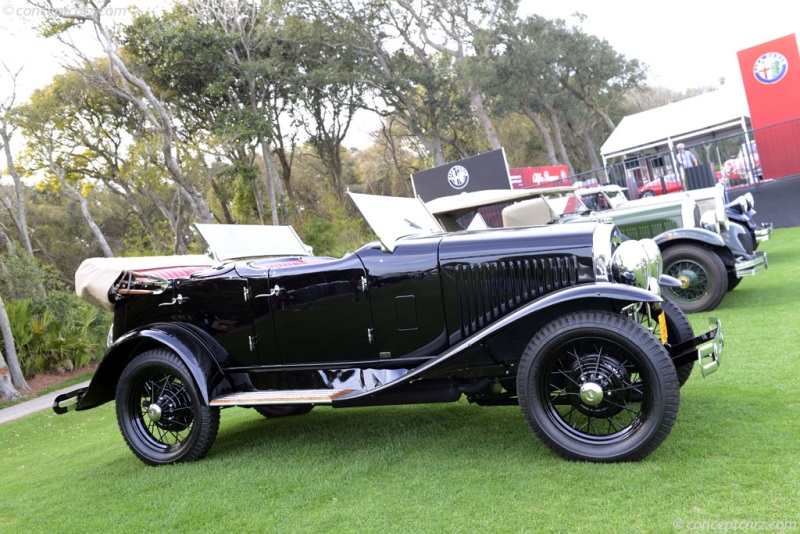
Unique would only begin to describe what would end up being fashioned. Leaning upon the expertise of the coachbuilders LeBaron, Edsel would not be disappointed. The finished product would be a dual-cowl Sport Phaeton that was simple, and yet, very handsome.

Boasting of sweeping fenders, shortened running boards and a metal-covered rear spare the Sport Phaeton creates an illusion of having a lengthened profile. The narrow track and custom radiator, however, would certainly please Edsel's love for the artistry of master coachbuilt chassis.

The coachwork, however, would manifest an aggressive character with its raked windscreen and the lack of embellishment. To top it all off, the open body style immediately caused thoughts to run toward the ultimate luxury cars of the period, cars like Duesenberg and Lincoln. It would seem LeBaron had succeeded in marrying the two worlds together, but it shouldn't be at all surprising when Edsel, himself, had been intimately involved in just about every stage of the car's formulation.

When completed, Edsel would certainly own perhaps the most desirous Model A ever produced. Overflowing with such amenities and elegant appointments as custom-tailored splash aprons, leather, chrome door hinges and swept-back door handles, the dual-cowl Sport Phaeton certainly fit the definition of a one-off design.

Finished in 1930, the Sport Phaeton would remain in Edsel Ford's possession until his passing in 1943. Then, in the 1950s, the car would be sold to Vernon Jarvis. Jarvis was a pioneer in antique cars and had a remarkable collection. Considering Jarvis' extensive collection, it wouldn't be all that incredible that he would store the Sport Phaeton away. However, a dairy barn in Springfield, Illinois would certainly not be most peoples' first choice.

The Sport Phaeton would be all but forgotten, locked away in the dairy barn. In time, the Edsel Sport Phaeton took on something of a mythical status. Documents proved of its existence, but the actual whereabouts left many to ponder the car's fate. Even Ford Motor Company commenced a search, but would come up empty.

Decades would go by, and it seemed certain the Sport Phaeton had befallen upon some unfortunate and calamitous fate. But then, in 2007, some unsuspecting discovers would enter the now derelict barn on the Jarvis property. Low and behold, still there, in somewhat faded glory, was Edsel's Model A Sport Phaeton.

The condition of the car, despite its decades being stored away in a dairy barn, was still surprisingly splendid. In spite of the years, the car would be found, still, in a highly original state with many of its body panels, fenders and mechanical components intact. Upon further inspection, the LeBaron body number, LB-4093, would confirm what everybody was hoping would be the case. Edsel's Sport Phaeton had been found!

Purchased by its current owner, the Sport Phaeton would then undergo restoration, which would be handled by Manns Restoration & Maintenance of Festus, Missouri. When finished, the Model A Sport Phaeton would be of concours quality and would retain all of the unique features that had made the Edsel Sport Phaeton one of a kind.

The Gooding & Company auction in Scottsdale, Arizona in 2013 will mark the car's first appearance since completion of the restoration work and is certain to attract a number of interested buyers just waiting to own this important piece of Ford history. Estimates before the event have the 1930 Ford Model A Sport Phaeton drawing between $325,000 and $400,000.

Sources:
'Lot No. 012: 1930 Ford Model A Sport Phaeton', (http://www.goodingco.com/car/1930-ford-speedster-phaeton). Gooding & Company. http://www.goodingco.com/car/1930-ford-speedster-phaeton. Retrieved 15 January 2013.

'1930 Ford Model A News, Pictures and Information', (http://www.conceptcarz.com/vehicle/z7026/Ford-Model-A.aspx). Conceptcarz.com: From Concept to Production. http://www.conceptcarz.com/vehicle/z7026/Ford-Model-A.aspx. Retrieved 15 January 2013.

Wikipedia contributors, 'Ford Model A (1927–1931)', Wikipedia, The Free Encyclopedia, 23 December 2012, 02:24 UTC, http://en.wikipedia.org/w/index.php?title=Ford_Model_A_(1927%E2%80%931931)&oldid=529381537 accessed 16 January 2013

By Jeremy McMullen
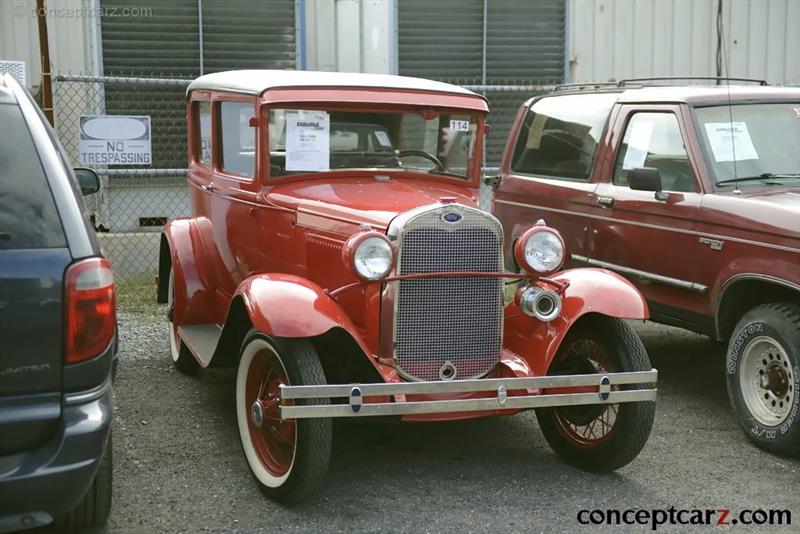
Town Sedan
 
The Model A received a significant facelift in 1930. Wider fenders, a deeper radiator shell and the elimination of the cowl stanchion contributed to its fresh look. Options for the year included an external sun-visor, a rear luggage rack, a rear-view mirror and a spare tire lock.

The Model T Ford put America on the road but had become outdated by 1927 and the Model A was its replacement in 1928.

Prices ranged from US $385 for a roadster to $570 for the top-of-the-line Fordor. The engine was an L-head 4-cylinder with a displacement of 201 cubic-inches. Typical fuel consumption was between 20 and 30 mpg.

This particular automobile is a tribute to a husband and wife performing a total restoration themselves. The car was purchased in 1981 from its original owner's grand-daughter. While the car has just traveled 52,000 miles, it acquired an extensive restoration which included wood replacement and a complete engine re-build. The restoration was completed in 1985. The car is regularly used in car shows and parades and the occasional family wedding.
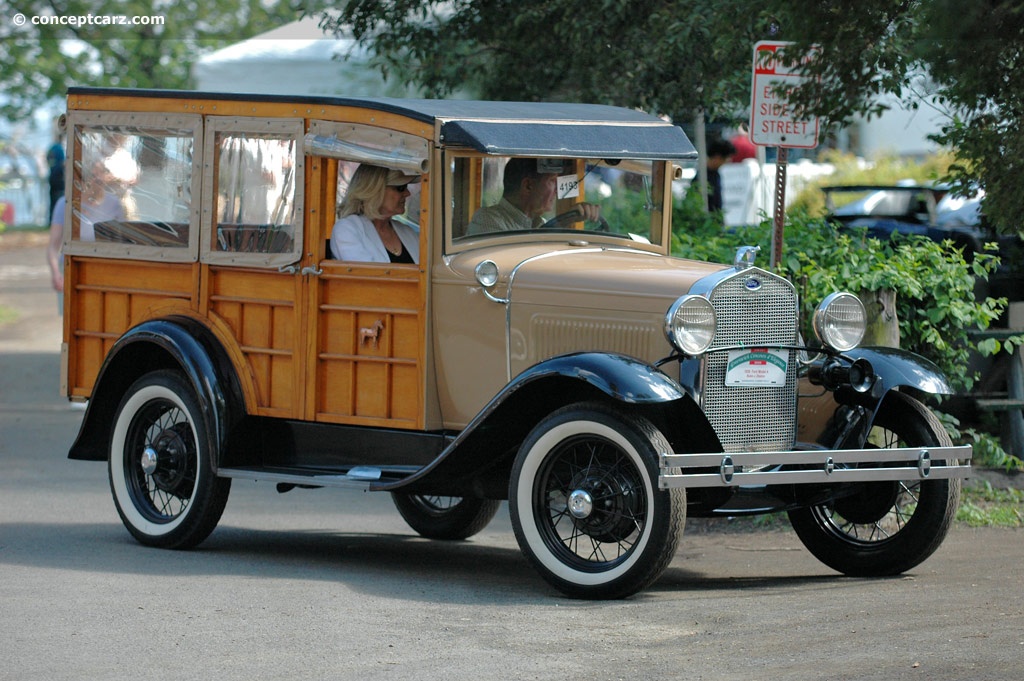
Woody Wagon
 
Ford's first attempt at mass producing a true 'dual purpose' vehicle came in 1929 with the introduction of the Model 'A' Station Wagon. Designated as the type 150-A, the unique design could accommodate up to eight passengers with baggage, or reconfigured to carry cargo by removing the three rear seats.

The wooden bodies for the Station Wagon were assembled at both the Murray body and Baker Raulang Companies from subassemblies supplied by Ford. Finished assemblies were then mated with the chassis on Ford's own production line. Bodies were constructed of hard or soft maple, paneled with birch plywood. Spar varnish was applied to completed bodies to protect the wood.

Exterior color selection on the Wagon was limited to Manila Brown, with the remaining structural metal finished in Black.
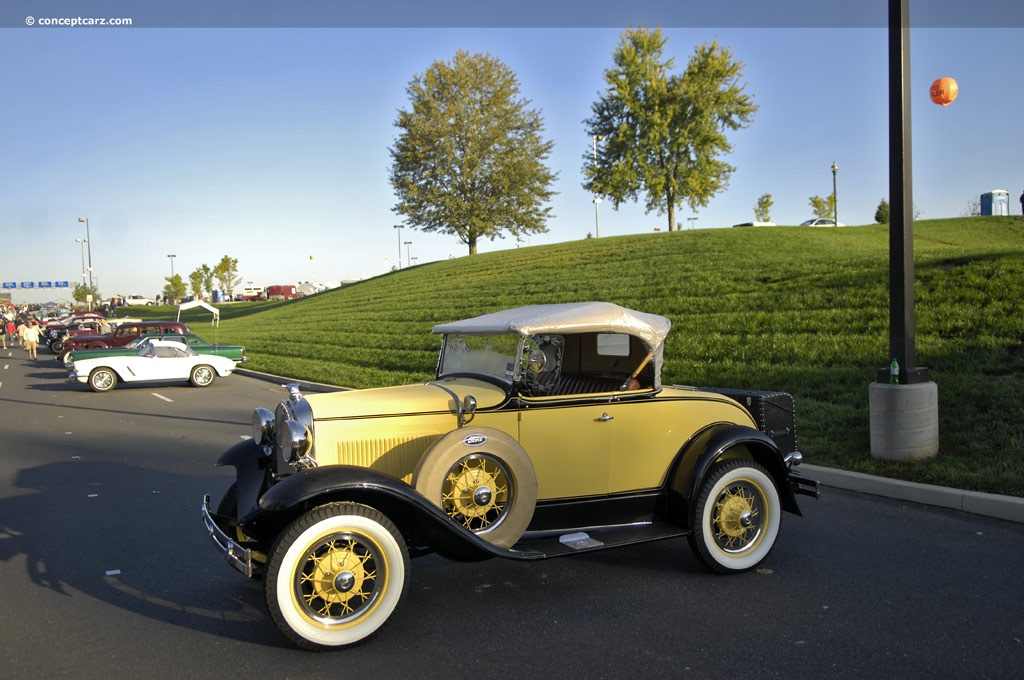
Roadster
Chassis Num: A1862942
 
Sold for $37,400 at 2008 RM Auctions.
This 1930 Ford Model A Deluxe Rumble Seat Roadster is powered by a 200.5 cubic-inch four-cylinder engine that offers 40 horsepower. There is a three-speed manual gearbox and four-wheel mechanical drum brakes.

The four-cylinder engine of the Model A provided twice the power of the previous design and was fitted with a modern electric starter. The Model A incorporated several significant Lincoln styling elements, including a higher beltline and an attractively rounded grille. A wider selection of exterior colors were available. It retained the low price tag, now selling for a base of $385. By 1932, 4.85 million Model As of all body style had been built.

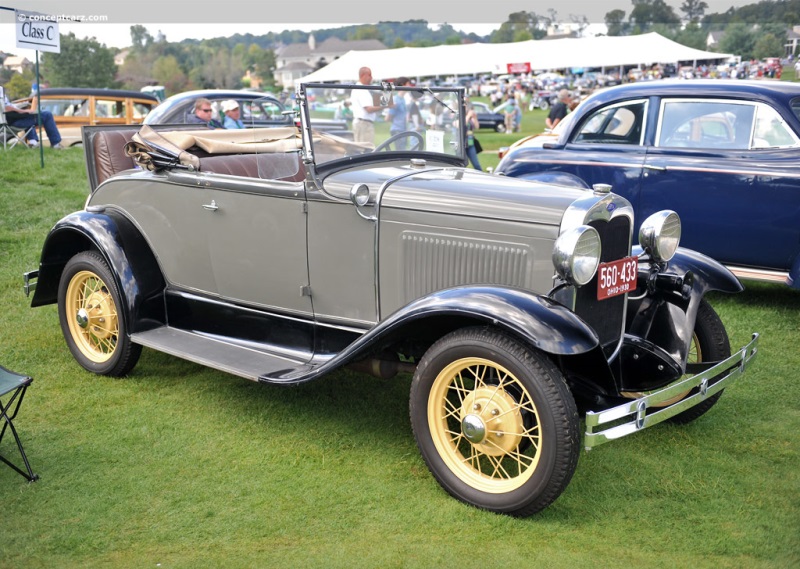
This car was restored during the 1990s and still shows well in modern times. It has a tan canvas top, brown upholstery, blue exterior, and black floor mats. There are wide whitewall tires with cream-colored wire wheels with chrome hubcaps. There is a radiator-mounted coolant temperature meter, dual side-mounted spare tires with tan covers, dual cowl lights, dual wind wings, side-view mirror, and a chrome-plated grille guard. All of these items were optional equipment.

In 2008 this car was brought to the 2nd Annual Vintage Motor Cars of Hershey presented by RM Auctions where it was estimated to sell for $30,000 - $40,000. It was offered without reserve. The estimated value of the vehicle was proven accurate when the lot was sold for $37,400 including buyer's premium.

By Daniel Vaughan | Oct 2008
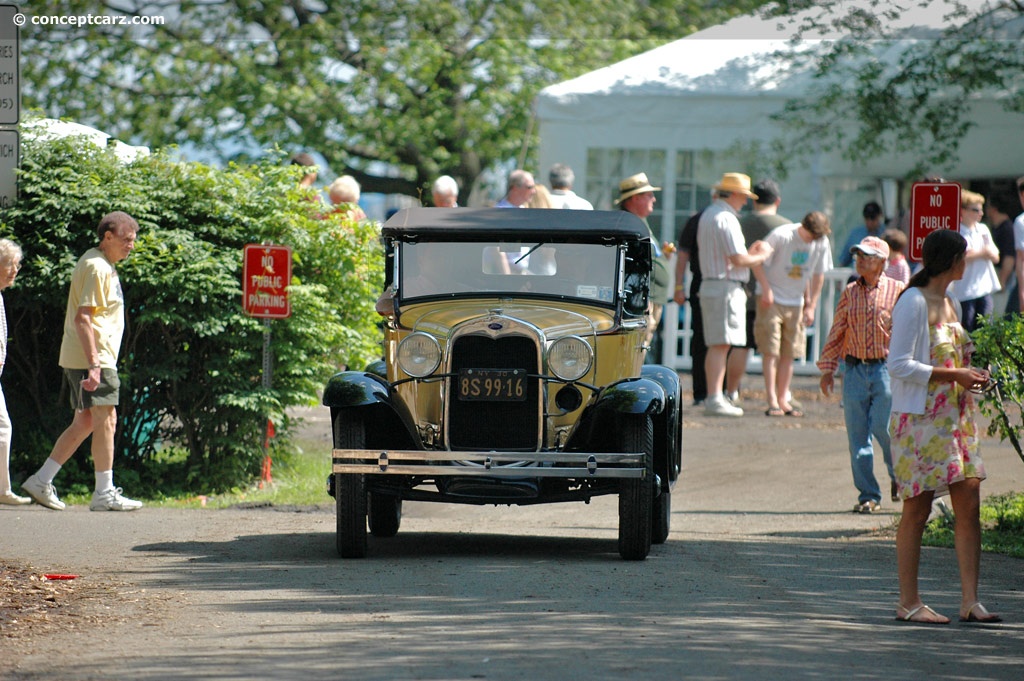
Roadster
 
If the Model T was 'the car that put America on wheels' the Model A, introduced in December 1927, was the car that helped Ford Motor Company remain competitive in its segment of the automobile market.

For 1930, the Model A received a bit of face lift. There was a new radiator shell, wider fenders and larger 4.75 inch wide tires on smaller wheels (19 inch from 21 inch) reduced the car's overall height. IN addition, chrome plating and stainless steel replaced the nickel used on the 1928-29 models.

The Model A was powered by Ford's four-cylinder motor that developed 40 horsepower. In all, 17 body styles were available in 1930, including this sporty Standard Roadster, which sold for $435 without options.
The name Model A was first used by Ford in 1903 and also known as the Fordmobile. This was the first vehicle produced by the Ford Motor Company and its first owner was Dr. Ernst Pfenning of Chicago, Illinois who purchased the Model A on July 23, 1903. Production of the first generation Model A lasted from 1903 through 1905 with 1750 examples being produced.

Automobile production was new and experiments with design, techniques, and technology were still being experimented with. Many early producers of the automobile had been in either the coachbuilding business or the bicycle business. Upon the invention of the automobile, they switched to the production of horseless carriages.

Henry Ford had $28,000 in investment capital to begin his new business. Upon completion of his first motorcar, he had spent all but $223.65. The Model A's were available as either a two-seater runabout or a four-seater tonneau. A flat-2 engine was horizontally-mounted midship and capable of producing 8 horsepower. A three-speed planetary transmission was matted to the engine. Dimensions and weight varied but the advertised top speed of the vehicle was about 45 miles per hour. The base price was $750 and was available with options such as a rear seat for $100. A rubber roof would set the buyer back an additional $30 while the leather roof was $50.

The Model A was replaced by a sequence of 'letter cars' until Ford produced the perfect combination of accordability and reliability with the Model T. It was mass produced and by 1914 the adaptation of the assembly line streamlined the process even further. By the 1920s, Ford had mobilized the United States with their customers wanting more and willing to pay more for it. Chevrolet's were becoming popular because they were similar to the Ford but offered a few extra amenities at a slightly higher but still reasonable price. Near the close of the 1920's and after sales began to slip, Ford realized that a replacement was needed.

So as production came to a close for the Model T, Henry Ford halted all production for six months to retool the equipment and prepare for the production of the Model A. The second generation of the Ford Model A began on October 20th, 1927. Sale of the Model A began on December 2nd, 1927 and was offered in four colors. The Model had been available in the United States only in black because it dried the fastest.

The public eagerly awaited the sale of the Model T's replacement and were not disappointed. It was a stylish and elegant vehicle, which had been designed by Henry Ford's son, Edsel. In comparison to its predecessor, it was more sophisticated and complex.

The cost of the second generation Model A, produced 24 years after the original Model A was sold for $365 less, with price ranging from $385 through $570. The car was powered by an L-head 4-cylinder engine with just over 200 cubic-inches in displacement. A three-speed sliding gear transmission with 1 reverse speed was used. Top speed was achieved a little over sixty-miles per hour with the average fuel mileage being rather exceptional at over 40 MPG.

Just like the Model T, the Model A was available in multiple configurations such as the top of the line Fordor in either 2 or 3 window, Victoria, Station Wagon, Truck, Town Car, Convertible Cabriolet, Phaeton, Business Coupe, Sport Coupe, Roadster Coupe, and Coupe to name a few.

During the production lifespan of the Model A, lasting until August 31, 1931, Ford produced 4,320,446 Model A's. It was replaced by the Model B.

By Daniel Vaughan | Mar 2006
For more information and related vehicles, click here

Edsel Ford's Speedster Stars at 'The Amelia'
Edsel Ford's 'continental car', a custom boattail speedster, will take its rightful place in the Sports Car Class of the 18th annual Amelia Island Concours d'Elegance. In the shape of Edsel's seminal speedster is the genesis of Ford's legendary design department. Edsel Ford was hardly 'a chip off the old block'. The acorn fell well away from the mighty oak that was Henry Ford, founder of the Ford Motor Company. Edsel was not just the President of Ford, he was a car guy to his core. His ta...[Read more...]
Classic Motorcar Auctions' Grande Salon Event Tops $1.7 Million
Classic Motorcar Auctions LLC announces total sales for their 3rd annual Grande Salon Auction reached $1.7 million, including buyer's premium. The two-day auction, which was held Sept. 15-16, 2012 during the Glenmoor Gathering event at the historic Glenmoor Country Club in Canton, Ohio, had a 51% sell-through rate. The auction's high sale was a beautifully restored 1937 Cord 812 Supercharged Phaeton at $150,000, followed by the 1912 Ford Model T prototype six cylinder Speedster once belong...[Read more...]
Rolex Monterey Motorsports Reunion : Cobras Take It To The Limit
 Today was the day everyone was waiting for, or at least the 30 or so thousand people flocking to the Rolex Monterey Motorsports Reunion were waiting for it: the chance to see 45 competition Shelby Cobras charging around California's famously challenging 2.238-mile road course known as Mazda Raceway Laguna Seca. The Cobras are part of the Reunion's celebration of the Shelby Cobra's 50thAnniversary, and besides those signed up for racing, there were hundreds more in the paddock, surrounding corr...[Read more...]
Four more legends join Gooding & Company's 2012 Pebble Beach Auctions, its greatest collection of automobiles ever assembled
Gooding & Company, the official auction house of the Pebble Beach Concours d'Elegance acclaimed for selling the world's most significant and valuable collector cars, is thrilled to present four automotive icons at its Pebble Beach Auctions on August 18 & 19: the Clark Gable 1935 Duesenberg Model JN Convertible Coupe; the 'Green Hornet,' a 1931 Bentley 4 1/2 Litre SC 'Blower' Sports 2/3 Seater Boattail; the 1957 Ferrari 250 GT LWB California Spider Prototype and a 1932 Bugatti Type 55 Cabriolet. ...[Read more...]
Classic Motorcar Holds Grande Salon Auction During Glenmoor Gathering
1912 Edsel Ford Model T Six Cylinder Speedster to Cross the Block CANTON, Ohio - Classic Motorcar Auctions LLC will hold their 3rd annual Grande Salon Auction Sept. 15-16, 2012 during the Glenmoor Gathering event at the historic Glenmoor Country Club in Canton, Ohio. The Grande Salon Auction will feature more than 150 antique, classic and sports cars as well as various automotive memorabilia up for bid. Vehicles will be available for preview on Friday, Sept. 14 from 1-8 p.m. The a...[Read more...]

Arrow Right 1930 Ford models
Ford Model A Speedster
Ford Sprint Car Special
Ford Tudor

Similar Automakers
CadillacChevrolet
ChryslerDodge
GMCHummer
JeepLincoln
MercuryPontiac
Saturn
Similarly Priced Vehicles from 1930
Ford Tudor ($495-$495)
American Austin Roadster ($445-$550)
Essex Challenger Six Coupe ($650-$685)
Vauxhall Hurlingham ($650-$650)
American Austin Coupe ($465-$550)

Average Auction Sale: $22,321

 
Ford: 1920-1930
Similar Automakers
Ford History
Other models by Ford
Manufacturer Website

Related Articles and Event Coverage
Gooding and Company - The Scottsdale Auction
Mecum - Monterey, CA
RM Auctions - Hershey
Glenmoor Gathering of Significant Automobiles
AACA
RM Auctions - Vintage Motor Cars of Hershey
Greenwich Concours d'Elegance : American Car Display
Eastern Division AACA National Fall Meet
Vintage Motor Cars of Hershey by RM Auctions
Kruse International at Hershey, PA
Walnut Street Invitational Car Show in Shadyside
Ault Park Concours d'Elegance
2006 RM Auctions at Meadow Brook
2006 Walnut Street Invitational Car Show in Shadyside
2006 Philadelphia International Auto Show
2006 Barrett-Jackson - Scottsdale 2006
2005 Potts Auction at Hilton Head
2005 PVGP Car Cruise at the Waterfront
2005 Crown Royal Invitational Car Show on Walnut Street
2005 Car Cruise - Pittsburgh PA
AACA Antique Auto Museum at Hershey
2003 Carlisle Collector Car Swap

Ford
Monthly Sales FiguresVolume
April 2013204,969 
March 2013229,335 
February 2013190,939 
January 2013162,310 
December 2012206,838 
November 2012171,941 
October 2012163,302 
September 2012168,174 
August 2012189,108 
July 2012166,991 
June 2012200,215 
May 2012208,993 
(More Details)

 
Anglia
Bronco
Capri
Comète
Cortina
Country Squire
Crestline Sunliner
Crown Victoria
Custom Deluxe
Customline
DeLuxe
E-Series
Edge
Escape
Escort
Expedition
Explorer
F-Series
Fairlane
Fairmont
Falcon
Fiesta
Flex
Focus
Focus ST500
Freestyle / Taurus X
Fusion
Galaxie
Granada
GT 350 Hertz
GT40
Mainline
Maverick
Mercury Speedster
Model 18
Model 40
Model A
Model B
Model F
Model N
Model R
Model S
Model T
Mondeo
Mustang
Pinto
Probe
Ranchero
Ranger
RS200
Shelby Cobra
Streetka
Taurus
Thunderbird
Torino
Transit Connect

Image Left 1929 Model AImage Left 1929 Model A SpecialImage Left 1929 Model A Station WagonImage Left 1929 Model AA1931 Model A Image Right
© 1998-2012. All rights reserved. The material may not be published, broadcast, rewritten, or redistributed.