1957 Ferrari 500 TRC news, pictures, and information | ||
| Tweet | ||
![]() | ![]() | ![]() | Spider Designer: Scaglietti Chassis Num: 0670 MDTR Engine Num: 0670 MDTR |
| Sold for $2,282,500 at 2006 RM Auctions. Sold for $3,993,976 (2,800,000) at 2011 RM Auctions. | |||
Chassis: 0670MDTR
After a disagreement in 1940, Enzo Ferrari left Alfa Romeo. Having sold the rights of his Scuderia Ferrari team to Alfa, Enzo was unable to place his name on a car for four years. With engineers Massimino and Bellentani, Ferrari started a company called Auto Avio Construzione. They produced a model called the 815, of which only two were ever produced. They both were powered by a 1.5-liter eight-cylinder engine and were entered in the 1950 Mille Miglia. One of the cars had been sold to Alberto Ascari and the other to Marquesa Lottario di Rangoni. Both cars performed exceptionally well at the Mille Miglia before being forced to retire prematurely.World War II slowed the racing efforts for Enzo Ferrari; in 1945 he hired Gioacchino Colombo, a brilliant engineer who Ferrari had worked with at Alfa. Colombo began working on a 1.5-liter twelve-cylinder engine which proved difficult due to a shortage of materials in the post-WWII era. Despite this, the engine was ready for testing by 1946. The resulting vehicles wore the name Ferrari.
In 1947 Aurelio Lambredi was brought in to assist Columbo with engine building. Lambredi soon became convinced that a large engine that was naturally aspirated would have better fuel economy and provide more power. Colombo was of the belief that smaller engine compiled with a supercharger would produce the better results. Ferrari tested Lambredi's idea and proved it to be successful. Lambredi was promoted to chief design engineer and Colombo returned to Alfa Romeo.
Ever since the inception of the Ferrari cars, they proved to be highly competitive and quickly amassed many victories. To improve cash-flow, Ferrari eventually began building road-going cars. The designs and mechanics of many of his vehicles were unmatched, produced by some of the greatest coachbuilders and engineers of all time.
Aurelio Lampredi left Ferrari in 1955 and Vittorio Jano was brought in to take his place. Assisting him was Alberto Massimino, Luigi Bellentani and Adrea Fraschetti. They began working on a two-liter sports car which was dubbed the 500 TR. The 'TR' stood for 'Testa Rossa' mean 'red head'. Since the cylinder heads of the engine were read, the name was appropriate. The four-cylinder engine type 500 TR was debuted in 1956 and became replacements for the 500 Mondial. The first batch of cars were bodied by Carrozzeria Touring. This would be the last time Touring was commissioned by Ferrari to build bodies for his cars. Scaglietti and Pinin Farina were later tasked with providing bodies; in total, 17 examples were created. They carried chassis numbers designated Type 518 and engines Type 131.
The cars were successfully campaigned by privateers around the world. New regulations by the FIA meant the racers were soon obsolete. The Appendix C for modified sports cars read that changes were to be implemented for the 1957 season. The new rules stated that the windscreen had to be symmetrical over the axis of the car, a soft-top was required, and the fuel capacity was to be 120 liters. The width was set to 100 centimeters while the height had to be at least 15 centimeters.
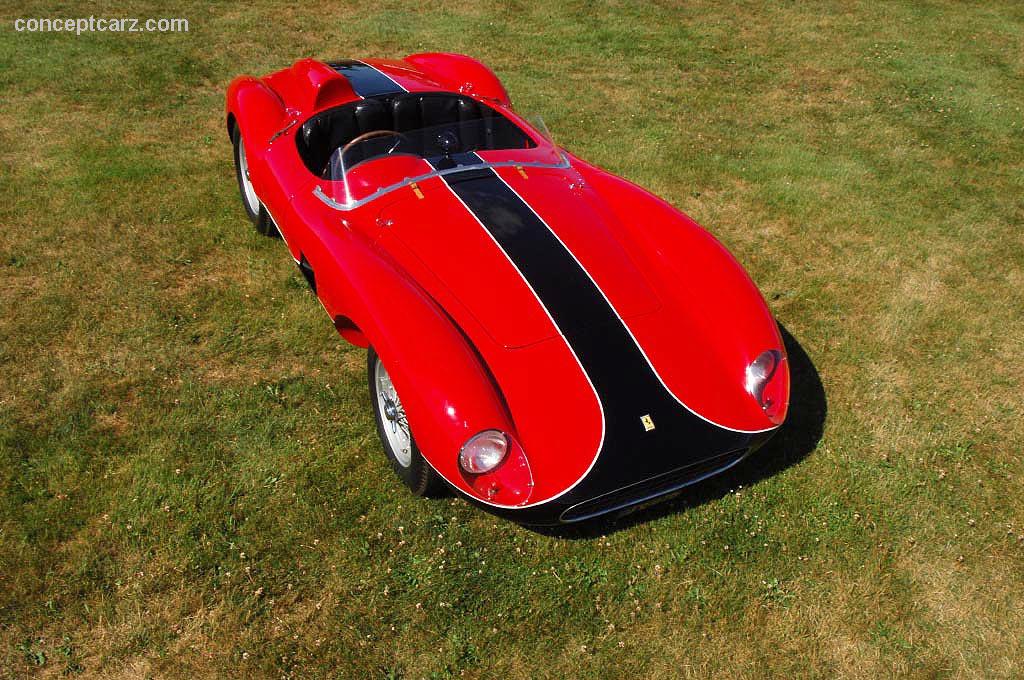
Ferrari set to work in making his cars legal for competition. After many late nights, the 500 TRC was introduced and was in compliance with the new FIA regulations. The 'C' on the TRC represented the compliance of the Appendix C regulations.
The gearbox, transmission, and engine were identical to the 500 TR. Most of the changes had been done to the bodies, though the De Dion rear suspension was replaced with a rigid axle and coil springs. The chassis had been reworked, resulting in increased rigidity. The engine had been lowered by moving the tubular frame members further apart. The 500 TRC were given chassis Type 518 C and engine Type 131 C.
Scaglietti was commissioned to produce bodies for the vehicles. In total, 19 were produced with most receiving two-tone paint jobs instead of the typical Ferrari red. There were actually 17 500 TRC's and two 625 TRCs. After just one year, the 500 TRC's were replaced by the new 250 Test Rossa which were powered by three-liter twelve cylinder engines.
The 500 TRC cars proved their abilities as a four-cylinder machine and often challenged competitors with larger, more powerful engines. This was also be the final time Ferrari would outfit their sports cars with a four-cylinder engine.
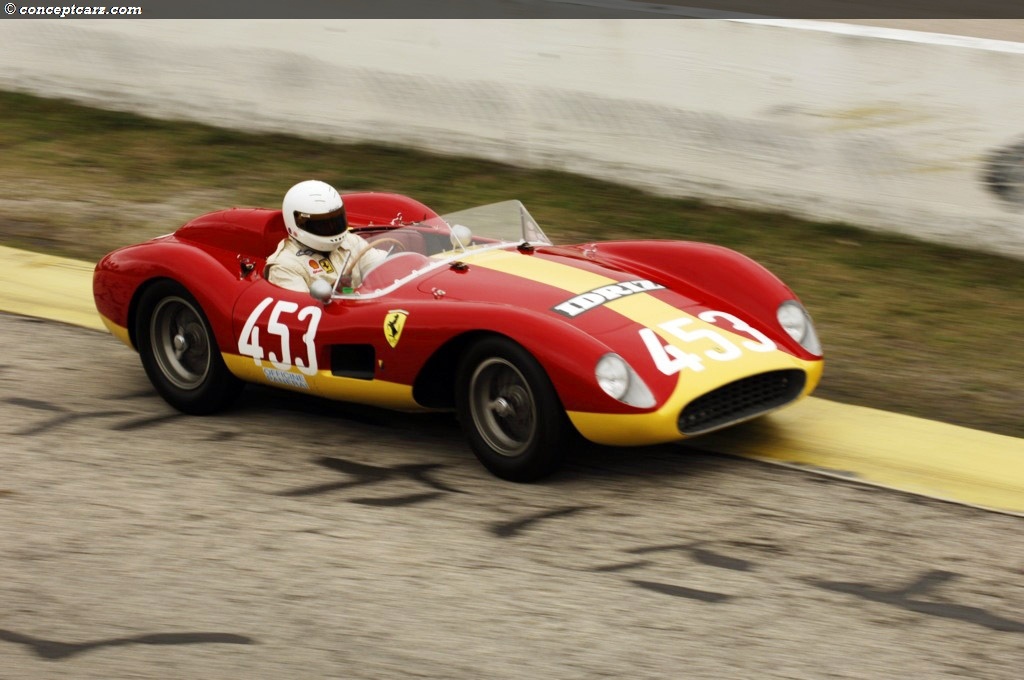
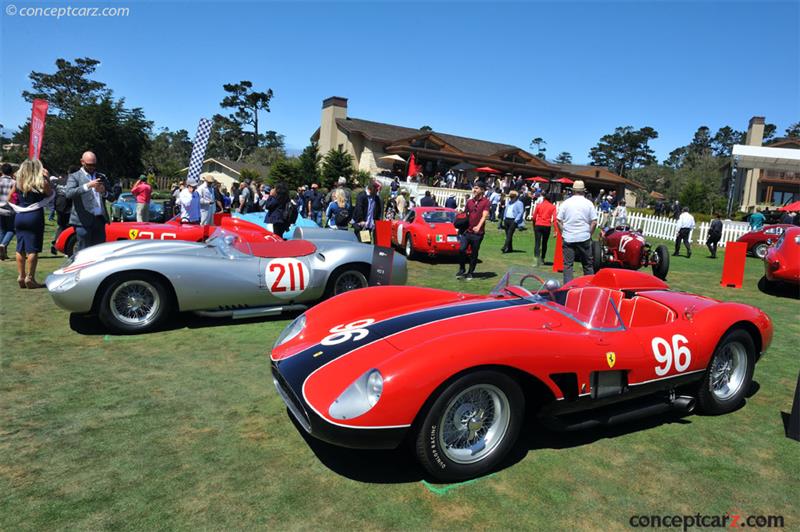
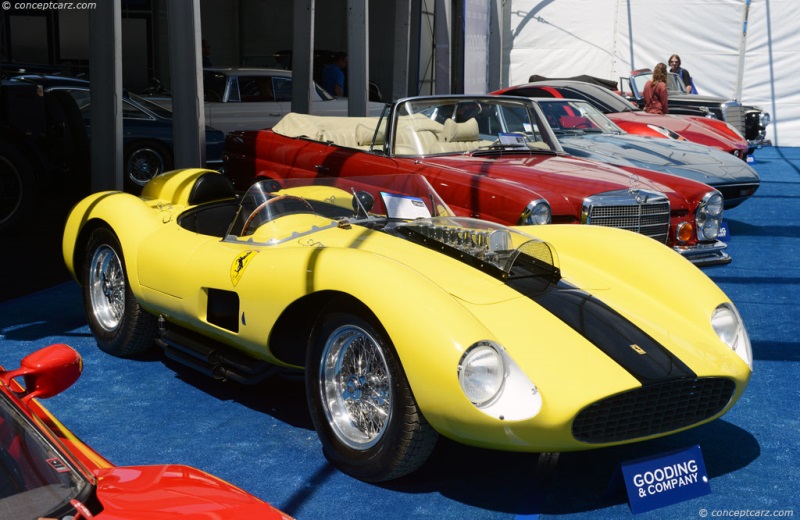
Ferrari 500 TRC with chassis number 0670MDTR has coachwork by Scaglietti and is powered by a four-cylinder double overhead cam engine. Dual Weber 40 DCO/A3 twin choke downdraft carburetors, a 9.75:1 compression, and roller tappet followers helps the 121 cubic-inch engine produce 190 horsepower. A four-speed all-synchromesh manual gearbox sends power to the rear wheels. The body is suspended in place by an independent front suspension with unequal length A-arms and coil springs. The rear suspension is comprised of a live rear axle, coil springs and single trailing arms. Braking power is by hydraulic four-wheel drum brakes.
It is the 6th car produced in the series of 19. It was sold on April 4th, 1957 to Bernardo Cammarata, the first of five owners (to date). It was raced on May 11th, 1958 at the Targa Florio by Cammarata and co-driver Domenico Tramontana. It finished seventh in its class and tenth overall. A year later it returned to Targa Florio where it finished 2nd in class and eighth overall. A third visit in 1962 to Targa Florio resulted in a DNS.
In June of 1963 it was raced at Monte Pellegrino Hillclimb where it finished third overall. A second visit in 1964 earned it a first-place overall and first in class.
Its fourth visit to Targa Florio in 1965, this time driven by Francesco Tagliavia and co-driver Silvestre Semilia, resulted in a DNF. Tagliavia raced the car in August of 1965 at the Trapani-Monte Erice Hillclimb where he finished seventh overall and second in class.
At the close of May in 1966, Francesco Tagliavia and co-driver DiLiberto raced the 500 TRC to a fourth-in-class finish at the Trofeo Automobilistico Internazional.
The car was later sold to its second owner, Cammarata. In 1966, Giulio Dubbini became the cars third owner and raced the car over twenty years in historic races. In 1998 it was sold to Corrado Cupellini who campaigned the car in the European Shell Ferrari Maserati Challenge. It was sold in 2003. The car underwent a restoration.
By Daniel Vaughan | Jul 2007
The 500 TR, meaning Testa Rossa after their red-topped cylinder heads, was introduced in 1956 as a replacement for the 500 Mondial. These machines were designed and built for customers with only a few being entered by the factory in races.
As was the case with many early Ferrari's, the body work was handled by custom coachbuilders. Three examples were bodied by Touring, their designs being easily distinquished by their large front wheel arches.
Gioacchino Colombo started out being the primary builder of Ferrari's engines in the late in 1940's and a major contributor to the success of Ferrari. Aurelio Lambredi became his assistant in 1947. Lambredi soon became convinced that a large engine that was naturally aspirated would have better fuel economy and provide more power. Colombo was of the belief that smaller engine compiled with a supercharger would produce the better results. Ferrari tested Lambredi's idea and proved it to be successful. Lambredi was promoted to chief design engineer and Colombo returned to Alfa Romeo. The Lambredi engines were used in the ladder part of the 1950's.
Ferrari's V-12 engines had dominated the Formula 2 class in 1949. Enzo also realised the benefits of using a smaller engine, such as less fuel consumption and a decrease in weight. He instructed Lampredi to design a four cylinder engine that could potentially replace the Colombo designed V12. This project was given a low priority until the regulations for the World Championship changes switched to those of Formula 2.
In 1952 a Lampredi developed 2-liter, alloy engine was introduced and fitted in a 500 F2. The vehicle driven by Ascari captured the World Championship and again the following year. Lampredi also developed a 2.5-liter version of the four-cylinder engine.
The body of the 500 TR was designed by Scaglietti and the engine was a 2.5-liter Lampredi engine. In 1956 it was debuted at the Monza Supercortemagiore where it was driven by Mike Hawthorn and Peter Collins. When the checkered flag dropped, it the 500 TR that had made it to the finish line first.
The design and capability of the 2.5-liter engine were further explored with continual improvements that increased the cars potential. It was to be entered in Le Mans but rulers were changed and Ferrari was forced to comply with new 'Appendix C' regulations for sports cars. The rules included a windshield, and a passenger door. In 1957, Ferrari complied by introducing the 500 TRC, a 500 TR with a slightly modified body. Only 19 of the 500 TRC were ever created.
The 500 TRC was first raced at Avandaro, Mexico where it dominated the track and easily won first place. That race was followed with eight other victories including Laguna Seca. The four cylinder engine was capable of producing 190 horsepower and was capable of carrying the 1500 pound TRC to a top speed of just over 160 mph.
This car proved its abilities as a four-cylinder machine and often challenged competitors with larger, more powerful engines. Its agility and durability were legendary and with a limited number of the TRC models produced, their exclusivity is forever guaranteed.
By Daniel Vaughan | Aug 2006
As was the case with many early Ferrari's, the body work was handled by custom coachbuilders. Three examples were bodied by Touring, their designs being easily distinquished by their large front wheel arches.
Gioacchino Colombo started out being the primary builder of Ferrari's engines in the late in 1940's and a major contributor to the success of Ferrari. Aurelio Lambredi became his assistant in 1947. Lambredi soon became convinced that a large engine that was naturally aspirated would have better fuel economy and provide more power. Colombo was of the belief that smaller engine compiled with a supercharger would produce the better results. Ferrari tested Lambredi's idea and proved it to be successful. Lambredi was promoted to chief design engineer and Colombo returned to Alfa Romeo. The Lambredi engines were used in the ladder part of the 1950's.
Ferrari's V-12 engines had dominated the Formula 2 class in 1949. Enzo also realised the benefits of using a smaller engine, such as less fuel consumption and a decrease in weight. He instructed Lampredi to design a four cylinder engine that could potentially replace the Colombo designed V12. This project was given a low priority until the regulations for the World Championship changes switched to those of Formula 2.
In 1952 a Lampredi developed 2-liter, alloy engine was introduced and fitted in a 500 F2. The vehicle driven by Ascari captured the World Championship and again the following year. Lampredi also developed a 2.5-liter version of the four-cylinder engine.
The body of the 500 TR was designed by Scaglietti and the engine was a 2.5-liter Lampredi engine. In 1956 it was debuted at the Monza Supercortemagiore where it was driven by Mike Hawthorn and Peter Collins. When the checkered flag dropped, it the 500 TR that had made it to the finish line first.
The design and capability of the 2.5-liter engine were further explored with continual improvements that increased the cars potential. It was to be entered in Le Mans but rulers were changed and Ferrari was forced to comply with new 'Appendix C' regulations for sports cars. The rules included a windshield, and a passenger door. In 1957, Ferrari complied by introducing the 500 TRC, a 500 TR with a slightly modified body. Only 19 of the 500 TRC were ever created.
The 500 TRC was first raced at Avandaro, Mexico where it dominated the track and easily won first place. That race was followed with eight other victories including Laguna Seca. The four cylinder engine was capable of producing 190 horsepower and was capable of carrying the 1500 pound TRC to a top speed of just over 160 mph.
This car proved its abilities as a four-cylinder machine and often challenged competitors with larger, more powerful engines. Its agility and durability were legendary and with a limited number of the TRC models produced, their exclusivity is forever guaranteed.
By Daniel Vaughan | Aug 2006
![]() | ![]() | ![]() | Spider Designer: Scaglietti Chassis Num: 0670 MDTR Engine Num: 0670 MDTR |
| Sold for $2,282,500 at 2006 RM Auctions. Sold for $3,993,976 (2,800,000) at 2011 RM Auctions. | |||
In 2008, this vehicle returned to Pebble Beach, CA - this time up for sale at the Gooding & Company Auction. This is the only factory-certified Ferrari TRC in existence and is a remarkable automobile. This time, it failed to find an interested buyer willing to satisfy its reserve. The lot was left unsold.
By Daniel Vaughan | Mar 2009
![]() | ![]() | ![]() | Spider Designer: Scaglietti Chassis Num: 0702MDTR |
| RM Auctions Announces Consignment of Ex-Works Ferrari 340/375 MM For Its Concorso D'Eleganza Villa D'Este Auction | |
![]() | • Wonderful and historically significant Ferrari 340/375 MM to be offered at RM's exclusive evening sale on the banks of Lake Como, Italy, 25th May • Chassis 0320AM boasts unsurpassed provenance with Le Mans history and drivers, including world champions Hawthorn, Farina, and Ascari • Winner of the Pescara 12 Hours, piloted by Hawthorn and Maglioli • The car established a never broken, record setting pace in the Carrera Panamericana in the hands of Maglioli • Chassis 0320AM on preview at ...[Read more...] |
| 1955 Tourist Trophy: One Last Victory | |
![]() | The tragedy at Le Mans on the 11th of June, 1955 would dramatically affect motor racing. For one of the manufacturers involved, Mercedes-Benz, it would be a confirmation of what it had already come to believe. Toward the end of the 1955 season it was known Mercedes-Benz would withdraw from all motor racing having achieved just about everything possible in Formula One and sportscars. However, on the 18th of September, there would be one last race in which the mighty Silver Arrows would be gunning...[Read more...] |
| Gooding & Company's Annual Pebble Beach Auctions | |
![]() | Gooding & Company, the acclaimed auction house celebrated for selling the world's most significant and valuable collector cars, will host its annual Pebble Beach Auctions on August 18th & 19th in association with the prestigious Pebble Beach Concours d'Elegance. Once again, Gooding & Company is poised to present an outstanding array of blue chip and concours-quality collector cars on its record-setting stage, including the elegant 1955 Maserati A6G/54 Frua Berlinetta owned by Grammy Award-winni...[Read more...] |
| 1956 24 Hours of Le Mans: The Rise of Two Counts | |
![]() | The 1955 24 Hours of Le Mans would end up being the darkest day in all of motorsport when Pierre Levegh launched off the back of Lance Macklin's Austin-Healey and crashed into a barrier sending large portions of the car flying through the air acting like guillotines to the record crowd crammed along the main straight. It would be estimated that more than eighty would lose their life as a result, scores more would be severely injured. Yet, despite the graphic horror of the event the race would co...[Read more...] |
| 1958 Moroccan Grand Prix: British All the Way | |
![]() | After years of frustration, and well past his life-expectancy, Mike Hawthorn would be on the verge of his first World Championship. This was more than likely Hawthorn's last and best hope at a World Championship title. Just one last race, and a fellow Brit, would separate Hawthorn from his World Championship. Emotionally, Hawthorn was done. The last few seasons had seen Hawthorn fail to experience anywhere near the level of success he had even in his rookie year of 1952. In 1952, with an unde...[Read more...] |
| View more Targa Florio vehicles |
| View more Mille Miglia vehicles |
| Similar Vehicles | |
![]() | 1962 Kurtis Aguila Racer |
| Similar Automakers | |
| Aston Martin | Bentley |
| Bugatti | Devon |
| GTA | Koenigsegg |
| Lamborghini | Lotus |
| Maserati | Maybach |
| McLaren | Porsche |
| Rolls-Royce | Spyker |
| Tesla | |
| Ferrari: 1951-1960 |
| Similar Automakers |
| Other models by Ferrari |
© 1998-2012. All rights reserved. The material may not be published, broadcast, rewritten, or redistributed.


1957