1960 250 GT SWB | 1962 250 GT SWB ![]() |
Image credits: © Ferrari.
1961 Ferrari 250 GT SWB Competition news, pictures, and information | ||
| Tweet | ||
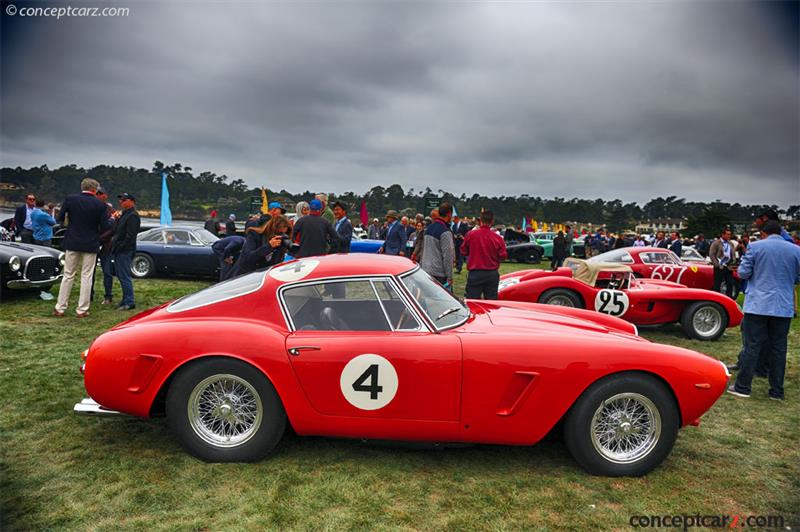
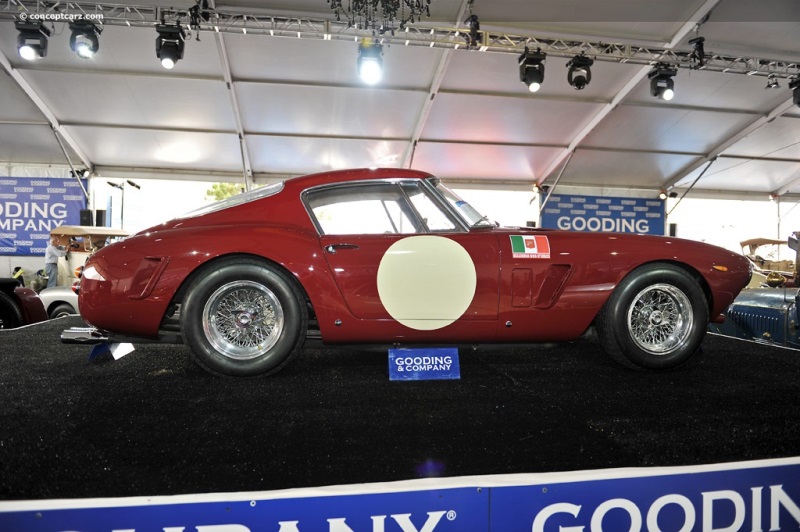
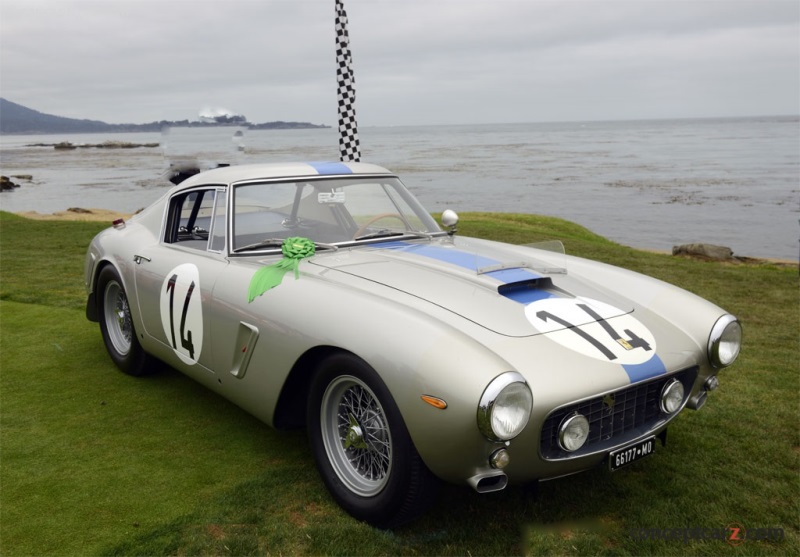
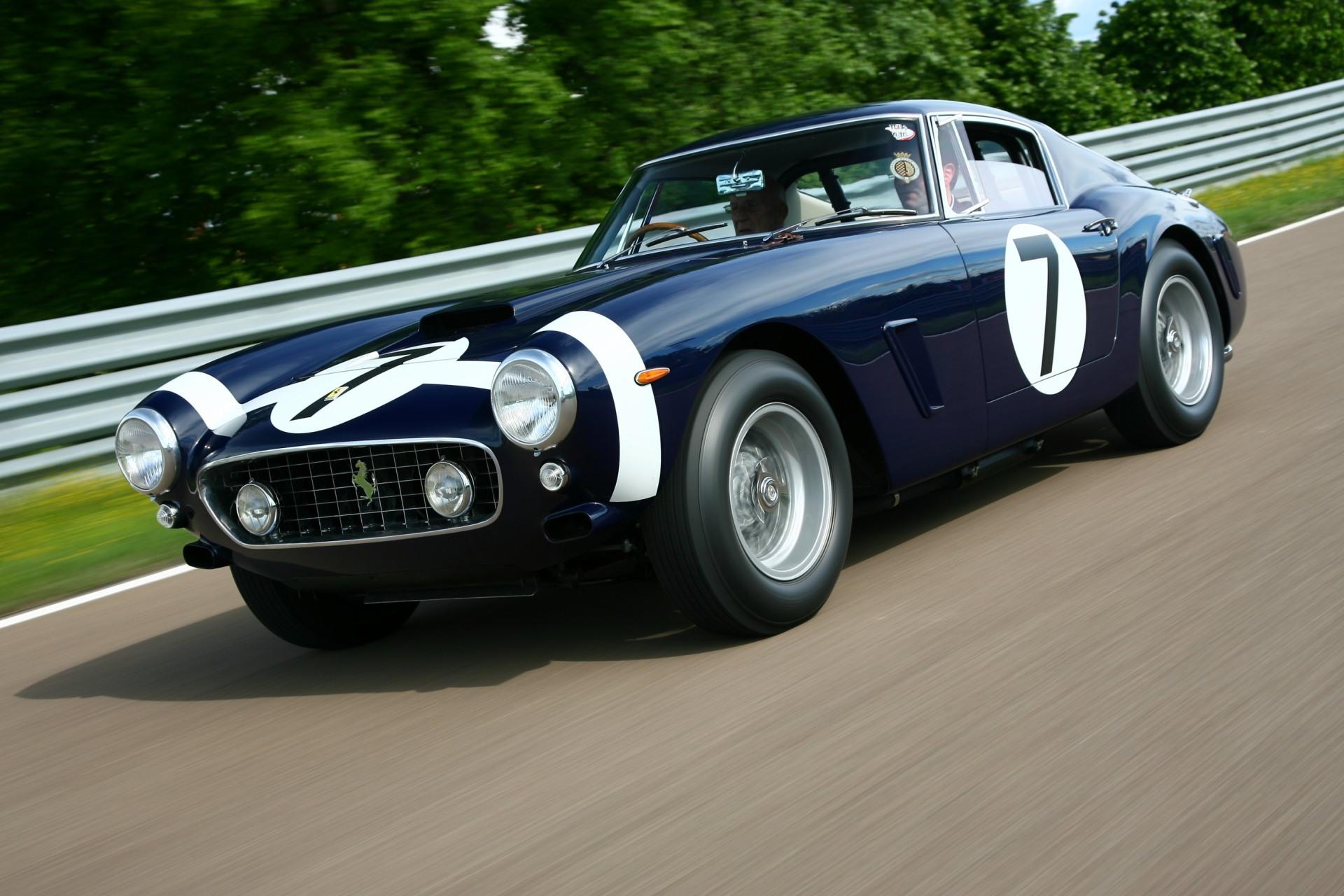
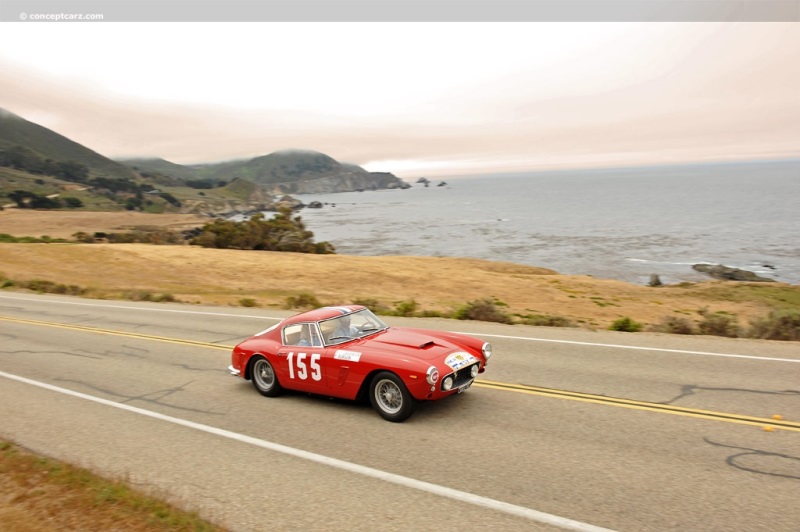
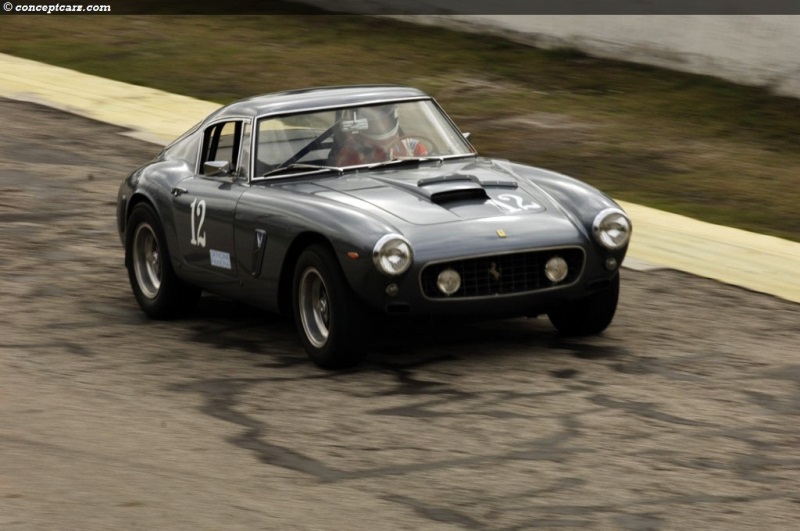
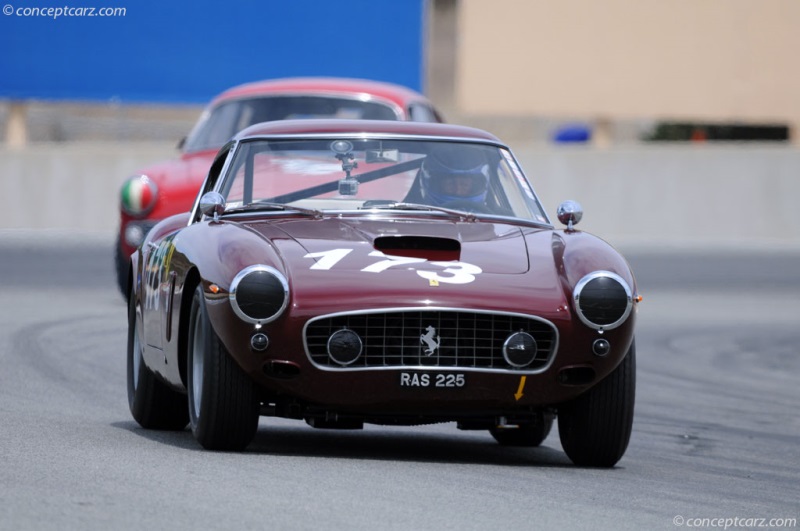
The 250 GT SWB was designed by Pininfarina and built by Scaglietti. It was designed for the race track and the road. This two-seater had an aggressive stance and a wheel base 8 inches shorter than the LWB edition. The street versions were called 'Lusso' (luxury) and contained a Colombo V-12 producing as much as 280 BHP and propelled the vehicle to a top speed of about 150 mph. Modifications had been made to the engine to make it easier to work on during competition events. For example the spark plugs were moved to make them more accessible. The competition models had their body entirely made of the weight-saving metal aluminum. Also, plastic side windows were used to help keep the weight to a minimum. By shortening the wheel base, the chassis became more solid and the vehicle more agile.
The Berlinetta (litle coupe) Lusso (luxury), more commonly known as the 250 GT/L was also designed by Pininfarina and debuted at the 1962 Paris show.
There were vents located under the front head lights. These were used to cool the disc brakes. There were also vents behind each wheel which served the same purpose.
The Berlinetta (litle coupe) Lusso (luxury), more commonly known as the 250 GT/L was also designed by Pininfarina and debuted at the 1962 Paris show.
There were vents located under the front head lights. These were used to cool the disc brakes. There were also vents behind each wheel which served the same purpose.
![]() | ![]() | ![]() | Coupe Designer: Pininfarina Chassis Num: 2443 GT |
The car has been entered into the Oldtimer Grand Prix in Nuerburgring drivers P. Luigi Pantaleoni, Fabrizio Violati, and Archibald von Wegner.
In 2001 the car was sold at Bonhams Gstadd Auction where the car netted $1,640,750 which included buyers premium. In 2004 it was driven by Bobby Rahal in the Monterey Historic Races. In 2006 it was driven by Rahal at the Cavallino Classic.
By Daniel Vaughan | Jan 2007
![]() | ![]() | ![]() | Coupe Designer: Pininfarina Chassis Num: 2701GT |
This aluminum body competition model won Monterey Historics in its race in 2006, driven by Hans Hugenholtz.
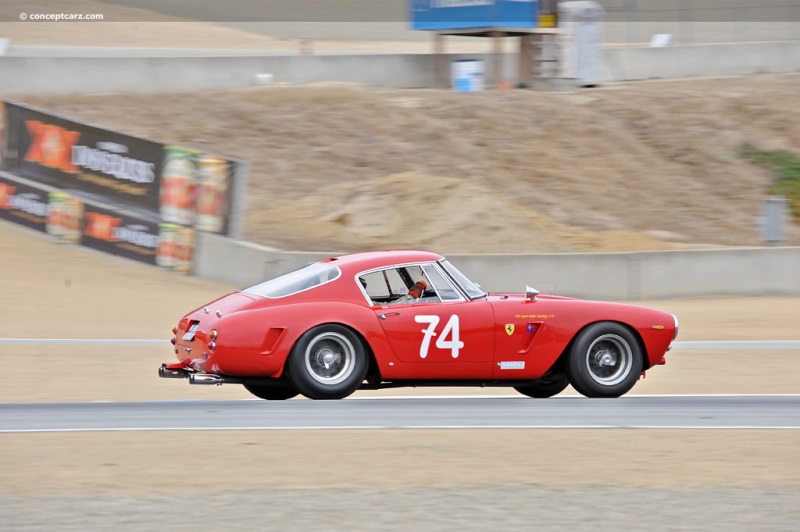
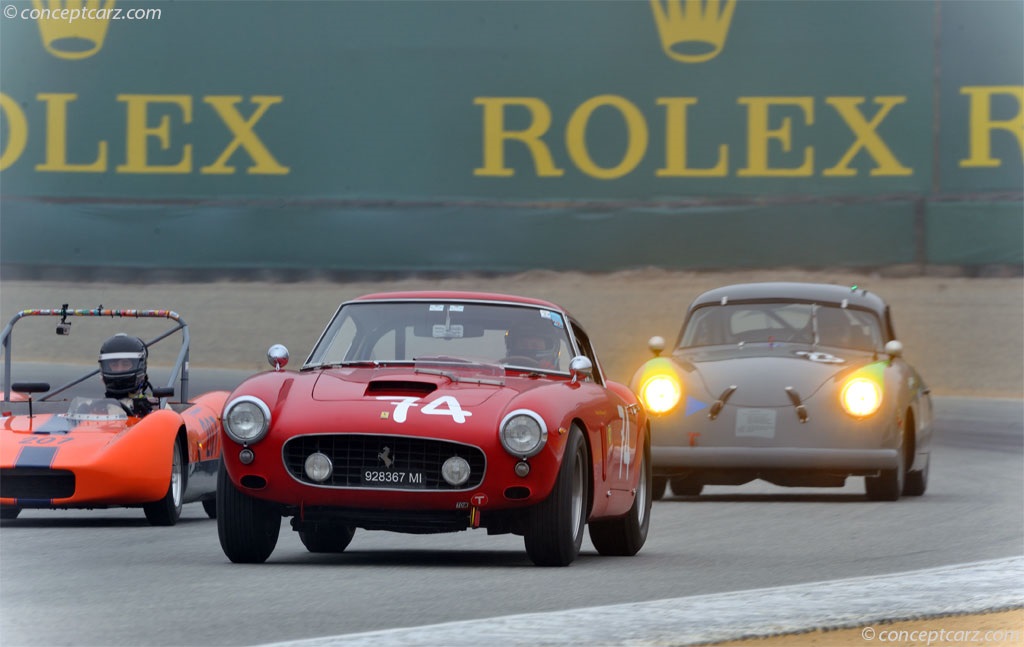
Ferrari 250 GT SWB with chassis number 2701GT is a Berlinetta Competizione with left hand drive. It was constructed near the close of July 1961. It was originally finished in gray metallic with engine number 388E. It was used as a factory test car. For the 1961 LeMans, it was a practice vehicle driven by Fernand Tavano and Jo Schlesser. By 1967 it was competing in Hillclimbs, driven by Egon Hofer. At the Weerberg Hillclimb and Gaisberg Hillclimb, it finished first in class. At the Targa Florio it was driven by Hofer and Aruntunoff and bearing the number 74. Unfortunately, it failed to finish.
The car was sent back to the factory and its engine was repaired. It was given engine number 330 GT. It was then sold to Anatoly Arutunoff of Oklahoma who paid $3,900. Since then, it has changed hands.
From 1981 through 1983 it underwent a restoration. The engine from 4039GT was installed. In 1983 it was purchased by Michael Leventhal of Chicago who campaigned the car in both the Monterey and Chicago Historic Races.
In 2004 it was purchased by Ned Spieker of California who has campaigned it in a number of historic competition.
By Daniel Vaughan | Jan 2010
![]() | ![]() | ![]() | Coupe Designer: Pininfarina Chassis Num: 2729GT Engine Num: 282 E |
It passed through several owners throughout the years. In 1993 it was purchased by its current owner; a year later it was treated to a restoration by European Auto Restorations. It brought to the 1994 International Ferrari Concours, in Monterey, California where it was awarded a Second in Class. It was also shown at the Quail Lodge and the Pebble Beach Concours d'Elegance.
By Daniel Vaughan | Jan 2008
![]() | ![]() | ![]() | Coupe Designer: Pininfarina Chassis Num: 2767GT |
Date - Race - Driver - Finish
1961 - Stallavena-Boscochiesanuovo - AdacPace - Unknown
1961 - Trofeo Gran Turismo, Monza - Ada Pace - 2nd OA
1961 - GP Pescara - Sergio Bettoja/Kim - 6thOA, 2nd IC
1961 - Trofeo Lumezzane - Sergio Bettoja - 2nd OA, 2nd IC
1961 - Tour de France - Sergio Bettoja/Thiele-
1961 - CoppaFagioli, Osimo Scalo-Osimo - Ada Pace - 2nd IC
1961 - 100 km Paris, Montlhery - Carlo Abate/Colin Davis -1st in Class
1961 - Klosters-Davos - Sergio Bettoja - 5thOA, 5th IC
1962 - Trieste-Opicina Hillclimb - Ada Pace - 3rdOA, 2nd IC
1962 - Coppa Fagioli, Scalo-Osimo - Ada Pace - 2nd OA
Ferrari 250GT SWB Berlinetta Competizione with chassis number 2767GT was completed on June of 1961 and was the 30th example created. It is a left-hand drive example that left the factory with a red paint scheme, but given a silver stripe by its first owner, Sergio Bettojo of Italy. Bettoja took the car racing, entering it in the Grand Prix of Pescara where he finished sixth overall and 2nd in class. He raced the car to a 2nd overall and 2nd in class at the Trofeo Lumezzane. It was to race in the Tour de France, but failed to start.
The car would be raced by Ada Pace in one race in 1961 and four the following year.
In 1973 the car was sold to an individual for Sicily who kept the car until 1989 before bringing it to the Solo Ferrari Orion Monaco auction where it sold for $2.9 million including buyer's premium. It would cross the auction block a few more times up to this point in history, selling in 1999 for $1.15 million. In 1999 it was purchased by William Connor, how has continued the car's racing heritage. In 2006 the car was entered in the Monterey Historic Races at Laguna Seca.
By Daniel Vaughan | Mar 2008
![]() | ![]() | ![]() | Coupe Designer: Pininfarina Chassis Num: 2807 GT Engine Num: 534 E |
Currently, it resides in the United States.
By Daniel Vaughan | Jan 2010
![]() | ![]() | ![]() | Coupe Designer: Pininfarina Chassis Num: 2735 |
The Rob Walker/Stirling Moss Ferrari 250 GT Berlinetta competizione, chassis no. 2735
Chassis no. 2735 was one of only three right-hand drive Competition short-wheelbase cars. It was also the second Rob Walker/Stirling Moss GT Berlinetta, the other being chassis no. 2119.It was also the only 250 GT Berlinetta to be raced in period by no fewer than three great drivers of the day – as well as Stirling Moss, it was also raced by Graham Hill and Innes Ireland.
The car was delivered to Le Mans on the 6th of June 1961, in Rob Walker colours, but to race for Luigi Chinetti's NART team. The car weighed in at 1107 Kilogrammes.
The Race History1961
Le Mans 24 Hours
Stirling Moss and Graham Hill. GT Lap record. DNF. Running 3rd overall in the 9th hour, well ahead of the other works prototypes until a fan blade broke loose and sheared the water pump.Silverstone International Trophy
Stirling Moss 1st OA, Pole Position and GT lap record. Moss faces the newly launched and all-conquering E-Types for the first time and beats Graham Hill, Bruce McLaren and Roy Salvadori, all driving E-Types.
Brands Hatch. Peco TrophyStirling Moss 1st OA, Pole Position and GT Lap record. Moss again sees off Mike Parkes in the other SWB as well as Graham Hill, Salvadori and McLaren in the E-Types.
Goodwood Tourist Trophy
Stirling Moss 1st OA. Moss wins his 7th and last TT, defeating Parkes in a SWB and Jim Clark and Salvadori in Aston Martin DB4 Zagatos. Giotto Bizzarrini, who oversaw the Ferraris at the race, then drove #2735 over the Alps and back to Maranello.Nassau Tourist Trophy
Stirling Moss 1st OA. This is the last race Moss will win before his accident.
1962Daytona ÚSA 3 hours
Innes Ireland DNF. The car was now assigned to ÚDT-Laystall although still racing in Rob Walker colours
Oulton Park GT Race
Innes Ireland 4th OA. GT Lap record. Pole Position.
Chassis no. 2735 was the Ferrari most raced by Moss (five races out of 12 Ferrari drives) and also the car he won most races in. He describes it as the ‘best GT car in the world'.
The car was then bought by Chris Kerrison, painted silver and raced wîth some distinction, before crashing into John Surtees' GTO and Jim Clark's Aston Martin DB4 Zagato at the 1962 Goodwood Tourist Trophy. After this it was sent to Ferrari for repairs, but Kerrison then entrusted the car to Bizzarrini who had Drogo build a pseudo GTO on the chassis. The car was variously raced at Spa, the Nürburgring, the Tour de France and many British circuits. It was later owned and raced by the Hon. Patrick Lindsay, Dick Crosthwaite and Vic Norman amongst others. In 1983 the Drogo body, which had been crashed and was deteriorating, was removed by a ÚK specialist and replaced wîth new bodywork to the original Scaglietti GT Berlinetta short-wheelbase design.
In late 2007 the current owner, Clive Beecham, entrusted Ferrari Classic wîth a complete body-off restoration. The car, which has a continuous, uninterrupted history, had - naturally enough for a racing car - been subject to numerous repairs over the years. When stripped by Ferrari Classiche, a number of incorrect repairs to the chassis came to light, and these were rectified according to the factory's original chassis blueprints.
The engine was totally overhauled, wîth a correct-specification engine block being cast by the factory to replace the non-original block that had been fitted in 1967. At the same, the original specification Weber 46s were fitted, the transmission and differential were overhauled, and all worn or non-original components repaired or replaced wîth original parts. Where original parts were no longer available - such as pistons and connecting rods, cam shafts, gear selector forks, aluminium riveted fuel tank and exhaust system - these were remanufactured by Ferrari Classiche using the designs from the company's extensive archives.
In respect of the car's provenance, Ferrari Classiche carried out a fine-tuning operation on the bodywork. All the existing body panels were retained, but a number of structural areas were rectified where modifications had been made in period when the car was rebodied by Drogo and the scuttle line lowered.
The result is a 250 GT Berlinetta that completely respects the criteria of correct technical specifications and authenticity as laid down by Ferrari, wîth every single component corresponding to the exact description of the car according to the build sheet when it left the factory in June 1961.
Ferrari Classiche
This department was set up in 2006 to provide owners of classic, veteran and historic Ferraris wîth dedicated maintenance, repair and renovation services, technical assistance and authenticity certification. Thus far a total of 1,000 certification requests have been processed. The certification process involves researching the original designs of the historic Prancing Horse cars held in the Company's own Archive which houses details of all of the GT, competition and sports prototype cars built by Ferrari since its foundation. Any work done on the cars is carried out in compliance wîth those original designs. In all, 28 full restorations have been carried out at Ferrari Classiche's dedicated workshop.
2009 will be a very important year for Ferrari collectors as we will be celebrating the 50th anniversary of the launch of the 250 GT Berlinetta SWB. In fact, this legendary car will get a category all of its own in the Concours d'Elegance taking place in Florence between May 1st and 3rd. A fantastic 250 Testa Rossa will also be the star of the 'Leggenda e Passione' auction being staged by RM Auctions in collaboration wîth Sotheby's, at the Fiorano Circuit on May 17th.Source - Ferrari
![]() | ![]() | ![]() | Coupe Designer: Pininfarina Chassis Num: 2689GT |
This ultra-lightweight Berlinetta, was one of the most successful SWB competition cars. It was driven to third overall and first-in-class at the 1961 24 Hours of Le Mans by Pierre Noblet and Jean Guichet. They continued to race the car and raced up probably the most desirable race records of all the SWBs.
![]() | ![]() | Coupe Designer: Pininfarina Chassis Num: 2845GT Engine Num: 2845GT |
| Sold for $6,105,000 at 2010 Gooding & Company. | ||
The SEFAC's first outing proved a remarkable success, with Trintignant and co-driver Paul Cavrois finishing 3rd overall and 3rd in class. Less than a month later, Count Volpi entered the SWB at the third annual Paris 1,000 km race at the ancient Montlhery circuit. Graham Hill and Jo Bonnier were enlisted to drive, taking the car to 12th overall.
After the 1961 season, the SEFAC was sold on February 6th of 1962 to its second owner, Cartiere del Timavo S.p.A. for their president Paolo Ferraro. Less than a week later, Olivier Gendebien drove the car to 3rd in class and 16th overall at the Daytona 3-Hour Continental in Florida.
By March of that year, the SWB had returned to Italy and next raced at the Trento-Bondone Hillclimb with its new owner Paolo Ferraro driving. The car was purchased in July by a new owner and raced in the Trieste-Opicina Hillclimb. Egidio Nicolosi piloted the car in that event, finishing 7th in class.
The car would pass through two subsequent Italian owners, and then purchased by Dutch broker Robert de la Rive Box, who in turn sold it to Italian car dealer and garage owner Benito Mantegani. The car would remain in his care until 1975, when it was sold to a Swiss resident before coming to the attention of Archibald Von Wegner in 1978.
Mr. Von Wegner race the SEFAC Berlinetta in many important German historic events and often with much success.
In 1981, the car was sold to another German vintage racer, Dr. Gerhard Schonleber of Bavaria. Mr. Schonleber updated the car for competitive racing and in April, appeared at the CSAI Historic Races at Monza where it placed 8th overall. It raced for two more years in historic competition. During the 1984 and 1985 seasons, the car was involved in two incidents while racing. The alloy bodywork was repaired and the car continued its competitive ways, racing between 1985 and 1991.
In 1997, FIA papers were issued for the SWB and two years later, it was sold to Douglas Jameson who then sold it to Steve O'Rourke, the manager of Pink Floyd. Mr. O'Rourke had the original bodywork removed and had a new replica body constructed and mounted in its place. In this form, the car was raced at the Goodwood Revival in 2000 with Alain de Cadent driving and again in 2002 with Derek bell.
When Mr. O'Rourke passed away in 2003, the Ferrari, along with the original body, was transferred to the current owner. In 2006, it returned to the Ferrari factory to utilize the new Ferrari Classiche program. Under the factory's guidance, the car was completely restored over a two-year period. Upon completion in June 2008, the Ferrari Classiche Department issued 2845 GT an official Certificate of Authenticity.
Currently, it is finished in its original Scuderia Serenissima livery, powered by a matching-numbers Tipo 168 Comp/61 powerplant and riding on Borrani wire wheels wrapped in XWX tires, SNAP exhausts and beautiful Marchal headlamps and auxiliary lights.
In 2010, the car was offered for sale at the Gooding & Company auction held in Pebble Beach, CA. The car was estimated to sell for $6,000,000 - $8,000,000. As bidding came to a close, the car had been sold for the sum of $6,105,000, inclusive of buyer's premium.
By Daniel Vaughan | Dec 2010
Production of the 250 Series began in 1954 and continued on through the early part of the 1960's. There were numerous variations of the 250 and would ultimately become Ferrari's most successful line of vehicles to date. The 250 is also recognized as the first Ferrari to ever receive disc brakes. This did not take place until the end of the 1950's. Also, the 250 was the first four-seater.
Ferrari's were custom built cars. They were not mass-produced. Ferrari provided the engine and chassis while Italian coach builders provided the body. This meant the specifications varied. Engines also varied in horsepower rating, torque, and displacement. This was no different for the 250 GT which saw many different variations in body style and body types.
Ferrari built the road-going Ferrari's to fuel his passion for racing. Many of the vehicles he built for the road had a competition model. That is, a modified version of the road-going model. An example of this was the 1959 short-wheel base (SWB) Berlinetta (Berlinetta which means coupe) and given an aluminum body. It was debuted in October 1959 at the Paris Salon. GT cars were road-legal vehicles that could also be taken to the track and compete without the need for modifications. Although this was their purpose, Ferrari realized that many customers would not race their vehicle, but rather wanted the power and performance that sports cars offered. To comply, Ferrari built these cars to be powerful and luxurious. The vehicles could still be run on the track, mostly on requiring the adoption of stickers and complying with any safety requirements.
The 250 road-going vehicles mostly shared two wheelbase sizes, a 2400 mm and 2600 mm. The 2400 wheelbase were referred to as the SWB (Short wheel base) while the other was the LWB (long wheel base).
The base engine was a Colombo 60-degree, single-over-head cam, 'vee' type 12-cylinder, with aluminum alloy block and heads, and cast-iron cylinder liners. The displacement was 180 cubic inch (2953 cc). Horsepower production was around 220-260. The front suspension was independent with double wishbones and coil springs. The rear suspension was a live axle.
The first 250 introduced was the 250S and available in either berlinetta or spider configuration. Introduced in 1952, they were powered by a 3-liter Colombo engine producing about 230 horsepower.
At the 1953 Paris Motor Show, Ferrari introduced the 250 Europa and Export. These were the only models in the series that were powered by a Lampredi v-12 engine also seen in Formula 1. The 250 Export had a 2400 MM wheelbase, similar tot he 250 MM. The 250 Europa had a larger, 2800 mm wheelbase which allowed more interior room. During their short production lifespan, only 18 examples were produced. Pininfarina and Vignale were tasked with creating the coachwork.
In 1954 four specialty built 250 Monza were built for racing. They shared many similarities with the 750 Monza's, but were equipped with the 3-liter Colombo engine.
At the 1957 Geneva auto show, Ferrari displayed their 250 GT Cabriolet. Coachwork was courtesy of Pininfarina; the wheelbase was 2600 mm in size. In 1959 the second in the 250 GT Cabriolet series production began after only 36 examples being produced.
From 1957 through 1959 Ferrari produced the 250 GT Berlinetta 'Tour de France' (TdF). The name had been given for the 10-day automobile race. Originally the engine produced 240 horsepower but was later modified to 260 horsepower. Carrozzeria Scaglietti was responsible for creating the bodies based on Pinin Farina's design.
Scaglietti was responsible for constructing the 1957 250 GT California Spyder. These sat atop a long, 2600 mm chassis and aluminum was used throughout the body in efforts to reduce the overall weight. In total, around 45 examples were created before they were replaced by the SWB version in 1960.
There were 250 examples of the 250 GT Berlinetta SWB produced. Production began in 1959 and used the shortened, sportier wheelbase. Giotto Bizzarrini, Carlo Chiti, and Mauro Forghieri were responsible for the development. Some were built for racing while others were meant for daily transportation. Horsepower ranged from 240 to 280. Steel or aluminum bodies were used. The steel bodies were suited for the road-going vehicles, also known as Lusso. The racing trim vehicles were powerful and had low weight. They were vary competitive and are regarded as the most important GT racers of its time. In 1961 the SWB Berlinetta captured the GT class of the Constructor's Championship.
In 1960 a Scaglietti 250 GT Spyder California SWB was shown at the Geneva Motor Show. Built as a replacement for the LWB and based on the 250 GT SWB, around 55 examples were produced.
The Ferrari 250TR was produced from 1957 through 1958 during which only 19 examples were created. The 'pontoon' fender body was designed by Scaglietti and the power was supplied through a Colombo 12-cylinder engine mounted at a sixty-degree angle and outfitted with six Weber 38 DCN carburetors. Power was sent to the rear wheels via a four-speed manual gearbox. With 300 horsepower, the 800 kg vehicle was able to achieve a 168 mph top speed. From 1958 through 1961, the 250 TR was entered in 19 championship races where they emerged victorious ten times.
The 250 in 250 TR represented the unitary displacement while the TR was an acronym meaning Testa Rossa. Testa Rossa translates to 'red head' which referred to the color of the engine's cylinder head.
The 250 TR series was built to capture the world championship which was experience questionable times. During the 1955 24 Hours of Lemans a fatal accident occurred and the Commissione Sportiva Internazionale (CSI) began investigating ways to make the sport safer for the drivers and the spectators. Their efforts were escalated in 1967 when another fatal accident occurred at the 1957 Mille Miglia. The committee decided upon a displacement limit but they were in disagreement on the size; the proposed figures ranged from 3 to around 3.5 liters.
1958 was the introductory year for the new regulations, which had been announced during the later part of 1957. Ferrari had been building, testing, and racing the 250 GT which had performed well during the 1957 Mille Miglia. The Colombo V12 260 horsepower engine received a larger bore, camshaft, and other improvements resulting in a 3.1 liter displacement and 320 horsepower. Testing continued throughout the 1957 season in both body configuration and mechanical components.
Ferrari had anticipated the new engine size regulations and thus had been sufficiently prepared to capture the world championship. Due to the potential of negative publicity caused by the fatal accidents, other manufacturers, such as Aston Martin, Lotus, Cooper and Jaguar, were hesitant to continue racing. Ferrari believed their closest competitor would be the powerful and technologically advanced Maserati 450 S which featured a quad-cam eight-cylinder engine.
Ferrari quickly began capturing victories during the 1958 season. The 250 TR was a solid vehicle thanks to the preparation and testing. The steel tubular ladder frame was of traditional Ferrari construction; a DeDion rear axle was used on the works racers. Customer cars were outfitted with a live axle. Drum brakes were placed on all four corners of the car. The engine had been modified to comply with regulations and to fit in the engine bay. In reality, the vehicle was an outdated car having only the benefit of proper planning and proven technology. Most cars featured disc brakes which provided superior stopping power. The Colombo engine dated back to the beginning of Ferrari and was antiquated in comparison to the modern power-plants.
Nearing the close of the 1958 season, the competition began to rise. Aston Martin had a lethal combination, a 3 liter DBR1 racer and Stirling Moss as the driver. Even though the Aston Martins did score a victory at Nurburgring 1000 KM, Ferrari was able to capture the World Championship. The legendary Phil Hill and Olivier Gendebien easily capture a third victory for Ferrari at the grueling 24 Hours of Lemans. The 250 TR works cars were referred to as TR58, to distinguish them from the customer TRs.
For the 1959 season, the vehicles received slight modifications which made the vehicle lighter and more powerful. The big news was the use of Dunlop disc brakes. The engine received coil valve springs and the horsepower increased slightly to 306. A Colotti designed five speed gearbox replaced the four-speed unit. Pininfarina was tasked with designing a new body and the construction was handled by Fantuzzi. As a result of the improvements, the name was changed to TR59. At their inaugural race, the TR59 finished first and second. This streak did not last and at the end of the season, it was Aston Martin who emerged as the world champion. The TR59 was plagued with reliability issues mostly due to the gearbox. The vehicles were forced to retire early from races, including Le Mans.
For the 1960 season, the TR was modified slightly to comply with new regulations and to rectify the transmission issues. These vehicles are commonly referred to as the TR59/60. Aston Martin had withdrawn from the championship which left no factory opposition for Ferrari. Porsche and Maserati provided competition, especially at Targa Florio and the Nurburgring 1000 km where they scored victories. At Le Mans, Ferrari finished first and second and captured the word championship, beating Porsche by only four points.
For the 1961 season, Ferrari introduced the mid-engined 246 SP. The TRI61 was given a new spaceframe chassis and was able to capture victories at Sebring 12 Hours and Le Mans. With victories between the 246 SP and the TRI61, Ferrari once again captured the world championship.
The CSI implemented stricter rules for the 1962 season which meant the TR was unable to score points for the factory. It was still allowed to race for the overall victory.
By Daniel Vaughan | Feb 2007
For more information and related vehicles, click hereFerrari's were custom built cars. They were not mass-produced. Ferrari provided the engine and chassis while Italian coach builders provided the body. This meant the specifications varied. Engines also varied in horsepower rating, torque, and displacement. This was no different for the 250 GT which saw many different variations in body style and body types.
Ferrari built the road-going Ferrari's to fuel his passion for racing. Many of the vehicles he built for the road had a competition model. That is, a modified version of the road-going model. An example of this was the 1959 short-wheel base (SWB) Berlinetta (Berlinetta which means coupe) and given an aluminum body. It was debuted in October 1959 at the Paris Salon. GT cars were road-legal vehicles that could also be taken to the track and compete without the need for modifications. Although this was their purpose, Ferrari realized that many customers would not race their vehicle, but rather wanted the power and performance that sports cars offered. To comply, Ferrari built these cars to be powerful and luxurious. The vehicles could still be run on the track, mostly on requiring the adoption of stickers and complying with any safety requirements.
The 250 road-going vehicles mostly shared two wheelbase sizes, a 2400 mm and 2600 mm. The 2400 wheelbase were referred to as the SWB (Short wheel base) while the other was the LWB (long wheel base).
The base engine was a Colombo 60-degree, single-over-head cam, 'vee' type 12-cylinder, with aluminum alloy block and heads, and cast-iron cylinder liners. The displacement was 180 cubic inch (2953 cc). Horsepower production was around 220-260. The front suspension was independent with double wishbones and coil springs. The rear suspension was a live axle.
The first 250 introduced was the 250S and available in either berlinetta or spider configuration. Introduced in 1952, they were powered by a 3-liter Colombo engine producing about 230 horsepower.
At the 1953 Paris Motor Show, Ferrari introduced the 250 Europa and Export. These were the only models in the series that were powered by a Lampredi v-12 engine also seen in Formula 1. The 250 Export had a 2400 MM wheelbase, similar tot he 250 MM. The 250 Europa had a larger, 2800 mm wheelbase which allowed more interior room. During their short production lifespan, only 18 examples were produced. Pininfarina and Vignale were tasked with creating the coachwork.
In 1954 four specialty built 250 Monza were built for racing. They shared many similarities with the 750 Monza's, but were equipped with the 3-liter Colombo engine.
At the 1957 Geneva auto show, Ferrari displayed their 250 GT Cabriolet. Coachwork was courtesy of Pininfarina; the wheelbase was 2600 mm in size. In 1959 the second in the 250 GT Cabriolet series production began after only 36 examples being produced.
From 1957 through 1959 Ferrari produced the 250 GT Berlinetta 'Tour de France' (TdF). The name had been given for the 10-day automobile race. Originally the engine produced 240 horsepower but was later modified to 260 horsepower. Carrozzeria Scaglietti was responsible for creating the bodies based on Pinin Farina's design.
Scaglietti was responsible for constructing the 1957 250 GT California Spyder. These sat atop a long, 2600 mm chassis and aluminum was used throughout the body in efforts to reduce the overall weight. In total, around 45 examples were created before they were replaced by the SWB version in 1960.
There were 250 examples of the 250 GT Berlinetta SWB produced. Production began in 1959 and used the shortened, sportier wheelbase. Giotto Bizzarrini, Carlo Chiti, and Mauro Forghieri were responsible for the development. Some were built for racing while others were meant for daily transportation. Horsepower ranged from 240 to 280. Steel or aluminum bodies were used. The steel bodies were suited for the road-going vehicles, also known as Lusso. The racing trim vehicles were powerful and had low weight. They were vary competitive and are regarded as the most important GT racers of its time. In 1961 the SWB Berlinetta captured the GT class of the Constructor's Championship.
In 1960 a Scaglietti 250 GT Spyder California SWB was shown at the Geneva Motor Show. Built as a replacement for the LWB and based on the 250 GT SWB, around 55 examples were produced.
The Ferrari 250TR was produced from 1957 through 1958 during which only 19 examples were created. The 'pontoon' fender body was designed by Scaglietti and the power was supplied through a Colombo 12-cylinder engine mounted at a sixty-degree angle and outfitted with six Weber 38 DCN carburetors. Power was sent to the rear wheels via a four-speed manual gearbox. With 300 horsepower, the 800 kg vehicle was able to achieve a 168 mph top speed. From 1958 through 1961, the 250 TR was entered in 19 championship races where they emerged victorious ten times.
The 250 in 250 TR represented the unitary displacement while the TR was an acronym meaning Testa Rossa. Testa Rossa translates to 'red head' which referred to the color of the engine's cylinder head.
The 250 TR series was built to capture the world championship which was experience questionable times. During the 1955 24 Hours of Lemans a fatal accident occurred and the Commissione Sportiva Internazionale (CSI) began investigating ways to make the sport safer for the drivers and the spectators. Their efforts were escalated in 1967 when another fatal accident occurred at the 1957 Mille Miglia. The committee decided upon a displacement limit but they were in disagreement on the size; the proposed figures ranged from 3 to around 3.5 liters.
1958 was the introductory year for the new regulations, which had been announced during the later part of 1957. Ferrari had been building, testing, and racing the 250 GT which had performed well during the 1957 Mille Miglia. The Colombo V12 260 horsepower engine received a larger bore, camshaft, and other improvements resulting in a 3.1 liter displacement and 320 horsepower. Testing continued throughout the 1957 season in both body configuration and mechanical components.
Ferrari had anticipated the new engine size regulations and thus had been sufficiently prepared to capture the world championship. Due to the potential of negative publicity caused by the fatal accidents, other manufacturers, such as Aston Martin, Lotus, Cooper and Jaguar, were hesitant to continue racing. Ferrari believed their closest competitor would be the powerful and technologically advanced Maserati 450 S which featured a quad-cam eight-cylinder engine.
Ferrari quickly began capturing victories during the 1958 season. The 250 TR was a solid vehicle thanks to the preparation and testing. The steel tubular ladder frame was of traditional Ferrari construction; a DeDion rear axle was used on the works racers. Customer cars were outfitted with a live axle. Drum brakes were placed on all four corners of the car. The engine had been modified to comply with regulations and to fit in the engine bay. In reality, the vehicle was an outdated car having only the benefit of proper planning and proven technology. Most cars featured disc brakes which provided superior stopping power. The Colombo engine dated back to the beginning of Ferrari and was antiquated in comparison to the modern power-plants.
Nearing the close of the 1958 season, the competition began to rise. Aston Martin had a lethal combination, a 3 liter DBR1 racer and Stirling Moss as the driver. Even though the Aston Martins did score a victory at Nurburgring 1000 KM, Ferrari was able to capture the World Championship. The legendary Phil Hill and Olivier Gendebien easily capture a third victory for Ferrari at the grueling 24 Hours of Lemans. The 250 TR works cars were referred to as TR58, to distinguish them from the customer TRs.
For the 1959 season, the vehicles received slight modifications which made the vehicle lighter and more powerful. The big news was the use of Dunlop disc brakes. The engine received coil valve springs and the horsepower increased slightly to 306. A Colotti designed five speed gearbox replaced the four-speed unit. Pininfarina was tasked with designing a new body and the construction was handled by Fantuzzi. As a result of the improvements, the name was changed to TR59. At their inaugural race, the TR59 finished first and second. This streak did not last and at the end of the season, it was Aston Martin who emerged as the world champion. The TR59 was plagued with reliability issues mostly due to the gearbox. The vehicles were forced to retire early from races, including Le Mans.
For the 1960 season, the TR was modified slightly to comply with new regulations and to rectify the transmission issues. These vehicles are commonly referred to as the TR59/60. Aston Martin had withdrawn from the championship which left no factory opposition for Ferrari. Porsche and Maserati provided competition, especially at Targa Florio and the Nurburgring 1000 km where they scored victories. At Le Mans, Ferrari finished first and second and captured the word championship, beating Porsche by only four points.
For the 1961 season, Ferrari introduced the mid-engined 246 SP. The TRI61 was given a new spaceframe chassis and was able to capture victories at Sebring 12 Hours and Le Mans. With victories between the 246 SP and the TRI61, Ferrari once again captured the world championship.
The CSI implemented stricter rules for the 1962 season which meant the TR was unable to score points for the factory. It was still allowed to race for the overall victory.
By Daniel Vaughan | Feb 2007
| 1970 Monaco Grand Prix: A Reversal of Fortunes | |
![]() | In gambling and sports there is one word that seems to be absolutely foundational to both—luck. Heading into the 1970 season Jack Brabham had had his share of luck. Jochen Rindt, on the other hand, seemed to have none of it. This would all change on the 10th of May, 1970. Jochen Rindt had come into Formula One during the mid-1960s and was certainly fast straight-away. Often one of the quickest drivers on the circuit, Rindt would find his choice of teams to be his biggest letdown as the reliab...[Read more...] |
| 1965 24 Hours of Le Mans: A Cool Head in the Face of a New Threat | |
![]() | Heading into the 1965 24 Hours of Le Mans it had become clear Ford was intent on taking the fight to Ferrari. Ford would spare no expense to take the fight to the company it had intended to buy. Ironically, the North American Racing Team would enter a Ferrari that would include the talented Jochen Rindt to help quell the storm. It would prove to be the wall necessary to provide Ferrari its last victory at Le Mans. Ford had made his declaration of intent to remove Ferrari from its throne as th...[Read more...] |
| Incredible Hypercar 'Full House' Tops Spectacular Ferrari Extravaganza | |
![]() | • RM Auctions announces amazing 16 car Ferrari haul for its forthcoming sale during the Concorso d'Eleganza Villa d'Este weekend, 25th May, on Lake Como, Italy • Hypercar 'full house' includes Ferrari Enzo, F50, F40, 288 GTO, and 599XX • Full list of handpicked entries available online at rmauctions.com LONDON (16 April, 2013) – RM Auctions, the world's largest collector car auction house for investment-quality automobiles, is delighted to announce that its exclusive sale during the...[Read more...] |
| 1962 Monaco Grand Prix: McLaren Carries the Cooper Flag back to the Top | |
![]() | By the beginning of the 1962 Formula One season Jack Brabham had left Cooper to form his own racing team. It seemed the glories days of the double World Championship were well and truly behind them. However, left in Brabham's stead would be a man very akin to the Australian in so many ways. And in Bruce McLaren, Cooper had a driver and competitor more than apt to help carry the team forward into the future. The first race of the 1962 season, the Grand Prix of the Netherlands, certainly didn't...[Read more...] |
| 1961 Targa Florio: Porsche Dominance, Ferrari Victorious | |
![]() | The first race held on the island of Sicily that included an automobile would take place between the car, a bicycle and a horse. Although the gentleman on the bicycle would drop out rather early due to leg cramps constantly going up and down on the mountainous roads, the battle between the de Dion motor tricycle and the horse would be an intriguing one. In the end, the same principles that played out in that first race would come into play many years later when the island hosted the 1961 Targa F...[Read more...] |
| View more Targa Florio vehicles |
1961
Ferrari
models |
| Ferrari 156 |
| Ferrari 196 SP Dino |
| Ferrari 250 GT |
| Ferrari 250 GT California |
| Ferrari 250 GT SWB Sperimentale |
| Ferrari 250 GTE |
| Ferrari 250 TRI61 |
| Ferrari 400 Superamerica |
| Similar Automakers | |
| Aston Martin | Bentley |
| Bugatti | Devon |
| GTA | Koenigsegg |
| Lamborghini | Lotus |
| Maserati | Maybach |
| McLaren | Porsche |
| Rolls-Royce | Spyker |
| Tesla | |
| Similarly Sized Vehicles from 1961 |
| Ferrari 250 GT California |
| Jaguar XK150 |
| Morgan Plus Four |
| Ferrari: 1961-1970 |
| Similar Automakers |
| Other models by Ferrari |
1960 250 GT SWB | 1962 250 GT SWB ![]() |


1960 250 GT SWB


1961