1963 Alfa Romeo 2600
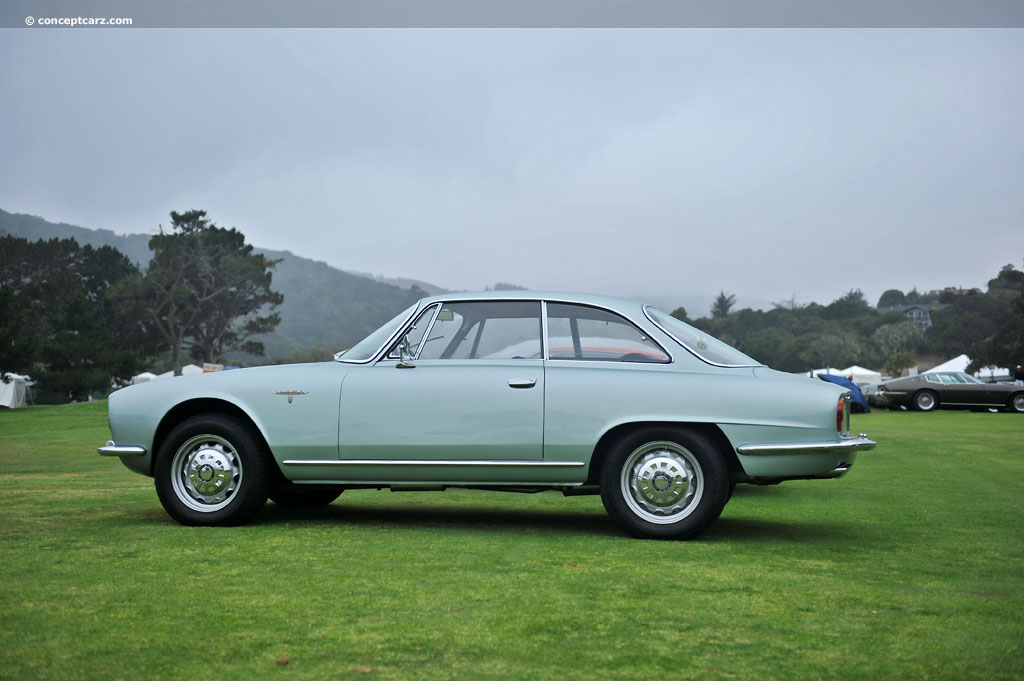
1963 Alfa Romeo 2600 Navigation
History
The Alfa Romeo 2600 was introduced in March of 1962 at the Geneva Motorshow. The 2600 was the replacement for the 2000. The Sprint was a four-seater coupe, easily recognizable by the hood ducts, powered by a six-cylinder engine, and based on the 2600 Spider and Saloon. A few of the bodies were outfitted by Italian coachbuilder Zagato and were sold as the 2600 SZ.
For the Spider and Sprint models, a 2584 cc straight six-cylinder, alloy dual overhead cam engine with triple carburetors was capable of producing 145 horsepower. The Berlina models had 130 horsepower. Placed in the front and powering the rear wheels, it could propel from zero to sixty in 10.4 seconds and had a top speed of 125 mph. Disc brakes were placed on the front and drum brakes were in the rear. A five-speed manual gearbox was standard.
The Sprint series continued in production until 1966. Production of the 2600 continued until 1969. During its lifespan, 105 Sprint Zagatos, 54 De Luxe, 2,038 Berlina, 2,255 Spider, and 6,999 Sprint models were produced.
By Daniel Vaughan | Sep 2007
For the Spider and Sprint models, a 2584 cc straight six-cylinder, alloy dual overhead cam engine with triple carburetors was capable of producing 145 horsepower. The Berlina models had 130 horsepower. Placed in the front and powering the rear wheels, it could propel from zero to sixty in 10.4 seconds and had a top speed of 125 mph. Disc brakes were placed on the front and drum brakes were in the rear. A five-speed manual gearbox was standard.
The Sprint series continued in production until 1966. Production of the 2600 continued until 1969. During its lifespan, 105 Sprint Zagatos, 54 De Luxe, 2,038 Berlina, 2,255 Spider, and 6,999 Sprint models were produced.
By Daniel Vaughan | Sep 2007
Debuting at the 1962 Geneva Motor Show, the classic 2600 series was introduced by Alfa Romeo. Replacing the popular 2000 series, the 2600 range was offered as a two-door Sprint coupe, a four-door Berlina sedan, and an open Touring two-door Spider. Sprints were designed by Bertone and constructed by OSI, Spiders were designed and built by Touring of Milan, and Berlinas were designed and built in-house by Alfa. Also called the Series 106, the 2600 Series was Alfa Romeo's six-cylinder flagship and was produced from 1961 through 1968.
A departure from the iron-block four-cylinders, which had been an industry standard with post-war Alfas, the 2600 used a new 2,584 cc aluminum inline-six-cylinder engine with cast-iron liners, a cross-flow head, and hemispherical combustion chambers. The engine inside the Berlina was fitted with two Solex carburetors that produced 130 hp. The Sprints and Spiders featured three twin-choke horizontal carburetors and pumped out 145 hp. The Berlinas engine was mated to a column-shift manual while Sprints and Spiders featured a five-speed synchromesh floor unit. The OSI De Luxe was offered with the two-carb or the three-carb setup.
The Sprint and the Spider had a top speed of 124 mph, with the Berlina coming in slightly lower at 112 mph. Discs were eventually made standard all around, but early on the 2600 models had front Girling disc brakes and rear drums. The suspension came from front double A-arms with coil springs and a sway bar, along with a solid rear axle with longitudinal radius arms and coil springs.
The Sprint, Berlina, and Spider were based on corresponding models in the 2000 range and all three models retained the previous body styles but with minor renovations.
In the marque's history, Romeo Berlinas normally outsold most specialized sporting models from the same range, but in this instance, the 2600 Berlina didn't outsell the 2600 Sprint and Spider. Many considered the Berlinas styling to not be very appealing and especially poor sales reflected this.
The styling of the Spider seemed to have been inspired by the Giulietta Spider, and though attractive enough, was not enough to win the hearts of the current automotive market. The Spider was constructed of steel instead of the standard aluminum and was technically considered a 2+2 roadster though the rear left much to be desired for an adult passenger.
The Sprint offered available leather seating, two-speed wipers, electric windows, and a rear demister. The Sprint was met with much more favorable appeal than the other two models. A large grand touring coupe, there was plenty of room for four adults to comfortably enjoy a long road trip. The Sprint became the best seller of the 2600 range, possibly due to its fresh, modern styling and smooth handling. The design of the Sprint was Giorgetto Giugiaro's first large project as head designer for Carrozeria Bertone and considered by many to be a great success.
Numerous 2600 Sprint models were bought by the Italian government and modified and specially equipped to be used as Police and Carabinieri patrol vehicles. These models were nicknamed 'Pantera' (panther) and 'Gazzella' (gazelle) and their speed made them a veritable force to be reckoned with when chasing offenders.
In 1965 at the Frankfurt Motor Show Alfa Romeo introduced the fastback coupe 2600 SZ (Sprint Zagato) with bodywork by Zagato, and the limited edition 2600 De five-window sedan Luxe with bodywork by OSI (Officine Stampaggi Industriali).
Though Alfa had expected much higher numbers, especially due to the excellent engine, the total production of the Sprint was around 6,999 cars and a total of 2,255 Spider models. Though the 2600 had plenty of power, the six-cylinder was heavy and cumbersome over the front wheels, which took away from the handling. Many didn't consider this range to be as sleek or elegant as previous Alfa models and sales were reflected accordingly. Poor sales could also be chalked up to higher prices for the 2600 models compared to other Alfa cars. Since the 2600 was basically a minor facelift from the 2000 range with a new engine, and the 2000 was a 1958 restyling of the 1950 1900, the 2600 was considered dated. Once the new Giulia appeared on the scene with brand new running gear, the 2600 was sadly forgotten.
In 1968 the much more sophisticated 1750 replaced the 2600 range. The 2600 Sprint and Spider are considered by many today to be a worthy classic collectible. In comparison to other more successful Alfa Romeo models of the same era, the 2600's are quite rare. Owners need to carefully research their parts since they are either dedicated to the 2600 range or derive from even earlier Alfa models. Only 105 2600 SZ's were ever created and as such are extremely rare and are designated the most valuable model in the range. Very few of the 2600 Berlinas have survived since the discontinuation of the model.
Sources:
http://en.wikipedia.org/wiki/Alfa_Romeo_2600
http://www.hagerty.com/price-guide/1965-Alfa_Romeo-2600
By Jessica Donaldson
A departure from the iron-block four-cylinders, which had been an industry standard with post-war Alfas, the 2600 used a new 2,584 cc aluminum inline-six-cylinder engine with cast-iron liners, a cross-flow head, and hemispherical combustion chambers. The engine inside the Berlina was fitted with two Solex carburetors that produced 130 hp. The Sprints and Spiders featured three twin-choke horizontal carburetors and pumped out 145 hp. The Berlinas engine was mated to a column-shift manual while Sprints and Spiders featured a five-speed synchromesh floor unit. The OSI De Luxe was offered with the two-carb or the three-carb setup.
The Sprint and the Spider had a top speed of 124 mph, with the Berlina coming in slightly lower at 112 mph. Discs were eventually made standard all around, but early on the 2600 models had front Girling disc brakes and rear drums. The suspension came from front double A-arms with coil springs and a sway bar, along with a solid rear axle with longitudinal radius arms and coil springs.
The Sprint, Berlina, and Spider were based on corresponding models in the 2000 range and all three models retained the previous body styles but with minor renovations.
In the marque's history, Romeo Berlinas normally outsold most specialized sporting models from the same range, but in this instance, the 2600 Berlina didn't outsell the 2600 Sprint and Spider. Many considered the Berlinas styling to not be very appealing and especially poor sales reflected this.
The styling of the Spider seemed to have been inspired by the Giulietta Spider, and though attractive enough, was not enough to win the hearts of the current automotive market. The Spider was constructed of steel instead of the standard aluminum and was technically considered a 2+2 roadster though the rear left much to be desired for an adult passenger.
The Sprint offered available leather seating, two-speed wipers, electric windows, and a rear demister. The Sprint was met with much more favorable appeal than the other two models. A large grand touring coupe, there was plenty of room for four adults to comfortably enjoy a long road trip. The Sprint became the best seller of the 2600 range, possibly due to its fresh, modern styling and smooth handling. The design of the Sprint was Giorgetto Giugiaro's first large project as head designer for Carrozeria Bertone and considered by many to be a great success.
Numerous 2600 Sprint models were bought by the Italian government and modified and specially equipped to be used as Police and Carabinieri patrol vehicles. These models were nicknamed 'Pantera' (panther) and 'Gazzella' (gazelle) and their speed made them a veritable force to be reckoned with when chasing offenders.
In 1965 at the Frankfurt Motor Show Alfa Romeo introduced the fastback coupe 2600 SZ (Sprint Zagato) with bodywork by Zagato, and the limited edition 2600 De five-window sedan Luxe with bodywork by OSI (Officine Stampaggi Industriali).
Though Alfa had expected much higher numbers, especially due to the excellent engine, the total production of the Sprint was around 6,999 cars and a total of 2,255 Spider models. Though the 2600 had plenty of power, the six-cylinder was heavy and cumbersome over the front wheels, which took away from the handling. Many didn't consider this range to be as sleek or elegant as previous Alfa models and sales were reflected accordingly. Poor sales could also be chalked up to higher prices for the 2600 models compared to other Alfa cars. Since the 2600 was basically a minor facelift from the 2000 range with a new engine, and the 2000 was a 1958 restyling of the 1950 1900, the 2600 was considered dated. Once the new Giulia appeared on the scene with brand new running gear, the 2600 was sadly forgotten.
In 1968 the much more sophisticated 1750 replaced the 2600 range. The 2600 Sprint and Spider are considered by many today to be a worthy classic collectible. In comparison to other more successful Alfa Romeo models of the same era, the 2600's are quite rare. Owners need to carefully research their parts since they are either dedicated to the 2600 range or derive from even earlier Alfa models. Only 105 2600 SZ's were ever created and as such are extremely rare and are designated the most valuable model in the range. Very few of the 2600 Berlinas have survived since the discontinuation of the model.
Sources:
http://en.wikipedia.org/wiki/Alfa_Romeo_2600
http://www.hagerty.com/price-guide/1965-Alfa_Romeo-2600
By Jessica Donaldson
- 1963 Alfa Romeo 2600 Menu
- Article
- Image gallery
- Valuation
- Specifications
- Profiles
Alfa Romeo
Similar Automakers
Similarly Sized Vehicles
from 1963
- Alfa Romeo Giulia 1600
Alfa Romeo Giulietta
Alfa Romeo Giulietta Sprint Speciale
Alfa Romeo TZ1
Amphicar 700
Austin-Healey 3000 MKII BJ7
Citroen AMI 6
Daimler SP 250
Fiat 1500GT
Lamborghini 350 GTV
Similarly Priced Vehicles
- Jaguar XKE E-Type ($5,599-$5,895)
- Studebaker Avanti R2 ($5,291-$5,291)
- Ford Thunderbird ($4,450-$5,560)
- Mercedes-Benz 190 SL ($5,210-$5,440)
- Cadillac Series 62 ($5,025-$5,595)
- Alfa Romeo Giulietta ($3,150-$5,550)
- Chrysler New Yorker ($3,980-$5,345)
- Cadillac Series 62 DeVille 6300 ($4,590-$5,630)
- Ford Thunderbird Italien Show Car ($4,550-$5,560)
Average Auction Sale: $73,310


1963 Alfa Romeo 2600 Vehicle Profiles


Recent Vehicle Additions


Performance and Specification Comparison
Price Comparison
$3,150 - $5,550
2600 Specification Comparison by Year
Year
Production
Wheelbase
Engine
Prices
Related Automotive News

Show-Quality, Coachbuilt Italian Exotics, Including Zagato-Bodied Maserati A6G/54 Berlinetta and ex-Emperor Bao Dai Ferrari 410 Superamerica, Announced for Pebble Beach
Gooding %26 Companys Pebble Beach Auctions to feature lineup of concours-level Italian classics from Ferrari, Maserati, Lamborghini, Lancia, and a one-off Serenissima by Ghia.
International auction house Gooding %26 Company has announced...

1963 – 2023: Automobili Lamborghini, 60 years of unique cars
From the 1963 350 GTV to the Invencible and Auténtica one-offs, 60 years of design prototypes, concept cars, one-offs and exclusive limited series
Ever since its foundation in 1963, Automobili Lamborghini has made one-off models that signal...

Phenomenal Ferraris and Italian Thoroughbreds Offered at Gooding & Company's Pebble Beach Auctions
The auction house announced a stable of Italian star cars, including a 1950 Ferrari 166 MM Berlinetta Le Mans, a 1961 Ferrari 400 Superamerica Series I Coupe Aerodinamico, and a 1954 Ferrari 500 Mondial Series I Spider.
A stunning group of star...

Lamborghini Celebrates The 50Th Anniversary Of The Jarama GT
This year marks the 50th Anniversary of the Lamborghini Jarama GT, presented for the first time at the Geneva Motor Show in March 1970.
The Jarama, whose name derives from an area north of Madrid famous for breeding fighting bulls, was the latest evolution...

The Best Of Lamborghini At London Concours 2020
The London Concours has announced its Great Marques Lamborghini display, celebrating the very best from SantAgata
Line-up includes icons early pioneers like the 400GT and iconic Miura, through to the Diablo SV, Murcielago and Aventador SVJ
Les...