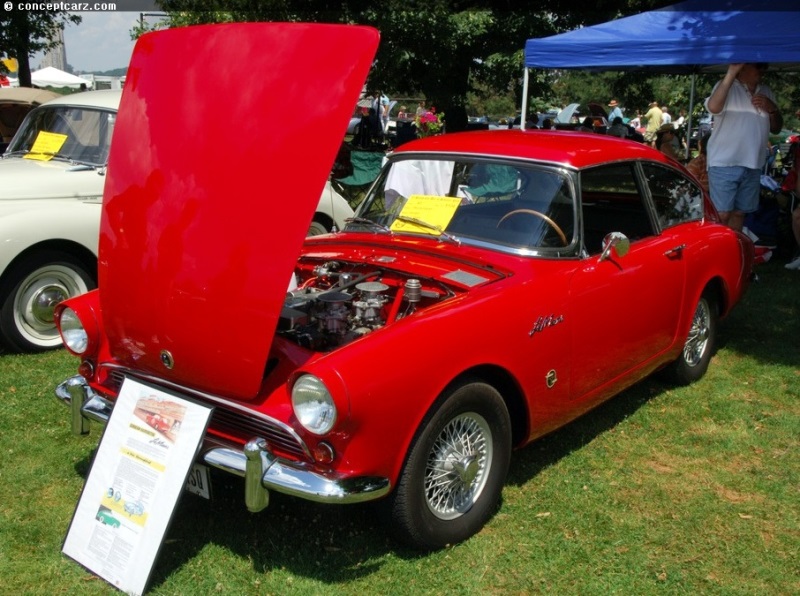
The Alpine name was revived for the 1960 model year. It used many design and mechanical elements from the Hillman Minx-based Rapier. The assembly work was done by Armstrong-Siddeley initially, but later handled by Rootes. The drivetrains were from the Rapier. The design featured long sharp-pointed tailfins that housed the tail lamps. In front there was a curved windshield and a grille with curved upper bar and small horizontal bars. 
Sport RoadsterPower initially came from a 91.2 cubic-inch four-cylinder overhead-valve engine capable of producing nearly 84 horsepower. The displacement later increased to 97.2 cubic-inches and developed 80 DIN. Standard equipment included roll-up windows and a tachometer. Disc brakes and a close-ratio four-speed gearbox were also standard. Options included a lighter, ammeter and a clock. From 1962 through 1963, Sunbeam produced a Le Mans edition. This fastback coupe was created by Harrington coachbuilders and had a fiberglass roof. Horsepower rating, depending on tune, ranged from the high 80s to 100 HP. In total, 250 examples of the LeMans edition were produced.
by Daniel Vaughan | Jun 2011

Sport Roadster
by Daniel Vaughan | Jun 2011
Related Reading : Sunbeam Alpine History
The Sunbeam Alpine was introduced in 1953 and its arrival was historic, as it was the first vehicle to bear the Sunbeam name alone since the 1920 merger of Sunbeam, Talbot, and Darracq. It was a derivative of the Sunbeam-Talbot 90 Saloon, and thus (in modern times), is often referred to as the Talbot Alpine. It was the work of Sunbeam-Talbot dealer George Hartwell in Bournemouth who was working on....
Continue Reading >>
Continue Reading >>
Similarly Sized Vehicles
from 1963
Similarly Priced Vehicles


1963 Sunbeam Alpine Vehicle Profiles


Recent Vehicle Additions


Performance and Specification Comparison
Price Comparison
$2,400 - $2,700
Alpine Series Specification Comparison by Year
Year
Production
Wheelbase
Engine
Prices
Related Automotive News

100 Years of the Bugatti Type 30 – A Cornerstone of Bugatti's Evolution
Eight cylinders, a displacement of two liters, 100 PS and speeds up to 145 kmh – the figures of a true sports car for the road of 100 years ago. Bugatti rolled out the Type 30 in 1922 as its latest production automobile. In addition to its increased...

Toyota Marks 50-Millionth Corolla Sold
From A Humble Start, the Corolla Grew to Become the Worlds Best-Selling Model, and Toyota Celebrates This Milestone Cars Place in Automotive History and Customers Lives
PLANO, Texas (August 26, 2021) – This past July, Toyota sold the 50-millionth...

The Ultimate Beach Cruiser: The 1974 Volkswagen Acapulco Thing
The Volkswagen Type 181 – commonly referred to as The Thing – has always been a fun summer classic for drivers who enjoy a cool and wildly original type of ride. The removable doors, retractable soft top and folding windshield provided a driving experience...

London Concours 2020 To Celebrate 'Lost Marques'
The London Concours has announced the Lost Marques display – an homage to those marques we have loved and lost
Models from the likes of Facel Vega, Bizzarrini, Austin Healey, Alvis, Jensen and many more will grace the lawn as part of the display...

Extremely Original 'Holy Grail' 1970 Oldsmobile 442 W-30 Convertible at Russo and Steele's 2016 Arizona Auction Event
Scottsdale, Arizona (November 24, 2015) – While Oldsmobile is believed to have created the first true American muscle car with the release of its 303 V-8 Rocket 88 in 1949, it was not until 1964 that it returned to the concept with the 442 option,...