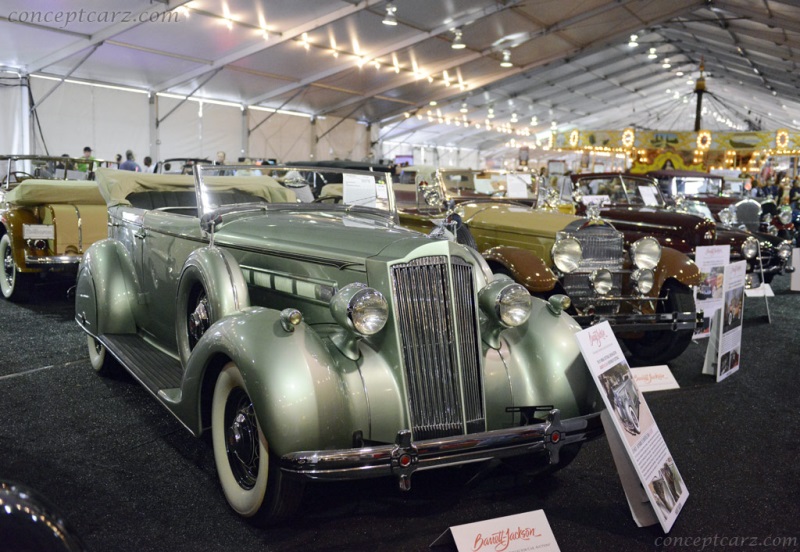
The Packard One Twenty was the car that enabled Packard to survive the Great Depression, costing less than half of what the Senior models did while still offering genuine Packard quality and straight eight-cylinder performance. Created under the supervision of Packard president Alvan Macauley and new hire George T. Christopher, it embraced the rounded, streamlined appearance that was becoming so popular at the time, with a steeply raked radiator shell and smooth fenders. They had the classic and traditional Packard appearance with red hexagon hubcaps, a radiator outline, and prominent Packard badges. 
Tourer Sedan
View info and historyPackard had previously attempted a smaller, lower-priced car in 1932 called the Series 900 Light Eight, however, it was a disappointment, but as the Depression deepened, the need for a price leader became more acute. Thus the birth of the One Twenty, named for its wheelbase.The 900 had used the same engine as the full-size Standard Eight, however, the One Twenty received a new straight-eight with four-fifths the displacement of the larger Eight, but making eighty-five percent of its power. The body was all new and the One Twenty pioneered two new features that were not yet seen on senior Packards: independent front suspension and hydraulic brakes. The nearly 25,000 units produced in its inaugural year were three times the volume of all other Packards combined. The 1936 Packard styling was an evolution of the designs introduced in 1932 that was a watershed and fleeting moment of perfection as industry priorities were changing rapidly. Quieter and smoother riding cars were growing in demand and drivers expected cars to provide light steering and proper braking. The stately twenty-inch wheels shrank to seventeen-inch wheels and fenders gained skirting to hide the empty space of the lost wheels. Packard stylists worked aggressively to keep pace with the mechanical changes and to adapt designs that would incorporate the new trends and technologies. Up to 1934, the bodies were basically designed for the earlier 1930-32 era cars, and the fenders and noses were changed to blend the two.
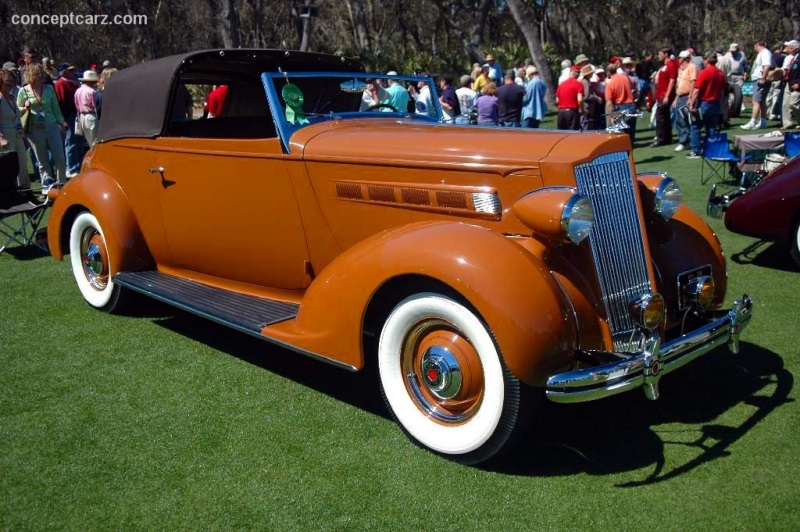
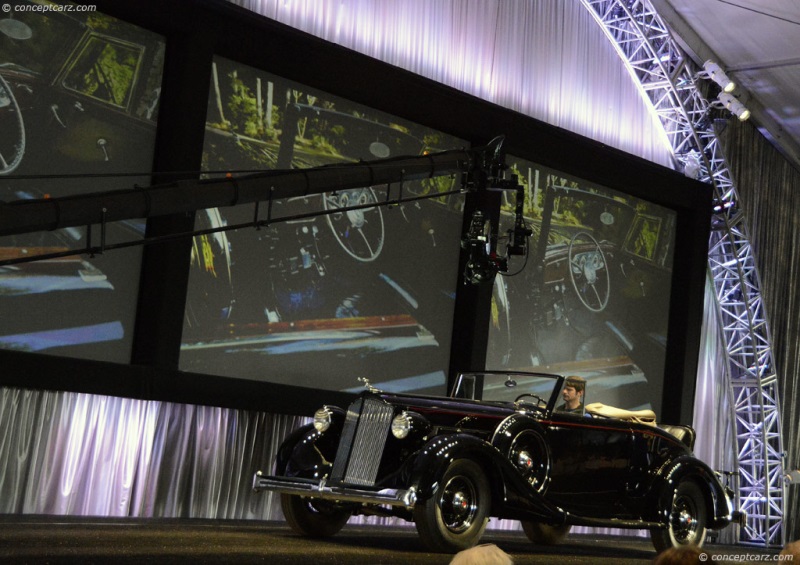
Convertible Sedan1935 ushered in a new line of Packard bodies and fenders that better embraced the smaller wheels and lower frames. Styling updates for 1936 perfected the radiator shell and front-end design that perfectly complemented the wonderfully proportioned bodies mated to fenders with exquisite lines and handsome curved lower edges. Additionally, the steering was light but responsive and the hydraulic brakes provided excellent stopping power. The One Twenty was upgraded in 1936 to 120-B specification and continued to sell in record numbers. The 120-B was revealed in September 1935 with a larger 282-cubic-inch straight-eight engine (now offering 120 horsepower, the same figure as its wheelbase size of 120-inches) and other refinements, such as a new cellular radiator, accelerator linkage, shift mechanism, and coil springs. The most expensive body style was the new convertible sedan body listing at $1,395, compared to the standard business coupe at $990. Other available bodies included the sport coupe, touring coupe, sedan, touring sedan, and the convertible coupe with rumble seat. Stylistically, the One-Twenty models were nearly identical in design and appearance to their vaunted 'Senior' counterparts, with the up-to-date streamlined design theme, fashionably raked radiator grilles, roomy and comfortable interior accommodations, and comprehensive instrumentation. It is believed that two examples of the 1936 One Twenty received LeBaron custom coachwork designed by Thomas Hibbard, formerly Howard 'Dutch' Darrin's partner in Paris coachbuilding and one of LeBaron's co-founders. it is believed that both cars were built for George Washington Hill, of White Plains, New York, the second-generation president of the American Tobacco Company. One example was a Convertible Victoria and the other had a similar design but with a fixed roof. Mr. Hill used the convertible while the fixed-roof version was for his wife.
Convertible SedanThe engine was backed by a three-speed selective synchromesh manual transmission with floor-shift control. The straight 8-cylinder engine helped the Packard 120 make for a sustainable 85 MPH top speed. Packard would continue the trend downmarket in 1937, adding a six-cylinder model to the lineup, its first six-cylinder car since 1927. The One Twenty line gained a 138-inch wheelbase and its 282 cubic-inch engine continued to offer 120 horsepower. The Packard Eight of 1936 did not appear for 1937 however its 320 cubic-inch could be found in the Super Eight (with wheelbase sizes of 127-, 134, and 139-inches, along with a commercial chassis of 165-inches). The Packard Twelve continued to occupy the top position within the Packard lineup, with its twelve-cylinder engine offering 175 horsepower and its wheelbase lengths of 132.25-, 139.25-, and 144.25-inches.The 1936 Packard One Twenty production was 55,042 units, accounting for approximately ninety percent of Packard's total production.
by Daniel Vaughan | Feb 2021
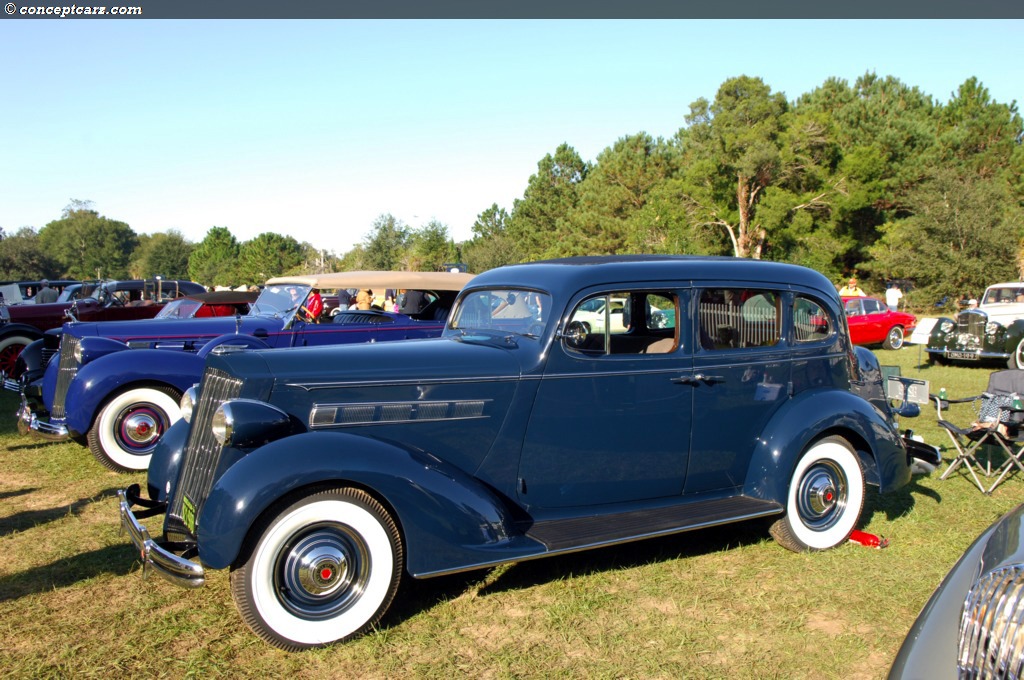
Tourer Sedan
View info and history
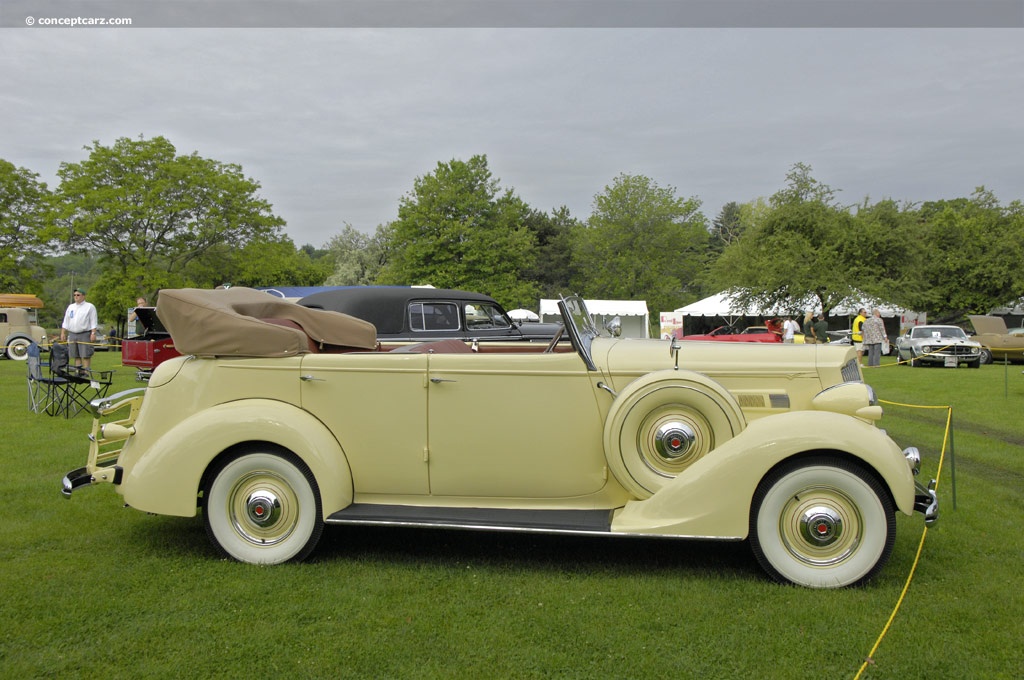
Convertible Sedan
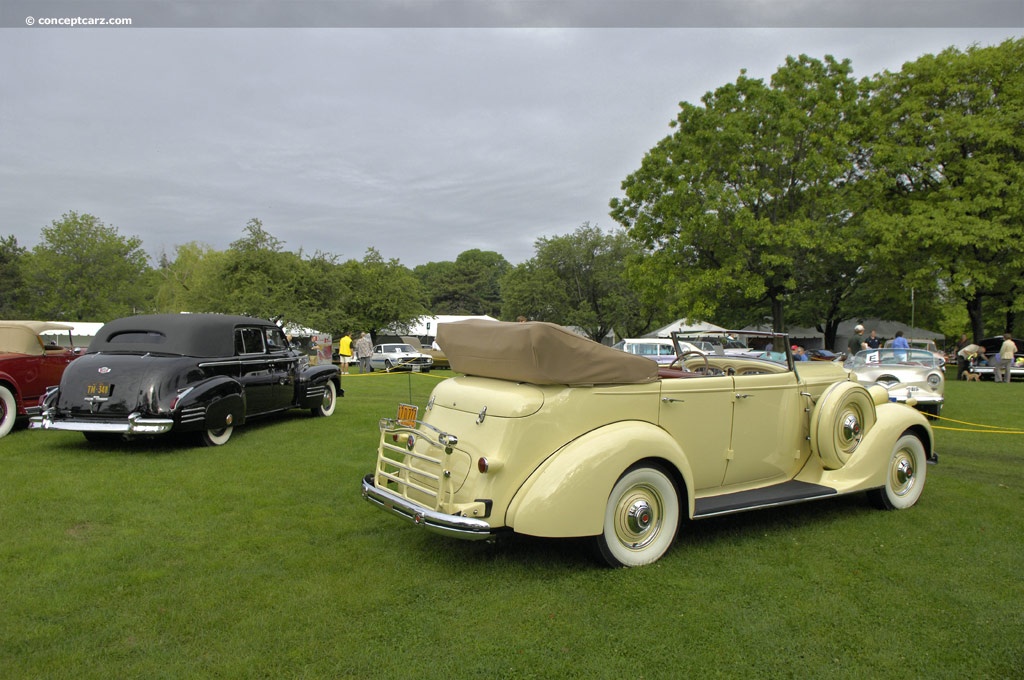
Convertible Sedan
by Daniel Vaughan | Feb 2021
Related Reading : Packard One-Twenty History
The Packard One-Twenty was produced from 1935 through 1937 and again from 1939 through 1941. The One-Twenty signified Packards move into the mid-priced eight-cylinder market a highly competitive segment that was filled with many marques with numerous offerings, options, and price ranges. The move had been made due to financial reasons and the need to stay competitive the Great Depression was taking....
Continue Reading >>
Continue Reading >>
Similar Automakers
Similarly Priced Vehicles


1936 Packard One Twenty Vehicle Profiles




Recent Vehicle Additions


Performance and Specification Comparison
Price Comparison
$2,470 - $5,400
$2,560 - $5,240
$2,900 - $5,820
$3,690 - $4,010
$3,800 - $6,300
$4,300 - $6,400
One-Twenty Specification Comparison by Year
Year
Production
Wheelbase
Engine
Prices
Related Automotive News

All-New Ford Mustang Redefines Driving Freedom With Immersive Digital Cockpit, Advanced Engines and Bold Style
Nearly 60 years after its debut, the all-new, seventh-generation Ford Mustang is the most exhilarating and fun-to-drive yet, thanks to a completely reimagined driving experience
Immersive digital cockpit inspired by fighter jets features two large...

The Hive Has Arrived: All-new 2023 Dodge Hornet Unlocks Gateway to Dodge Muscle, Offers Quickest, Fastest, Most Powerful Compact Utility Vehicle Under $30,000
All-new 2023 Dodge Hornet opens gateway for enthusiasts to enter the Dodge Brotherhood of Muscle, brings buzz to compact utility vehicle (CUV) segment with unmistakable Dodge styling cues and performance
All-new 2023 Dodge Hornet delivers best-in...

2019 Toyota 4Runner Strengthens Legacy In 35Th Year
New Nightshade Special Edition Available on Limited Grade
TRD Pro Adds Fox Suspension, TRD Roof Rack, JBL Premium Audio
Full-capability SUV with Body-On-Frame Construction
TRD Off-Road and Off-Road Premium Grades for Added Capability
270-hp V6 a...

Jaguar Unveils 2018 F-Type Line-Up With All-New Four-Cylinder Engine Option
Expanded F-TYPE model range will now appeal to an even broader range of potential new buyers with 24 variants on offer, with starting prices between %2459,900 and %24125,000(1)
Available with all-new turbocharged 296hp Ingenium four-cylinder engine
Ne...
THE 2015 NISSAN LINEUP: CHARTING THE CHANGES
Nissans U.S. sales have significantly outperformed the industry in 2014, up 12.7 percent CYTD through June. Sales have been led by the recently redesigned Altima, Rogue and Sentra – along with other models such as LEAF (29.4), JUKE (44.9), Frontier...