1911 Model 30 ![]() |
1910 Chalmers Detroit Model 30 news, pictures, and information | ||
| Tweet | ||
![]() | ![]() | ![]() | Touring |
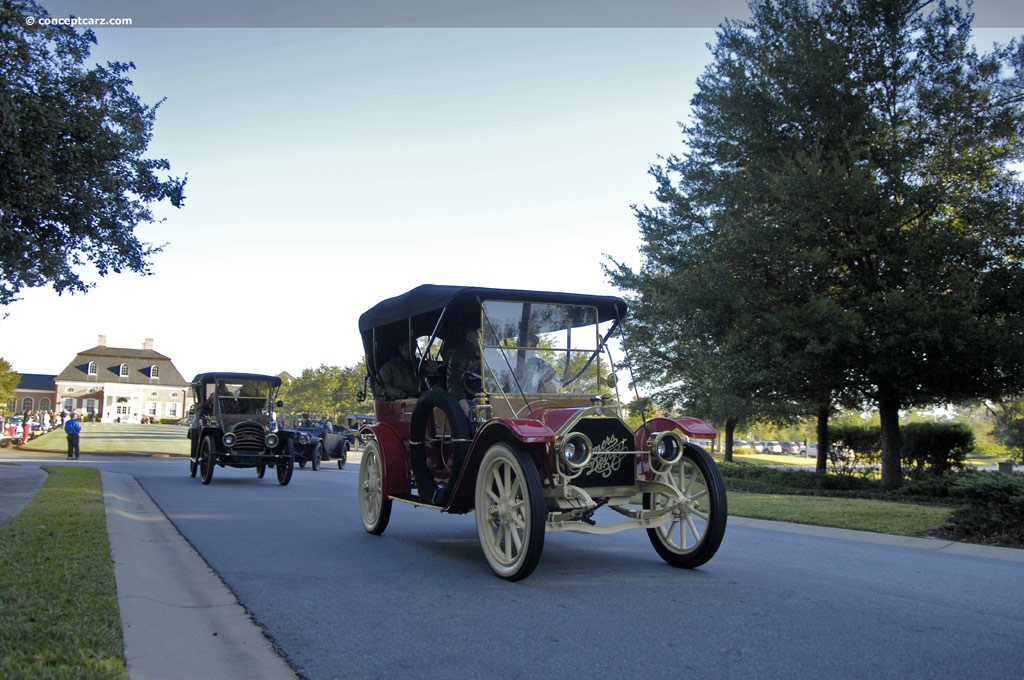
The Chalmers Detroit Model 30 was the winner of the 2,851 mile 1910 Glidden Tour. This was the first major competition won by an automobile costing less than $4,000.
The Chalmers Detroit Motor Company was bought out in late 1910 and it became the Chalmers Motor Company in 1911. It later went on to become the Chrysler Motor Company.
The Chalmers engine was a Thomas design and the crankshaft runs on ball bearings. The differential is the same as that used by the Mercer Motor Company. Both Thomas and Mercer built outstanding competitive automobiles.
In 1907, Hugh Chalmers was recruited by Roy Chapin and Howard Coffin to join the Thomas-Detroit Motor Company. The name of the company was changed to Chalmers-Detroit and new cars were soon introduced. Two examples managed a 1st and 2nd place finish at the Jericho Sweepstakes race on Long Island in 1908. The following year, four wins, three seconds and three thirds in seven races were won by the three-team cars called the 'Chalmers Bluebirds.'
Chapin and Coffin later left the Chalmers Company; by this point, the 'Detroit' part of the name had been dropped. They had formed Hudson in 1909 with financial support from a Detroit merchant. The Chalmers continued with their line of four-cylinder cars; by 1912, a six-cylinder version had been created.
In 1909, a Chalmers car earned a trophy on the 1909 Glidden Tour and won the event outright in 1910. To promote the cars even further, Chalmers presented cars to the baseball players in each major league with the highest batting average. The most valuable player as chosen by sportswriters was also given a car.
There were five models on four wheelbases offered for sale in 1912 by Chalmers. To add even more variety to the mix, there were four different engines with the smallest being the 30-horsepower four-cylinder unit. This engine came with either the Model 11 Tourer or the Model 9 Coupe or Roadster. The Model 9 had a short 104-inch wheelbase and the Model 11 a 115-inch wheelbase. The Model 10 had a 40-horsepower four-cylinder engine and a 122-inch wheelbase. The top-of-the-line model was the Model 12, fitted with a 54-horsepower six-cylinder engine and resting on a wheelbase that measured 130-inches.
By 1917, the Chalmers had sent new marks for 10 miles, 100 miles and a 24-hour average in speed-record activity. Even with these impressive accomplishments, the company struggled in the post-WWI recession. In 1922 the company merged with Maxwell and later, the combined company became part of Chrysler in 1924.
By Daniel Vaughan | Nov 2008
Chapin and Coffin later left the Chalmers Company; by this point, the 'Detroit' part of the name had been dropped. They had formed Hudson in 1909 with financial support from a Detroit merchant. The Chalmers continued with their line of four-cylinder cars; by 1912, a six-cylinder version had been created.
In 1909, a Chalmers car earned a trophy on the 1909 Glidden Tour and won the event outright in 1910. To promote the cars even further, Chalmers presented cars to the baseball players in each major league with the highest batting average. The most valuable player as chosen by sportswriters was also given a car.
There were five models on four wheelbases offered for sale in 1912 by Chalmers. To add even more variety to the mix, there were four different engines with the smallest being the 30-horsepower four-cylinder unit. This engine came with either the Model 11 Tourer or the Model 9 Coupe or Roadster. The Model 9 had a short 104-inch wheelbase and the Model 11 a 115-inch wheelbase. The Model 10 had a 40-horsepower four-cylinder engine and a 122-inch wheelbase. The top-of-the-line model was the Model 12, fitted with a 54-horsepower six-cylinder engine and resting on a wheelbase that measured 130-inches.
By 1917, the Chalmers had sent new marks for 10 miles, 100 miles and a 24-hour average in speed-record activity. Even with these impressive accomplishments, the company struggled in the post-WWI recession. In 1922 the company merged with Maxwell and later, the combined company became part of Chrysler in 1924.
By Daniel Vaughan | Nov 2008
![]() | ![]() | ![]() | Touring Chassis Num: 2475 |
| Sold for $60,500 at 2010 RM Auctions. | |||
The engine is a 141 cubic-inch, overhead-valve four-cylinder engine delivering 30 horsepower. There is a three-speed manual transmission and rear-wheel mechanical drum brakes. There is a solid front axle with semi-elliptic leaf springs with a live rear axle riding on three-quarter-elliptic leaf springs.
In 2010, this Model Thirty Touring car was offered for sale at the Vintage Motor Cars of Meadow Brook where it was estimated to sell for $30,000 - $40,000. As bidding came to a close, the car was sold for the sum of $60,500 including buyer's premium.
By Daniel Vaughan | Aug 2010
| Similar Automakers | |
| American | Chandler |
| EMF | Locomobile |
| Lozier | Marr |
| Mercer | National |
| Paige | Penn |
| Pierce Arrow | Simplex |
| Stellite | Stevens Duryea |
| Stoddard-Dayton | Stutz |
| Chalmers: 1900-1910 |
| Similar Automakers |
| Other models by Chalmers |
| Related Articles and Event Coverage |
| RM Auctions - Vintage Motor Cars of Meadow Brook |
| Hilton Head Island Concours d'Elegance & Motoring Festival |
| Thirty |
1911 Model 30 ![]() |


