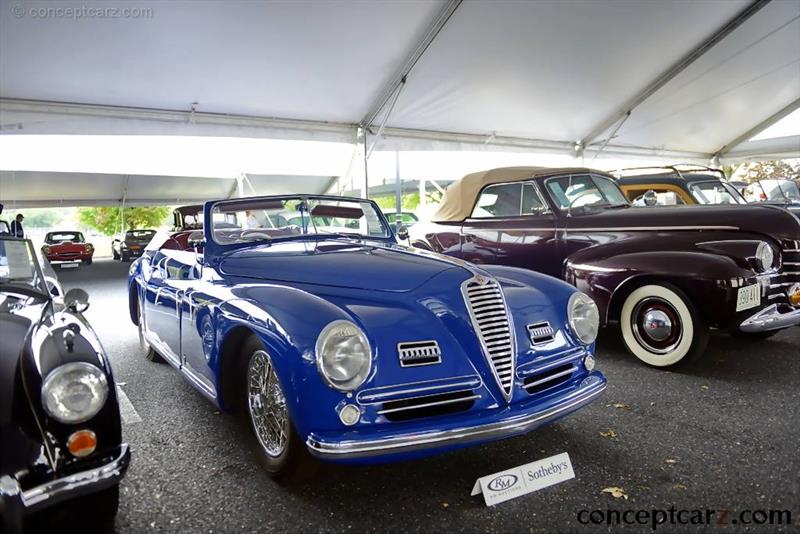
1947 6C 2500 Sport |
1948 Alfa Romeo 6C 2500 news, pictures, and information | ||
| Tweet | ||
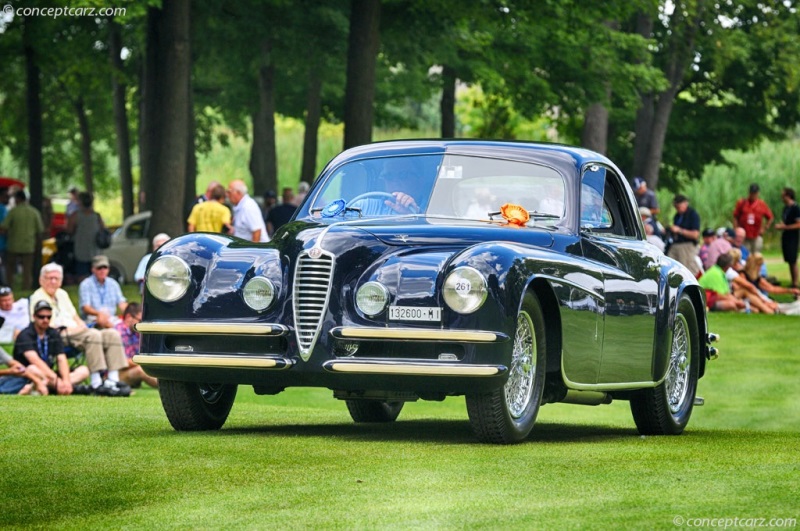
![]() | ![]() | ![]() | Coupe Coachwork: Touring |
The car is powered by a water-cooled, double-overhead-cam, 6-cylinder, 2,443 cc (2.44-liter), 95-horsepower engine, coupled to a 4-speed manual transmission. This 3,014-pound vehicle has a top speed of 95 mph.
A complete factory specification nut and bolt restoration was recently completed. The Amelia Island Concours was its first American concours participation.
One of the most beautiful cars of the lat 1940s, the Alfa Romeo 6C 2500 was among the first Italian sports cars to go into production after World War II. The superbly styled coachwork by Pininfarina earned the 6C 2500 dual honors; it was one of the last cars to be recognized by the Classic Car Club of America and one of the first to be honored by the Milestone Car Society as a postwar collectible. Subtle in its design, most Alfa Romeo 6C 2500s, such as this award-winning example from the Jerry McAlevy Collection, had only minor exterior embellishments.
Equipped with a four-wheel fully independent suspension and hydraulic brakes, the 6C 2500 Sport and Super models were powered by a race-proven 2,443-cc six-cylinder, dual-overhead cam engine, with hemispheric combustion chambers. Sport models had a single-barrel carburetor, 7:1 compression ratio, and developed 90 horsepower.
The car's striking shape was actually narrower at the rear than the front, which led to the unusual three-passenger front bench seat, divided by a smaller driver's cushion and a cozy two-passenger rear seat. The cars were right-hand drive, with a four-speed shifter mounted on the left side of the steering column.
The 6C 2500 interiors were superbly appointed with jewel-like instruments, faux yellow ivory control knobs, and luxurious upholstery of glove-soft leather. Such fine detail was a hallmark of these last almost hand-built Alfa Romeo tourers.
Equipped with a four-wheel fully independent suspension and hydraulic brakes, the 6C 2500 Sport and Super models were powered by a race-proven 2,443-cc six-cylinder, dual-overhead cam engine, with hemispheric combustion chambers. Sport models had a single-barrel carburetor, 7:1 compression ratio, and developed 90 horsepower.
The car's striking shape was actually narrower at the rear than the front, which led to the unusual three-passenger front bench seat, divided by a smaller driver's cushion and a cozy two-passenger rear seat. The cars were right-hand drive, with a four-speed shifter mounted on the left side of the steering column.
The 6C 2500 interiors were superbly appointed with jewel-like instruments, faux yellow ivory control knobs, and luxurious upholstery of glove-soft leather. Such fine detail was a hallmark of these last almost hand-built Alfa Romeo tourers.
The Alfa Romeo 6C 2500 was introduced near the end of the 1930's. The 6C name was derived from the engine size, an inline-six while the 2500 represented the engines cubic-centimeter displacement size.
The engine was a version of Vittorio Jano designed six-cylinder engine. The 6C was available in a plethora of body styles and wheelbases and was produced during two different times in history. Most of the coachwork was handled by Touring of Italy or by Pinin Farina. The body styles ranged from coupes and convertible to four-seater salon. In 1939 Alfa Romeo introduced the SS version, a short-wheelbase model, dubbed 'SS' for Super Sport, that had a high-compression 6C engine rated at 105 horsepower. It was the top-of-the line 6C model that married style and performance together to create the perfect road-going vehicle.
World War II had interrupted production for many automobile manufacturers. During this time many switched their efforts to support the war, such as building engines for marine and aircraft or by producing vehicles that were suitable for war time. When Alfa Romeo resumed production, their vehicles were similar to those they had offered in 1939. The main difference was that Alfa Romeo now bodied the cars themselves rather than providing the rolling chassis for custom coachbuilders to body. The designs had become standard but they were still based on sketches and designs produced by coachbuilders such as Pinin Farina and Touring. Pinin Farina built the exclusive bodies such as the Cabriolet. These vehicles were elegant and stylish and had a price tag that matched. Touring built the Coupes which became known as the Villa d'Este in 1949 after winning the famous Concours d'Elegance Villa d'Este. When outfitted with the Superleggera, meaning light weight, bodies they were capable of speed of over 100 mph.
The engines were similar to the Jano designed six-cylinder power plant, capable of producing 110 horsepower. Independent suspension was installed to soften the ride while improving performance and handling characteristics. A four-speed manual transmission was similar to the one used prior to the onset of the war.
The history of the Alfa Romeo 6C 2500 automobiles are extensive. The various designs and body-styles matched with their mechanical capabilities make these one of the finest Alfa Romeos ever produced.
By Daniel Vaughan | Oct 2005
The engine was a version of Vittorio Jano designed six-cylinder engine. The 6C was available in a plethora of body styles and wheelbases and was produced during two different times in history. Most of the coachwork was handled by Touring of Italy or by Pinin Farina. The body styles ranged from coupes and convertible to four-seater salon. In 1939 Alfa Romeo introduced the SS version, a short-wheelbase model, dubbed 'SS' for Super Sport, that had a high-compression 6C engine rated at 105 horsepower. It was the top-of-the line 6C model that married style and performance together to create the perfect road-going vehicle.
World War II had interrupted production for many automobile manufacturers. During this time many switched their efforts to support the war, such as building engines for marine and aircraft or by producing vehicles that were suitable for war time. When Alfa Romeo resumed production, their vehicles were similar to those they had offered in 1939. The main difference was that Alfa Romeo now bodied the cars themselves rather than providing the rolling chassis for custom coachbuilders to body. The designs had become standard but they were still based on sketches and designs produced by coachbuilders such as Pinin Farina and Touring. Pinin Farina built the exclusive bodies such as the Cabriolet. These vehicles were elegant and stylish and had a price tag that matched. Touring built the Coupes which became known as the Villa d'Este in 1949 after winning the famous Concours d'Elegance Villa d'Este. When outfitted with the Superleggera, meaning light weight, bodies they were capable of speed of over 100 mph.
The engines were similar to the Jano designed six-cylinder power plant, capable of producing 110 horsepower. Independent suspension was installed to soften the ride while improving performance and handling characteristics. A four-speed manual transmission was similar to the one used prior to the onset of the war.
The history of the Alfa Romeo 6C 2500 automobiles are extensive. The various designs and body-styles matched with their mechanical capabilities make these one of the finest Alfa Romeos ever produced.
By Daniel Vaughan | Oct 2005
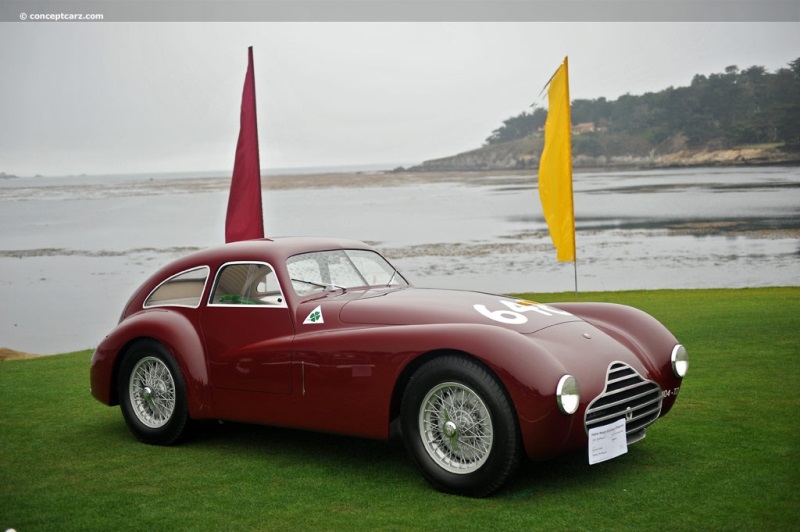
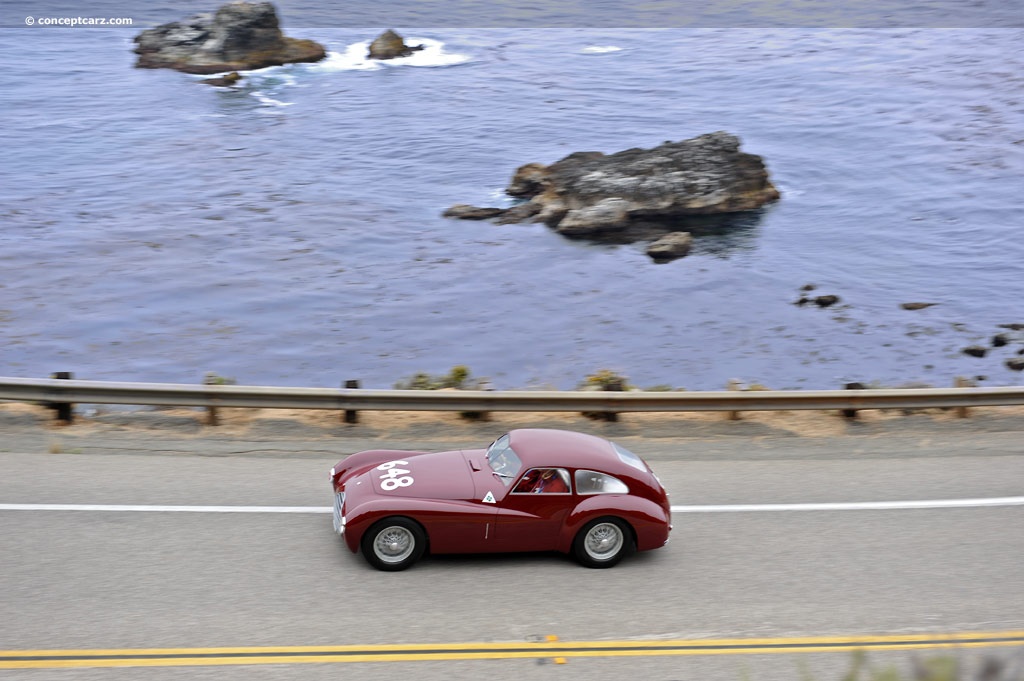
![]() | ![]() | ![]() | Competizione Coupe Chassis Num: 002 |
![]() | ![]() | ![]() | Coupe Coachwork: Touring |
Touring continued in operation until 1967 when it fell victim to Italy's labor unrest and closed down.
The 6C 2500 was produced from 1939, slowed during the war, and then continued from 1946 through 1953. It was a popular model with celebrities and examples were owned by Ali Kahn, Rita Haywood, Dick Powell and, more recently, Eric Clapton.
Photos of the car shown have appeared in two definitive books: 'Touring' and 'The 6C 2500 Histories.' Only 60 cars were built with this car's body style.
![]() | ![]() | ![]() | Competizione Coupe |
The Alfa Romeo 6C 2500 was introduced near the end of the 1930's. The 6C name was derived from the engine size, an inline-six while the 2500 represented the engines cubic-centimeter displacement size.
The engine was a version of Vittorio Jano designed six-cylinder engine. The 6C was available in a plethora of body styles and wheelbases and was produced during two different times in history. Most of the coachwork was handled by Touring of Italy or by Pinin Farina. The body styles ranged from coupes and convertible to four-seater salon. In 1939 Alfa Romeo introduced the SS version, a short-wheelbase model, dubbed 'SS' for Super Sport, that had a high-compression 6C engine rated at 105 horsepower. It was the top-of-the line 6C model that married style and performance together to create the perfect road-going vehicle.
World War II had interrupted production for many automobile manufacturers. During this time many switched their efforts to support the war, such as building engines for marine and aircraft or by producing vehicles that were suitable for war time. When Alfa Romeo resumed production, their vehicles were similar to those they had offered in 1939. The main difference was that Alfa Romeo now bodied the cars themselves rather than providing the rolling chassis for custom coachbuilders to body. The designs had become standard but they were still based on sketches and designs produced by coachbuilders such as Pinin Farina and Touring. Pinin Farina built the exclusive bodies such as the Cabriolet. These vehicles were elegant and stylish and had a price tag that matched. Touring built the Coupes which became known as the Villa d'Este in 1949 after winning the famous Concours d'Elegance Villa d'Este. When outfitted with the Superleggera, meaning light weight, bodies they were capable of speed of over 100 mph.
The engines were similar to the Jano designed six-cylinder power plant, capable of producing 110 horsepower. Independent suspension was installed to soften the ride while improving performance and handling characteristics. A four-speed manual transmission was similar to the one used prior to the onset of the war.
The history of the Alfa Romeo 6C 2500 automobiles are extensive. The various designs and body-styles matched with their mechanical capabilities make these one of the finest Alfa Romeos ever produced.
By Daniel Vaughan | Oct 2006
The engine was a version of Vittorio Jano designed six-cylinder engine. The 6C was available in a plethora of body styles and wheelbases and was produced during two different times in history. Most of the coachwork was handled by Touring of Italy or by Pinin Farina. The body styles ranged from coupes and convertible to four-seater salon. In 1939 Alfa Romeo introduced the SS version, a short-wheelbase model, dubbed 'SS' for Super Sport, that had a high-compression 6C engine rated at 105 horsepower. It was the top-of-the line 6C model that married style and performance together to create the perfect road-going vehicle.
World War II had interrupted production for many automobile manufacturers. During this time many switched their efforts to support the war, such as building engines for marine and aircraft or by producing vehicles that were suitable for war time. When Alfa Romeo resumed production, their vehicles were similar to those they had offered in 1939. The main difference was that Alfa Romeo now bodied the cars themselves rather than providing the rolling chassis for custom coachbuilders to body. The designs had become standard but they were still based on sketches and designs produced by coachbuilders such as Pinin Farina and Touring. Pinin Farina built the exclusive bodies such as the Cabriolet. These vehicles were elegant and stylish and had a price tag that matched. Touring built the Coupes which became known as the Villa d'Este in 1949 after winning the famous Concours d'Elegance Villa d'Este. When outfitted with the Superleggera, meaning light weight, bodies they were capable of speed of over 100 mph.
The engines were similar to the Jano designed six-cylinder power plant, capable of producing 110 horsepower. Independent suspension was installed to soften the ride while improving performance and handling characteristics. A four-speed manual transmission was similar to the one used prior to the onset of the war.
The history of the Alfa Romeo 6C 2500 automobiles are extensive. The various designs and body-styles matched with their mechanical capabilities make these one of the finest Alfa Romeos ever produced.
By Daniel Vaughan | Oct 2006
The engine in the 1927 Alfa Romeo 6C 1500 was the basis for a series of engines that would eventually define the marque as one of the great manufacturers of the pre-war era. The Vittorio Jano designed engine was expanded to 1752cc and became the 6C 1750 which, in various bodystyles and tune, would become the backbone of Alfa Romeo production from 1929 to 1933. Two additional cylinders were later added, becoming the 8C 2300 and ultimately the 8C 2900.
In 1934, Jano introduced a new generation of Alfa Romeo engines, the dual overhead camshaft 6C 2300. The unit had a bore that measured 70mm and a stroke of 100mm. The long stroke gave the engine high torque for drivability. It was given hallow camshafts for superior lubrication resulting in better reliability. There was an improved light alloy cylinder head with chain-driven camshafts. Also adding to the reliability were the seven main bearings, single-piece block and head castings, plus a dual-level sump that acted as an oil cooler.
In 1939, the bore was increased to 72mm, resulting in the 6C 2500 with 2,443cc displacement. This engine was mounted in brilliant chassis's that were a reflection of the company's history in Grand Prix competition. At both the front and rear were an independent suspension with parallel trailing arms at the front and swing axles at the rear. Coil springs could be found in the front and torsion bars in the back.
Most of the 6C models were given custom coachwork.
By Daniel Vaughan | Jan 2009
For more information and related vehicles, click hereIn 1934, Jano introduced a new generation of Alfa Romeo engines, the dual overhead camshaft 6C 2300. The unit had a bore that measured 70mm and a stroke of 100mm. The long stroke gave the engine high torque for drivability. It was given hallow camshafts for superior lubrication resulting in better reliability. There was an improved light alloy cylinder head with chain-driven camshafts. Also adding to the reliability were the seven main bearings, single-piece block and head castings, plus a dual-level sump that acted as an oil cooler.
In 1939, the bore was increased to 72mm, resulting in the 6C 2500 with 2,443cc displacement. This engine was mounted in brilliant chassis's that were a reflection of the company's history in Grand Prix competition. At both the front and rear were an independent suspension with parallel trailing arms at the front and swing axles at the rear. Coil springs could be found in the front and torsion bars in the back.
Most of the 6C models were given custom coachwork.
By Daniel Vaughan | Jan 2009
| Sir Stirling Moss Returns To The Amelia Concours | |
![]() | Sir Stirling Moss defined the image of a professional racing driver. By the time premature retirement was forced upon him by a racing accident at Goodwood in 1962, his name meant 'racing driver'. He was every English schoolboy's hero and the inheritor of grand master and Mercedes-Benz teammate Juan Fangio's orb, scepter and crown. In 1996 Sir Stirling was the Amelia Island Concours d'Elegance first Honorary Chairman. The cover of 'The Amelia's' 1996 collector-grade program depict...[Read more...] |
| Final Countdown Underway To South Florida's Premier Collector Car Auction | |
![]() | • Auctions America kicks off its 2013 auction season, March 22-24 with its highly anticipated Fort Lauderdale Collector Car Auction • Celebrating its 11th year, the multi-day auction features more than 550 quality collector cars • Latest feature attractions include an outstanding 1963 Shelby Cobra and a 1974 Ferrari Dino 246 GTS • Digital catalog now available for download at auctionsamerica.com AUBURN, Indiana (February 27, 2013) – With the final countdown underway to its highly an...[Read more...] |
| 1955 Tourist Trophy: One Last Victory | |
![]() | The tragedy at Le Mans on the 11th of June, 1955 would dramatically affect motor racing. For one of the manufacturers involved, Mercedes-Benz, it would be a confirmation of what it had already come to believe. Toward the end of the 1955 season it was known Mercedes-Benz would withdraw from all motor racing having achieved just about everything possible in Formula One and sportscars. However, on the 18th of September, there would be one last race in which the mighty Silver Arrows would be gunning...[Read more...] |
| Chubb Insurance Concours d'Elegance Judging Day Concludes Salon Prive 2012 | |
![]() | • 'Best of Show' prize goes to the 1950 Ferrari 166 MM Barchetta entered by Dudley and Sally Masson-Styrron • Most prestigious judging panel in Salon Privé history congratulates all category winners for the UK's most outstanding line-up of bikes and cars in 2012 Syon Park, West London, 10th September 2012 – The Chubb Insurance Concours d'Elégance judging day at Salon Privé London marked the close of the Luxury Super Car Show, with a fabulous line up of 111 cars and bikes...[Read more...] |
| Ferrari Club Of America-Southwest Region Hosts International Meet In Palm Springs | |
![]() | 50TH Anniversary of 250GT Enraptures Spirt of Ferrari with More than 150 Ferrari Vehicles to be Displayed The Ferrari Club of America International Meet will return to Southern California for the first time since 2002, to be held from October 10th to 14th in the Palm Springs desert playground. With Southern California being home to the largest concentration of Ferrari owners in the country, the 2012 FCA International Meet promises to be a spectacular event. The luxurious Hyatt Regency ...[Read more...] |
| Similar Automakers | |
| Citroen | Fiat |
| Lancia | Morgan |
| Opel | Peugeot |
| Renault | Seat |
| Skoda | Vauxhall |
| Similarly Sized Vehicles from 1948 |
| Oldsmobile Sixty Series |
| Alfa Romeo: 1941-1950 |
| Similar Automakers |
| Other models by Alfa Romeo |
| 147 156 164 1750 1900 SS | 2000 24HP 2600 6C 8C | 8C 2600 90 Alfetta Arna BAT | Giulia Giulietta Junior Zagato Milano Montreal | P3 RL Spider Sprint Zagato SZ | Tipo 158 Alfetta Tipo 33 TZ |
1947 6C 2500 Sport |


1947 6C 2500 Sport