Concept Cars Home
Image Left 1951 212 Inter1953 212 Inter Image Right
 

1952 Ferrari 212 Inter news, pictures, and information

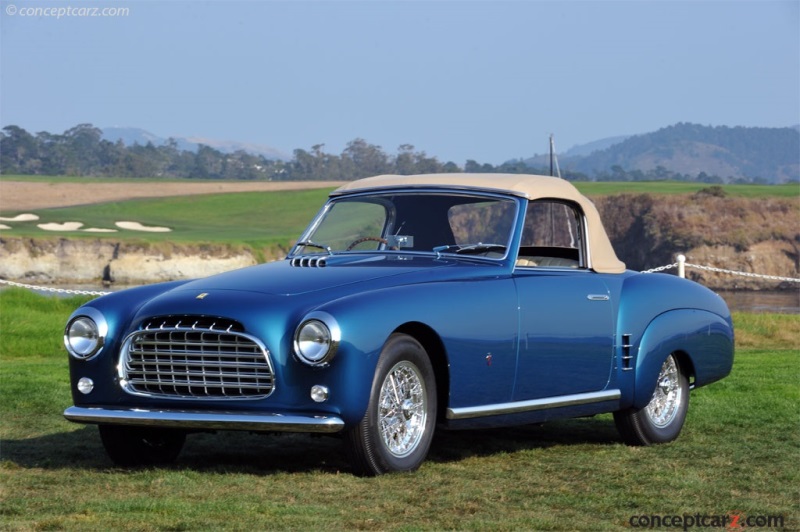
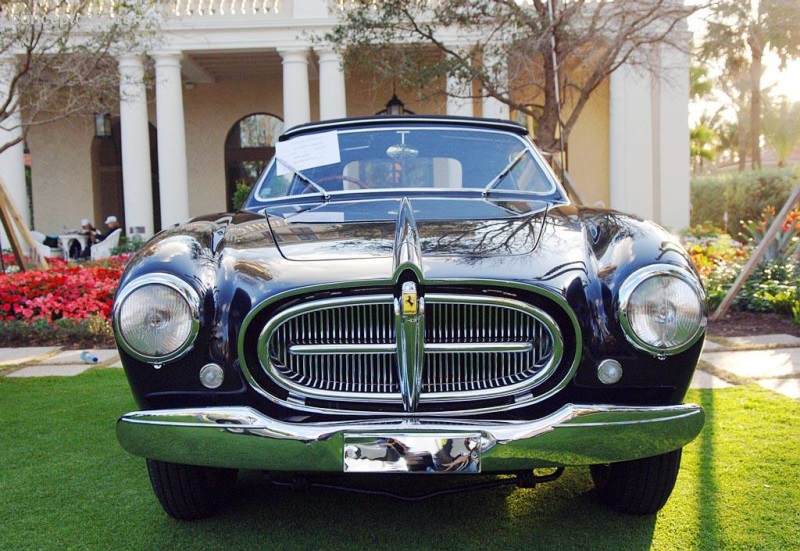
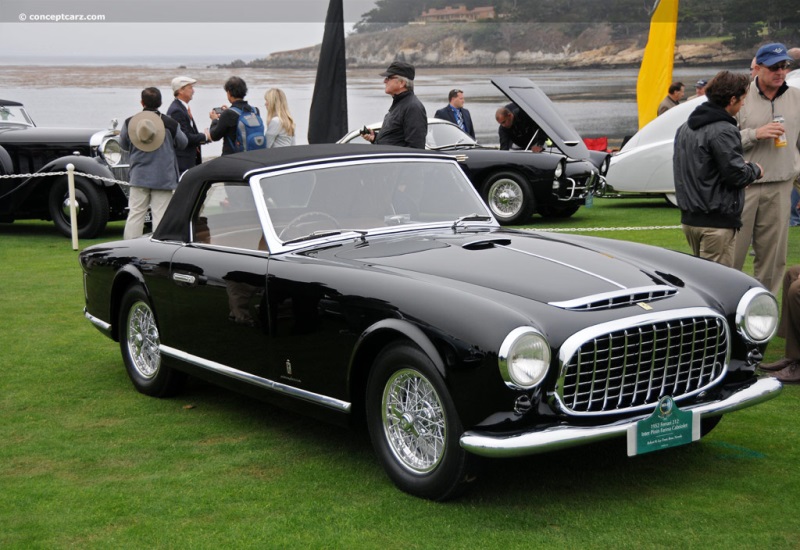
Cabriolet
Designer: Alfredo Vignale
Chassis Num: 0255EU
 
The V12 engine used in the 212 was bored out to 68mm and achieved a 2562cc displacement. Only one Weber carburetor was used but was good enough to produce about 130 horsepower and a top speed of 120 mph. The Export version received three Weber carburetors and produced about 150 hp and saw a top speed of about 140 mph. In 1952 modified cylinder heads were incorporated which produced another 5 hp. A little over 12 Export versions were produced while production numbers for the Inter (road) version was around 80.

Ferrari 212 Inter with chassis number 0255EU is a right-hand drive vehicle, bodied by Vignale in Cabriolet configuration. It is referred to as a 212 Europa. The car has spent most of its life in the United States, mostly in California. In most of its life it was finished in red with a black top. Only in recent years has it been given a black exterior, but still retains the red interior with blue carpet.

It was shown in 1984 at the International Ferrar Concours. It participated in the Tour de France Auto in 1997. It was sold to its present owner sometime during the late 1990s and early 2000's. Since that time it has participated in the Tour Auto in 2003 and 2005. It was a participate in the Mille Miglia in 2005 and shown at the Cavallino Classic in 2007.

By Daniel Vaughan | Feb 2010
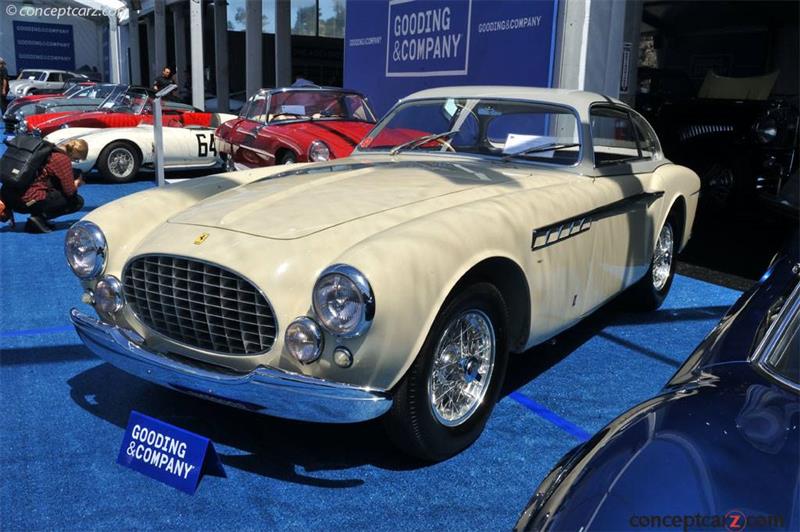
Coupe
Coachwork: Ghia
Chassis Num: 0213EL
 
The legend of Ferrari dates back to 1940. That year marks the birth of the Type 815 for use in the substitute Mille Miglia event. Ferrari went on to manufacture tools during the war, returning to vehicle production in 1946. Initial production was for racing; street cars came later.

The Ferrari 212 was built in two versions: the Inter and the short wheelbase Export. Production was approximately 90 cars. The power unit of the 212 was the classic Ferrari V12 designed by Giocchino Colombo in 1945. Among the 212's customers were Italian film star Anna Magnini and the neorealist film director Roberto Rosselini. Racing driver Mike Hawthorn used a 212 Fastback Coupe bodied by Touring as his personal road car. The 212's V12 produced 170 horsepower from its 2.56 liter displacement, and with a five-speed transmission, propelled the car to a top speed of 118 mph. The chassis was of tubular construction, and suspension was independent in front via transverse leaf springs and wishbone. Rear suspension is by semi-elliptic leaf springs, and brakes are four-wheel drums. The nominal weight is 2,420 pounds. This example has been owned by its current owner for over 50 years, and is the only three-window coupe ever built on a Ferrari chassis by Ghia.
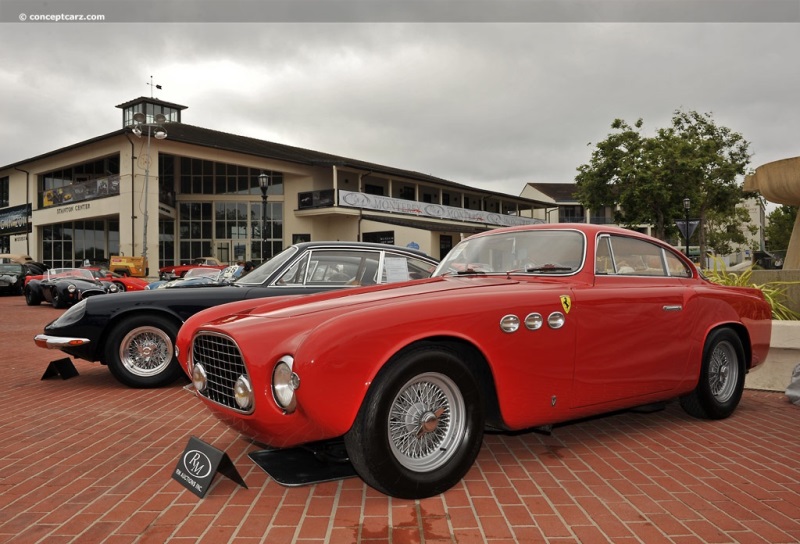
Coupe
Designer: Pininfarina
Chassis Num: 0263 EU
 
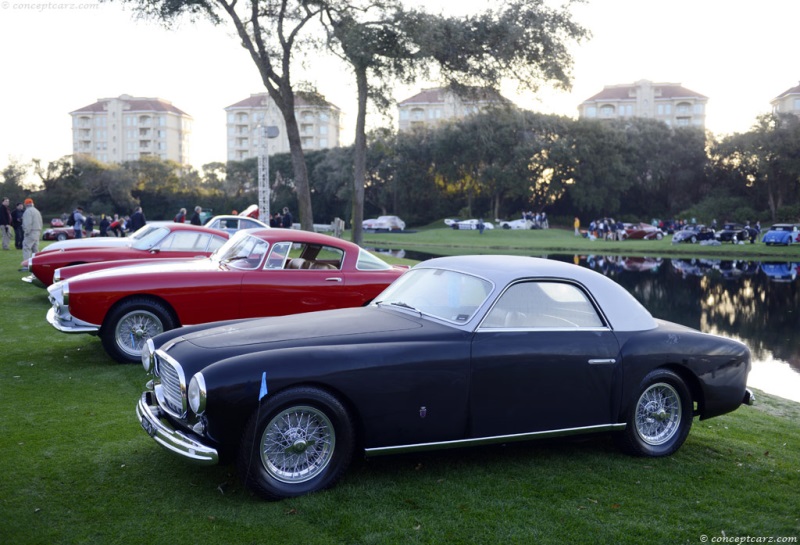
This 1953 Ferrari 212 Inter Pinin Farina Coupe with serial number 0263 EU was a Turin and Geneva show car in 1953. It is also the first Ferrari to score 100 points at the Pebble Beach Concours, which it did in August of 1993. It has been a class winner at the prestigious Cavallino Classic and the Ferrari Club National Meet.
By Daniel Vaughan | Feb 2007
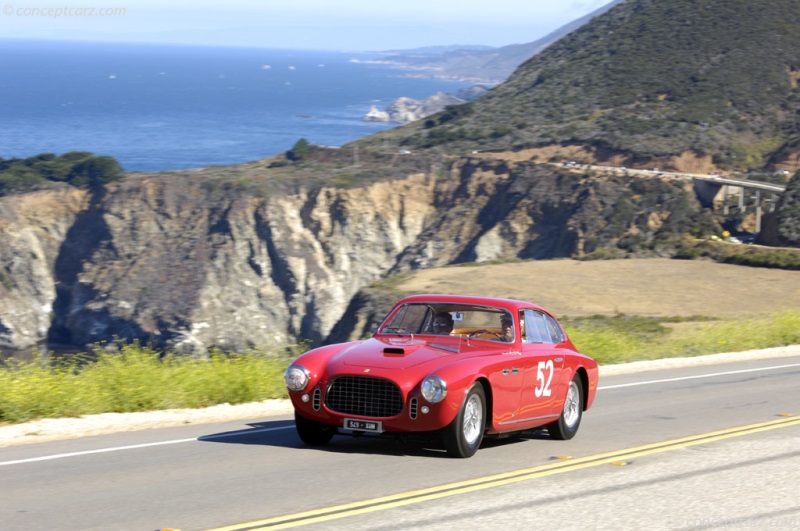
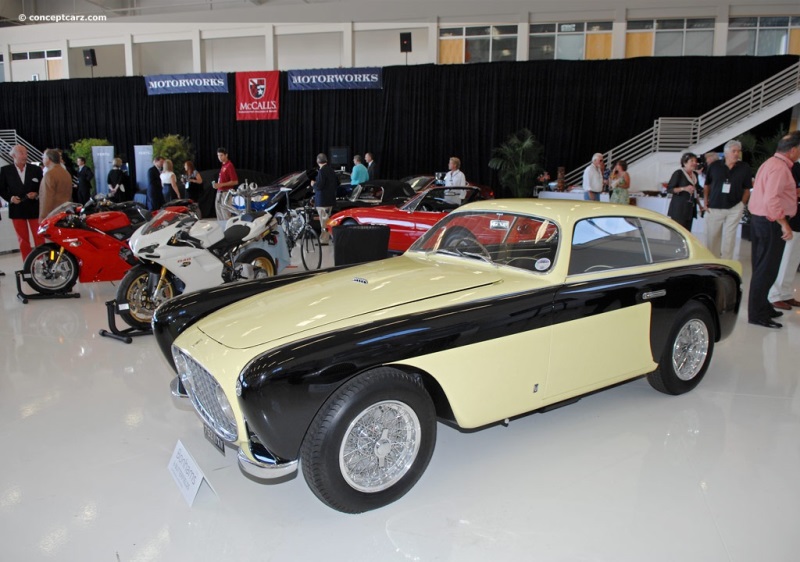
Coupe
Designer: Alfredo Vignale
Chassis Num: 0197 EL
Engine Num: 0197EL
 
Ferrari 212 Inter with chassis number 0197EL is a right-hand drive vehicle in coupe configuration and bodied by Vignale. It is finished in a brilliant two-tone yellow with black fenders and stripe that extends the length of the vehicle just under the side windows.

It was sold to its first owner in June of 1952. From then it passed to Luigi Chinetti, the major US importer of Ferrari automobiles. From then it passed through several owners, mostly from the North East part of the United States before returning to Europe in the mid-1970's and into the possession of a UK owner.

Since new it has been fitted with a 250 GT engine from chassis number 1901GT.

It has been campaigned in several historic events such as the Norwich Union RAC Classis run to Silverstone in 1988 and the Christies International Historic Festival at Silverstone in 1992.

In 2009, the car was offered for sale by Bonhams at the Exceptional Motorcars and Automobilia at the Quail Lodge Restort in Carmel, CA. The car was sold for $804,500 inclusive of Buyer's Premium.

By Daniel Vaughan | Nov 2009
Chassis Num: 0292MM
 
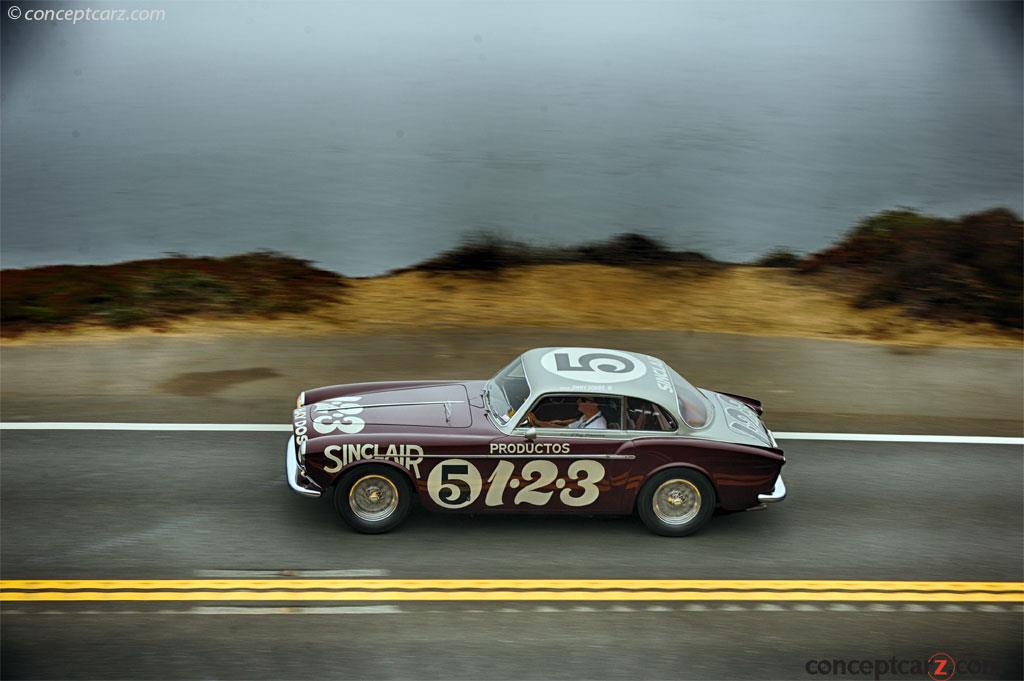
This car began life as a 212-Inter Vignale on October 11, 1952, when Efraim Ruiz Echevarria, a well-known Mexican football star, purchased it to race in the 1952 Carrera Panamericana. Unfortunately, he crashed during the second stage, while running ninth, being pursued by Phil Hill in his 212. This was no disgrace, as the only people ahead of him were Villoresi, Fitch, Kling, Bracco, Lang, Chinetti, McAffee, and Maglioli. After the race, Echvarria decided he would try the 1953 Carrera with the newly developed 250MM. He arranged for the 212-Inter to be returned to the factory and ordered a new 250MM, but as Mexican customs duty had already been paid on the 212, the factory agreed to number his 250MM with the same serial number as the 212. They shipped his new car in time for the 1953 race. His old car was repaired, and was then re-numbered 0292MM, making it very unique. It was sold in June of 1953 to Jan DeVeroon of Holland (a longtime associate of Luigi Chinetti), who took delivery from Modena with the intention of personal use as part of his growing collection.
Coupe
Designer: Alfredo Vignale
Chassis Num: 0257EU
 
Sold for $495,000 at 2007 RM Auctions.
In 1953 Ferrari introduced a new design built atop the 212 Inter chassis and bodied by the Turinese coachbuilder, Carrozzeria Vignale. These became known as the 'Geneva Coupe'. It featured jet-age styling elements such as the elegant fins and rakish roof line. The quarter bumpers sat unconventionally high at all four corners adding much to the dramatic appeal of the vehicles.

This Ferrari 212 Inter 'Geneva' Coupe is the earliest chassis of the six created in this style. It was brought to the San Remo, Italy Concours d'Elegance in 1954 and later shipped to the United states and delivered by Chinetti Motors to its first owner, a Milwaukee, Wi resident. The owner was Mr. Robert C. Wilke, the founder of the Leader Card Indianapolis racing team and owner of many coachbuilt Ferraris. While in Mr. Wilke's care, the engine block developed a crack. It was later replaced by Chinetti with a new block stamped 1499.

The car passed through several owners, coming to the present ownership in 2006, purchased by an American from a Dutch dealer who had it on display at Techno Classica in Essen, Germany.

The car is very much in original condition. It retains its original colors on the interior and exterior. It was brought to the 2007 Monterey Sports & Classic Car Auction presented by RM Auctions, where it had an estimated value of $475,000-$625,000. Bidding proved the estimated value to be accurate, as the lot was sold for $495,000 including buyer's premium.

By Daniel Vaughan | Dec 2007
Geneva Coupe
Coachwork: Vignale
Chassis Num: 0289EU
Engine Num: 0289
 
Sold for $742,500 at 2008 RM Auctions.
Zero-to-sixty miles per hour took only nine seconds in the 212 Inter Coupe with zero-to-100 miles per hour achieved at 22.5 seconds. Several examples were used successfully in international competition, such as in 1953 when Ferrari won the Tour of Sicily, the Coppa Inter Europa at Monza, the Tourist Trophy, the Tour de France and the Carrera PanAmericana in Mexico.

In 1953, a new design on the 212 Inter chassis was introduced by Carrozzeria Vignale, and would be known as the 'Geneva Coupe.' The design was surprisingly similar to the famous PanAmericana 340 Mexico Coupes.

This Ferrari 212 Inter is the last Ferrari 212 Inter bodied by Carrozzeria Vignale. It is one of the few all-alloy construction and left hand drive. The car is fitted with three factory carburetors which helped boost horsepower to 165. There are 12-inch hydraulically-operated aluminum drum brakes with steel liners.

The car was sold new to Alfred Momo in New York where it would remain until 2002 when it was sold to an enthusiast in Japan. It has had only a few owners such as Richard Merritt and Steve Barney (who ran it in the Mille Miglia Storica in 1986 with co-pilot Gerald Roush). In 1991 it was shown on the lawn at Pebble Beach along with a group of historic racing cars and ran regularly at the Monterey Historic races in subsequent years. It has participated in touring events such as the Colorado Grand and the Wine Country Classic.

The Japanese owner treated the car to a comprehensive restoration and then ran it in the Mille Miglia four times, each successfully with no mechanical problems. In the front, a new grille was fabricated to accommodate two flush-mounted, auxiliary driving lights. The front seats were replaced during the restoration. The car is currently painted in Rosso Rubino with tan interior.

In 2008, this vehicle was offered for sale at the 'Sports & Classics of Monterey' presented by RM Auctions. It had an estimated value of $650,000 - $750,000. This alloy-bodied example and the last of six 'Geneva Coupes' built was certainly one of the highlights of the auction. It was sold for $742,500 including buyer's premium.

The car returned to the 'Sports & Classics of Monterey' auction in 2010, where this time it had an estimated value of $650,000-$750,000. As bidding came to a close, the car had been sold for the sum of $654,500 inclusive of buyer's premium.

By Daniel Vaughan | Dec 2010
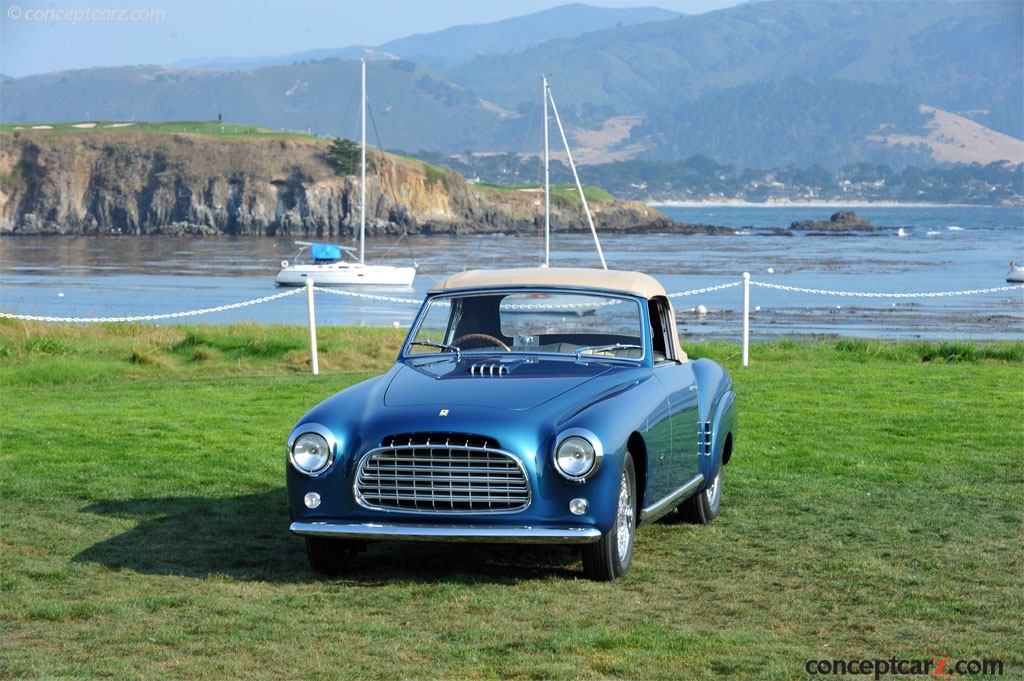
Cabriolet
Coachwork: Pininfarina
Chassis Num: 0177E
 
The Ferrari 212 Inter was built to accept more accommodating and comfortable bodies than its sporting predecessors. This 212 Inter wears the first-ever Pinin Farina coachwork on a Ferrari; it marks the moments that the two companies began their long and prestigious relationship. Ferrari replaced the 212 Inter with the 250 Europa in 1953 but Pininfarina has remained Ferrari's carrozzeria of choice to this day. This unique sports car was purchased by the present owner in the 1980s. It was restored by Pininfarina on the orders of Sergio Pininfarina himself.
Cabriolet
Coachwork: Pininfarina
Chassis Num: 0235EU
 
This is one of two Ferrari 212 Inter Cabriolets designed by Pinin Farina in 1952 for Ferrari to exhibit at European auto shows. This example, chassis 0235EU, appeared at shows in Paris and Brussels. In the 1953 1000 Kilometers of Nurburgring, this graceful, leather-upholstered cabriolet was driven by Autosport journalist Maurice Gatsonides. After many years with various owners, including Alex Ullman, the car has been restored to its 1952 Paris show condition.
The 212 Inter was descended directly from the first Ferrari of just four years previous. Introduced in 1951, the 212 was the replacement for Ferrari's very successful 166 and 195 Inter GT vehicles. This was the eventual evolution of the 166, a sports car that would win international races, as well as being a road-worthy warrior. Sharing a similar chassis to the 125, the 212 had double wishbones in front and live axles in the rear. The final model of the Ferrari's firs series, the versatile V-12 was updated and enlarged to 2,562 cc.

Becoming the youngest winner of the Italian Grand Prix in 1950, Giannino Marzotto, age 22, and heir to a large textile factory wasn't afraid to inform Ferrari about the heaviness and lack of aerodynamics in his available vehicles. Ferrari Responding that his cars were the most efficient in the world, Marzotto set a challenge to improve upon the previous year's Ferrari.

Incorporating a whole new design that was based on the Ferrari 166 with a 212 engine, the low slung body with a rounded shape was built similar to an egg or ‘Uovo'. Builders at this time based their designs on 'optical intuition' rather than wind tunnels eventually used in auto racing. Marzotto called on the aid of coachbuilders Paolo Fontana and Sergio Reggiani of Padua to assist in his design.

Construction of the body of the Ferrari 212 began by utilizing braced box tubes that were covered with Puralumana.; which was a type of Duralumin that assisted in a weight savings of nearly 200lbs. Offering relief from window reflections that can be annoying, a steeply raked front windshield was designed. Unfortunately, during rainstorms and when speed was involved, the wipers lost contact with the windscreen rendering it useless. A result of the original radiator not being delivered in time, the tall radiator was put in place instead, and pushed the bonnet of the 212 to be 15cm higher than originally planned.

Following road-testing in nearby mountains, the Marzollo brothers next took their Uovo to Ferrari in Maranello. This meeting did not go as expected as Ferrari took offence at what he perceived as a challenge from a family of amateurs. Ferrari told the Marzotto brothers that would enter a car in Sicily driven by Taruffi to ‘defend the colors of the Cavallino', which only served to stiffen the resolve of the brothers.

During the 1951 Mille Miglia, Giannino brought his Uovo newly fitted with triple carburetors to boost the engine to 186 hp. This now improved aerodynamics and lightened the weight, making it able to match the overall speed of the larger cars. The main advantage that the Uovo had over other vehicles was its maneuverability.

Following the first 600 of 1600 kilometers at the Giro di Sicilia, Giannino opened a 10-minute lead over the entire field. Unfortunately, Marzotto had to withdraw from the race due to a loud drumming noise coming from the rear of the car. Fearing a frozen differential that might toss his vehicle into the Italian countryside, and himself into immortality, Marzotti withdrew from the race that was eventually won by Villoresi in of the of the 4.1s.

The Uovo reached victory at the following race, the Giro di Toscana. A return to the Mille Miglia was made in 1953 by Giannino Marzotto, as well as a victory driving one of the Ferrari 4.1s.

The Coachbuilders for the Ferrari 212 included such elite designers as Pinin Farina, Ghia, Vignale and Carrozzeria Touring. Similar to the 195, the 212 produced additional displacement over the 166 with a larger bore, this time to 68 mm.

The Ferrari 212 V12 continued in production until as late as 1953 and continued for a longer period than a 195. Compared to about 80 of the 212 Inter versions, around two dozen Export models were produced. A total of 15 Ferrari 212 Vignale Coupes were ever produced.

By Jessica Donaldson

166, 195, and 212

The 166 Inter was powered by a 2-liter V12 engine and produced 115 horsepower. These were road cars and were given odd chassis numbers. The even chassis numbers were reserved for the vehicles that were intended for racing. The bodies of the Inter vehicles were mostly Berlinetta and Coupes. At first, Touring handled most of the road going body construction but it was not long before Vignale, Ghia, Pinin Farina and others were creating custom coachwork. The 166 Inter was mechanically similar to the racing versions; it was 25 horsepower shy of its racing sibling. The suspension was wishbones in the front and a live rear axle. The chassis was a simple steel tubular frame. A replacement was created in 1950 after around 40 examples of the 166 Inter were produced. The displacement of the engine was enlarged to just over 2.3 liters which resulted in a unitary displacement of 195cc. Thus, the 195 Inter came into existence. A year later, the engine was enlarged even further resulting in the 212 Inter. After a year of production and with only 142 examples being created, the production of the 212 Inter ceased.

The 212 Inter was intended for road use while the 212 Export was primarily constructed for competition. Ferrari produced the rolling chassis and a Carrozzeria, meaning coachbuilder, was given the task of constructing the body. Each body was hand built and often to customers specifications. Because of this, the dimensions, bodystyles, and features of the car vary from one to another. Many of the 212 Inter vehicles sat atop a 2600mm wheelbase chassis; some were on a shorter, 2500mm wheelbase. The 212 Exports were also built atop of a 2250 wheelbase.

Cars produced between 1952 and 1953 were given the 'EU' designation on their chassis. The ones that proceeded these were given chassis numbers ending in S, E, and EL. The 'E' represented Export while the 'L' represented Lungo. One special chassis carried the 'T' designation on its chassis plate.

Under the hood of the long and graceful bonnet was a Colombo designed V12 engine mounted at 60-degrees. The engine came in a variety of flavors and left up to the customers to chose. Standard was the single Weber 36 DCF carburetor which was capable of producing 150 horsepower. Triple Weber 32 DCF carburetors could be purchased which increased horsepower to an impressive 170. All versions came with the standard Ferrari five-speed non-synchromesh gearbox and hydraulic drum brakes.

In total there were 82 versions of the 212 Inter constructed. Vignale was given the task of creating 37 of these. Fifteen of his creations were coupes, seven were convertibles, and thirteen were in Berlinetta configuration. Ghia was tasked with constructing 15 coupes and one convertible. Touring clothed one coupe and six Berlinetta's. The English coachbuilder, Abbot, created a four-seat cabriolet which was not that pleasing to the eye. Pinin Farina created two convertibles and eleven coupes. Styling varied among each of these coachbuilders with some being heavily dictated by the customer's wishes. Most of the cars were elegant, with few flamboyant cues, and well-proportioned body lines. They were minimalistic with little chrome and rounded, smooth bodies.

The 212 was replaced by the 250 Europa in 1953 and Pinin Farina had become Enzo Ferrari's carrozzeria of choice.

By Daniel Vaughan | Feb 2007
For more information and related vehicles, click here

RM Auctions Announces Consignment of Ex-Works Ferrari 340/375 MM For Its Concorso D'Eleganza Villa D'Este Auction
• Wonderful and historically significant Ferrari 340/375 MM to be offered at RM's exclusive evening sale on the banks of Lake Como, Italy, 25th May • Chassis 0320AM boasts unsurpassed provenance with Le Mans history and drivers, including world champions Hawthorn, Farina, and Ascari • Winner of the Pescara 12 Hours, piloted by Hawthorn and Maglioli • The car established a never broken, record setting pace in the Carrera Panamericana in the hands of Maglioli • Chassis 0320AM on preview at ...[Read more...]
1955 Tourist Trophy: One Last Victory
The tragedy at Le Mans on the 11th of June, 1955 would dramatically affect motor racing. For one of the manufacturers involved, Mercedes-Benz, it would be a confirmation of what it had already come to believe. Toward the end of the 1955 season it was known Mercedes-Benz would withdraw from all motor racing having achieved just about everything possible in Formula One and sportscars. However, on the 18th of September, there would be one last race in which the mighty Silver Arrows would be gunning...[Read more...]
Gooding & Company Announces the distinguished Sherman M. Wolf Ferrari Collection for its Pebble Beach Auctions
Gooding & Company, the acclaimed auction house celebrated for selling the world's most significant and valuable collector cars, is proud to announce that it will present the extraordinary Ferrari collection of Sherman M. Wolf at its Pebble Beach Auctions on August 18 & 19. The renowned Sherman M. Wolf Collection is comprised of a rare, alloy-bodied 1960 Ferrari 250 GT LWB California Spider Competizione, a 1953 Ferrari 340 MM Spider, a 1957 Ferrari 500 TRC and a 1985 Ferrari 288 GTO, four excep...[Read more...]
Another Ferrari Classiche restoration attracts the crowds at Villa d'Este
Another important restoration by the Ferrari Classiche department debuted at the prestigious Villa d'Este Concorso d'Eleganza this weekend on the shores of Lake Como. The car, a 1952 212 Inter Cabriolet (chassis number 0235EU), is historically significant as it is only the second car ever to have been built by Pinin Farina who went on to become Ferrari's coachbuilder of choice. The 212 Inter Cabriolet was first shown to the public at the Paris Motor Show in November 1952 before being sold to...[Read more...]
1958 Moroccan Grand Prix: British All the Way
After years of frustration, and well past his life-expectancy, Mike Hawthorn would be on the verge of his first World Championship. This was more than likely Hawthorn's last and best hope at a World Championship title. Just one last race, and a fellow Brit, would separate Hawthorn from his World Championship. Emotionally, Hawthorn was done. The last few seasons had seen Hawthorn fail to experience anywhere near the level of success he had even in his rookie year of 1952. In 1952, with an unde...[Read more...]

View more Carrera Panamericana vehicles

Arrow Right 1952 Ferrari models
Ferrari 166 F2
Ferrari 212 Export
Ferrari 212 Speciale
Ferrari 212/225 Inter
Ferrari 225 Inter
Ferrari 225 Sport
Ferrari 250 S
Ferrari 340 America
Ferrari 340 Mexico
Ferrari 342 America
Ferrari 500 F2

Similar Vehicles
Ferrari 212 Export1951 Ferrari 212 Export
Ferrari 212 Inter1952 Ferrari 212 Inter
Similar Automakers
Aston MartinBentley
BugattiDevon
GTAKoenigsegg
LamborghiniLotus
MaseratiMaybach
McLarenPorsche
Rolls-RoyceSpyker
Tesla
Similarly Sized Vehicles from 1952
Allard J2R
Ferrari 212 Export
Ferrari 212 Speciale
Ferrari 250 S
Volkswagen Barndoor Westfalia Camper
Volkswagen Beetle 1100

Similarly Priced Vehicles from 1952
Ferrari 212 Speciale ($11,000-$11,000)

Average Auction Sale: $520,736

 
Ferrari: 1951-1960
Similar Automakers
Other models by Ferrari

Related Articles and Event Coverage
Pebble Beach Concours d'Elegance
Amelia Island Concours d'Elegance
RM Auctions - Sports & Classics of Monterey
McCalls Motorworks Revival
Sports & Classics of Monterey by RM Auctions
Amelia Island Concours d'Elegance
Monterey Sports and Classic Car Auction
Amelia Island Concours d'Elegance
Cavallino Classic Concorso d'Eleganza
2006 Meadow Brook Concours d'Elegance
2006 Palm Beach Cavallino Classic XV Concours


156
166
166 F2
195
196
212
246
250 GT
250 Monza
250 Testarossa
275
288
308
312
328
330
333 SP
335
342 America
348
360
365
375
400
410
410 S
456
458
500 F2
500 Superfast
500 TR
512
512 BB/LM
550
553
575
599
612 Scaglietti
625
California
Dino
Enzo
F12berlinetta
F355
F40
F430
F430 GTC
F50
FF
LaFerrari
Mondial
Mondial 500
Testarossa
Type 340

Image Left 1951 212 Inter1953 212 Inter Image Right
© 1998-2012. All rights reserved. The material may not be published, broadcast, rewritten, or redistributed.