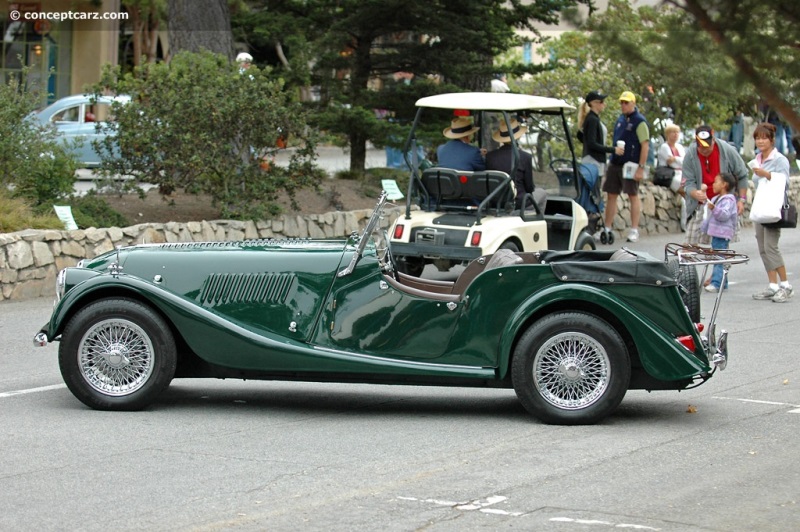
1962 Morgan Plus Four
1962 Morgan Plus Four Navigation
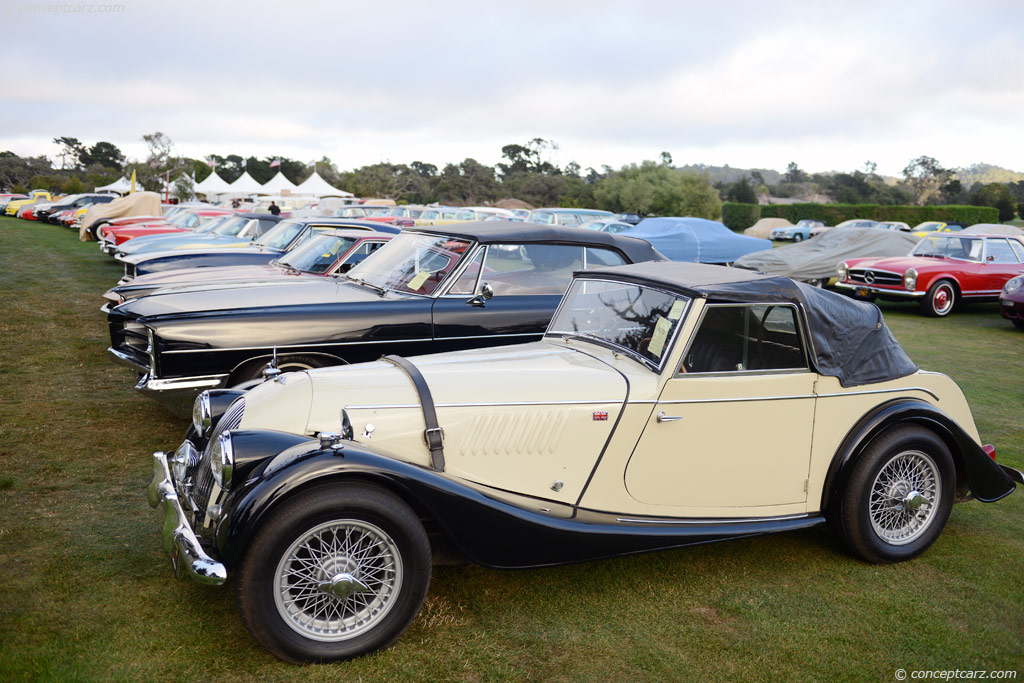
From the mid-1900s through the 1930s, the Morgan Motor Company built a car that had three wheels. The Morgan 4/4 introduced in 1936 was its first four-wheeled vehicle and it continued to follow the traditional coachbuilding methods of fitting steel or aluminum bodies over an ash frame. The Morgan Plus 4 that followed had a similar appearance to its predecessor but incorporated several notable improvements including a strengthened frame, longer wheelbase, revised suspension, and hydraulic brakes
Roadster
Chassis #: 5303
View info and history
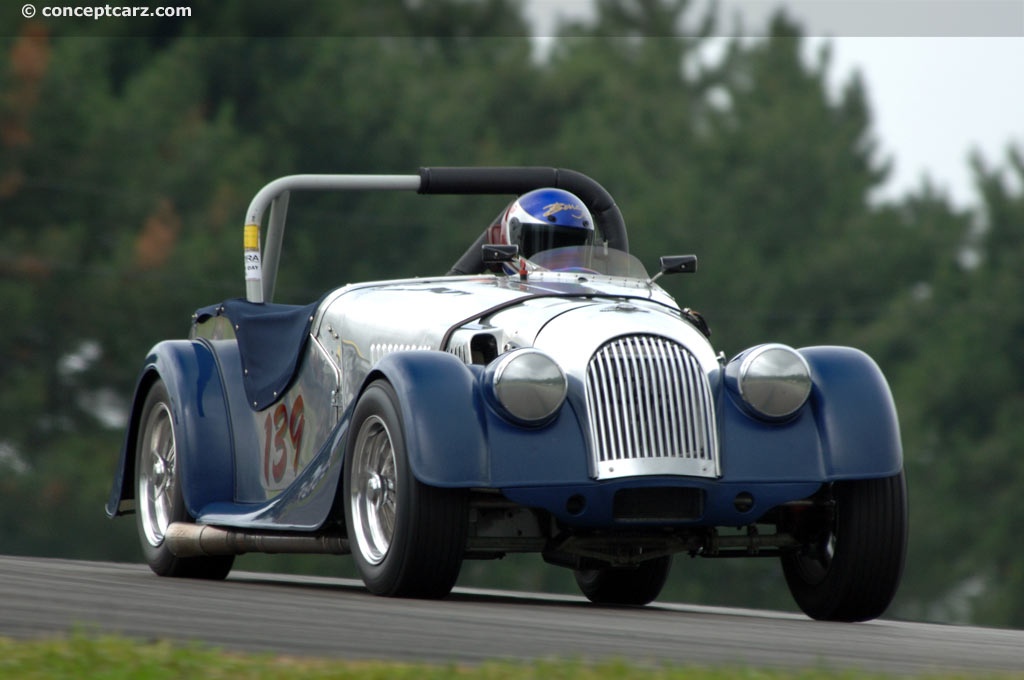
The Morgan Plus 4 was introduced in 1950 and produced through 1969, and then re-introduced in 1985. The Plus 4 was a larger, more powerful, and faster version of the company's popular 4/4 model. Power was from a 2088cc inline four-cylinder engine sourced from Standard Vanguard upon the model's introduction. With the Vanguard engine installed, the Plus 4 was placed in the over-2-liter class for racing purposes, forcing it to compete against cars of much larger capacity. As a result, the 1,991cc Triumph TR2 engine was made available in 1953. Throughout its production lifespan, the Plus 4 received several updates while retaining its classic styling cues.The 1960s models were powered by Triumph-sourced inline four-cylinder engines borrowed from the Triumph TR3, and later the TR4. The overhead-valve engines were paired with a Moss 4-speed manual transmission, Girling hydraulic front disc and rear drum brakes, and the Morgan sliding-pillar independent front and semi-elliptical sprung rear suspension. The wood-framed and hand-formed steel-bodied roadster was created in the finest Morgan handcrafted tradition and British sports-car heritage. The interiors featured a woodgrain instrument panel and steering wheel, and leather seating. At the 1962 24 Hours of LeMans, Lawrence and Richard Shepherd-Barron drove their Plus 4 to 13th place overall and a class win in the GT2 category.
by Daniel Vaughan | Oct 2017
Roadster
Chassis #: 5303
View info and history
The Morgan Plus 4 was introduced in 1950 and produced through 1969, and then re-introduced in 1985. The Plus 4 was a larger, more powerful, and faster version of the company's popular 4/4 model. Power was from a 2088cc inline four-cylinder engine sourced from Standard Vanguard upon the model's introduction. With the Vanguard engine installed, the Plus 4 was placed in the over-2-liter class for racing purposes, forcing it to compete against cars of much larger capacity. As a result, the 1,991cc Triumph TR2 engine was made available in 1953. Throughout its production lifespan, the Plus 4 received several updates while retaining its classic styling cues.The 1960s models were powered by Triumph-sourced inline four-cylinder engines borrowed from the Triumph TR3, and later the TR4. The overhead-valve engines were paired with a Moss 4-speed manual transmission, Girling hydraulic front disc and rear drum brakes, and the Morgan sliding-pillar independent front and semi-elliptical sprung rear suspension. The wood-framed and hand-formed steel-bodied roadster was created in the finest Morgan handcrafted tradition and British sports-car heritage. The interiors featured a woodgrain instrument panel and steering wheel, and leather seating. At the 1962 24 Hours of LeMans, Lawrence and Richard Shepherd-Barron drove their Plus 4 to 13th place overall and a class win in the GT2 category.
by Daniel Vaughan | Oct 2017
Related Reading : Morgan Plus 4 History
In 1936, the Morgan 44 was first introduced as Morgan Motor Companys first car. The 4-4, which would later come to be known as 44, stood for four cylinders and four wheels. The vehicles that Morgan had produced prior to the 4-4 were three-wheelers, with V-twin engines. Throughout the years, there have been many variations, body styles, and series of the original 4-4. Production of the....
Continue Reading >>
Continue Reading >>
- 1962 Morgan Plus Four Menu
- Article
- Image gallery
- Valuation
- Specifications
- Profiles
Morgan
Similar Vehicles

Similar Automakers
Similarly Sized Vehicles
from 1962
- Austin MINI Beach Car
Austin MINI Cooper
Austin Mini Cooper Pickup
Lotus Super Seven
Morgan 4/4 IV
Triumph TR3B
Similarly Priced Vehicles


1962 Morgan Plus Four Vehicle Profiles


Recent Vehicle Additions


Performance and Specification Comparison
Price Comparison
Plus Four Specification Comparison by Year
Year
Production
Wheelbase
Engine
Prices
96.00 in.
4 cyl., 121.50 CID., 90.00hp
4 cyl., 121.50 CID., 100.00hp
4 cyl., 130.47 CID., 115.00hp
4 cyl., 121.50 CID., 100.00hp
4 cyl., 130.47 CID., 115.00hp
$2,600 - $2,700
96.00 in.
4 cyl., 121.50 CID., 90.00hp
4 cyl., 130.47 CID., 105.00hp
4 cyl., 130.47 CID., 105.00hp
4 cyl., 130.47 CID., 120.00hp
4 cyl., 130.47 CID., 105.00hp
4 cyl., 130.47 CID., 105.00hp
4 cyl., 130.47 CID., 120.00hp
$2,650 - $2,960
96.00 in.
4 cyl., 130.47 CID., 100.00hp
4 cyl., 130.47 CID., 105.00hp
4 cyl., 130.47 CID., 115.00hp
4 cyl., 130.47 CID., 105.00hp
4 cyl., 130.47 CID., 115.00hp
$2,960 - $3,350
Related Automotive News

'Picture Perfect' Legendary Alfa Romeo Leads Bonhams Quail Motorcar Auction
A picture perfect, rare and highly original example of the legendary pre-war Alfa Romeo 8C 2300 will be the top lot offered in the Bonhams Quail Motorcar Auction on 14 August, with an estimate of US%246,500,000 - 7,500,000 (£4,900,000 - 5,700,000).
With...

Jay Kay's Cosmic Girls Lead Star Cars At Bonhams Bond Street Sale
Trio of Rare Supercars Offered from Jamiroquai Singers Collection
Jay Kay with his (L-R) 2016 Ferrari F12tdf Berlinetta,
1973 Porsche 911 Carrera RS 2.7-litre Lightweight and 2004 Porsche Carrera GT
A trio of rare and coveted motor cars...

Bugatti – A Brand Of Superlatives
Bugatti has claimed many world records over the past 30 years
Molsheim, 1 October 2019. Extraordinary vehicles with extravagant design. Paired with an unimaginable amount of power and very high speeds. Bugatti has been at the pinnacle...

All-New Lexus LC Performance Coupe Opens New Chapter In Brand History
Flagship model joins elite class of international grand touring coupes
New vehicle architecture delivers unfettered driving pleasure
Winner of multiple EyesOn Design awards
LC 500 features 471-hp high-performance V8 and 10-speed automatic tra...

FIRST 25TH ANNIVERSARY PANOZ ESPERANTE SPYDER DEBUTS AT STANDING-ROOM ONLY CELEBRATION
Panoz LLC also officially dedicates its new 10,000-sq.-ft. exhibition featuring interactive displays showcasing the storied Panoz sports car and racing history
Hoschton, Ga., April 04, 2014–Hundreds of Panoz fans, followers and owners...