1992 Ferrari F40
1992 Ferrari F40 Navigation
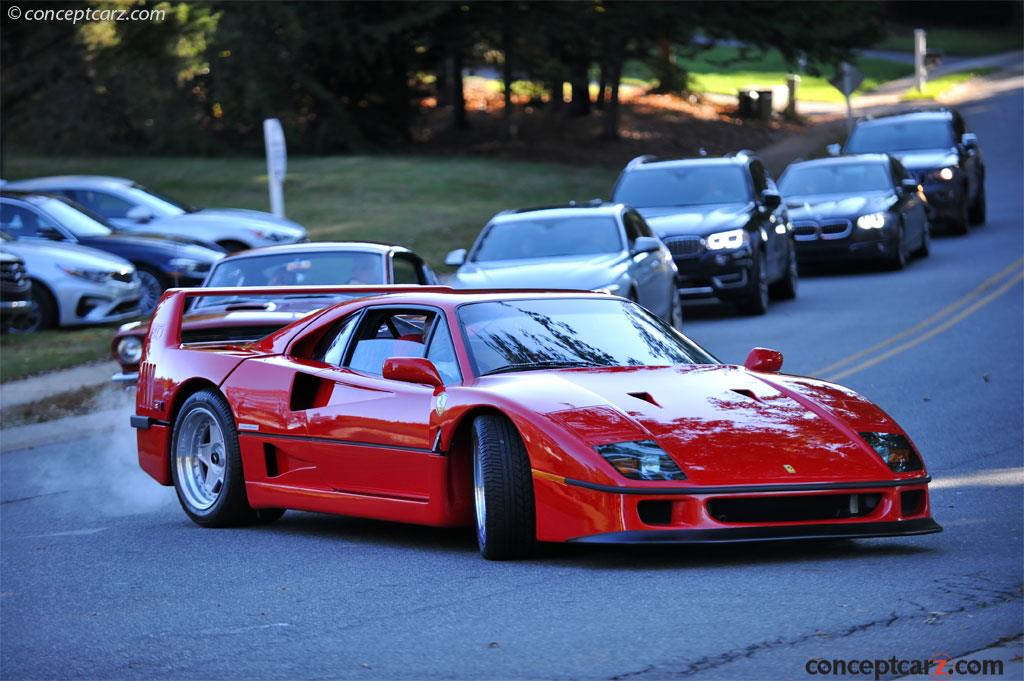
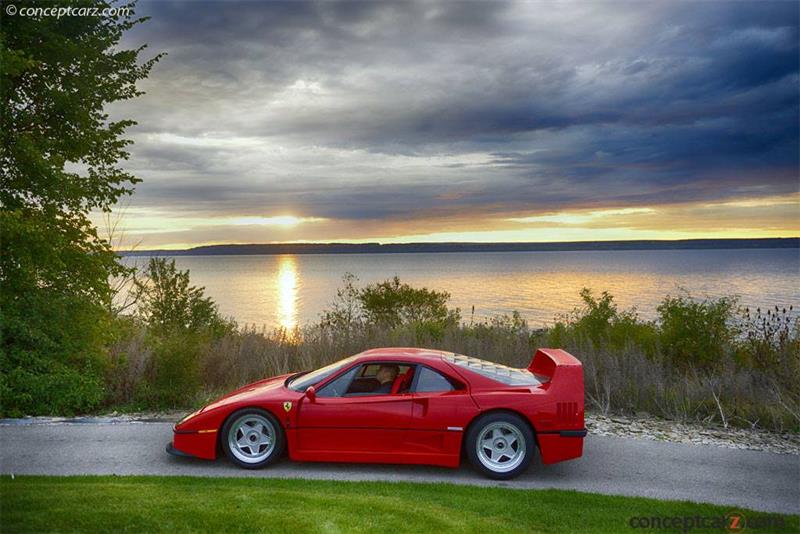
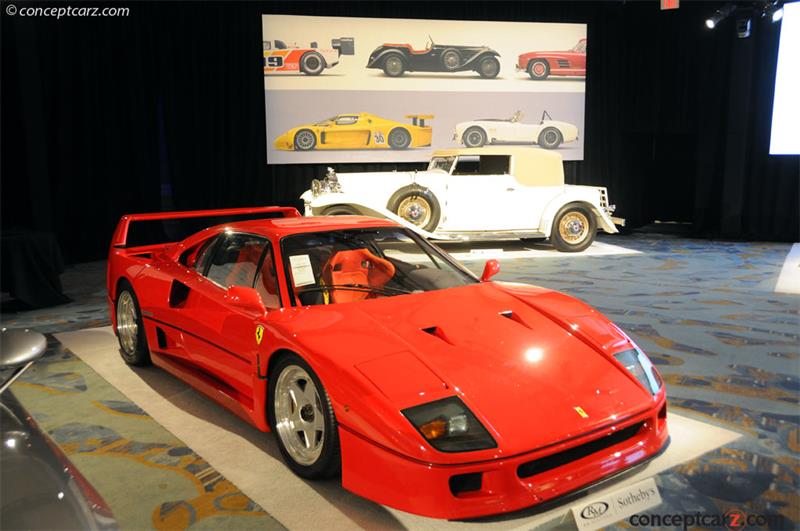
The Ferrari F40 was the first production car to break the 200 mph barrier. They were built in celebration of the company's 40th birthday and were the very last model that Enzo Ferrari personally oversaw before his passing. Carbon fiber was used for its chassis and bodywork, resulting in a lightweight 2,400 lbs.Introduced in 1988, the F40 exemplified Ferrari's traditional values and relied on enormous power, a race-bred suspension, large tires, wonderful aerodynamics, and low weight to achieve its impressive level of performance. It was a development of the limited-production 288GTO and came with twin IHI turbochargers with Behr intercoolers to produce 478 horsepower. A factory tuning kit was available which could help increase horsepower by 200 bhp. The 90-degree, dual-overhead-camshaft, 'vee' type eight-cylinder engine displaced 179 cubic inches and used five main bearings, a Weber-Marelli engine management system, and a compression ratio of 7.8:1. It was backed by a five-speed manual in the rear transaxle, the suspension was double-wishbone independent all around with coil-over Koni shock absorbers, and four-caliper ventilated disc brakes provided the stopping power. Using the company's Formula 1 experience, the F40 had a one-piece plastic molding, and the body was bonded to the tubular steel chassis. Removable panels, doors, boot lid, and bonnet were comprised of carbon fiber. The latest aerodynamic aids included the dam-shaped nose and high rear aerofoil, resulting in an impressively low drag coefficient of just 0.34. Leonardo Fioravanti's coachwork design, which was aerodynamically perfected in Pininfarina's wind tunnel, was built with paneling woven of Kevlar and carbon fiber, reducing the curb weight by approximately 20 percent, while tripling the car's structural rigidity. Zero-to-sixty mph was accomplished in 3.8 seconds, and top speed was achieved at 201 mph. The interior had body-contoured seats, and sliding Plexiglas windows, and was devoid of trim and carpeting.
CoupePublicly introduced at the 1987 Frankfurt Motor Show, the F40 was initially earmarked for a low production run of 400 examples, but strong consumer interest resulted in production reaching 1,315 units. Initially only offered in Europe, the early examples were built devoid of catalytic converters or adjustable suspensions. A more developed version arrived in 1990 as deliveries in the United States began, with standard equipment list including air conditioning and catalytic converters. When production ceased in the summer of 1992, Ferrari had built 213 examples for North American delivery.The 1992 Ferrari F40
The 1992 Ferrari F40 Coupe, priced at approximately $400,000 (with dealer markup, the price often exceeded $700,000), was powered by a 90-degree, dual-overhead-cam, eight-cylinder engine with 32 valves, two IHI turbochargers with Behr intercoolers, and displaces 179 cubic inches (2,936cc). It had five main bearings, a Weber-Marelli engine management system, 7.8:1 compression, and produced 471 (SAE) horsepower at 7,000 RPM and 426 lb-f of torque at 4,000 RPM. It was paired with a five-speed manual in the rear transaxle, disc brakes, and a composite body on a steel-tube space frame. It had a 94.5-inch wheelbase, an overall length of 174.4 inches, a width of 78 inches, and stood 44.5 inches tall.1992 was the final production year of the F40.
by Daniel Vaughan | Aug 2019
Coupe
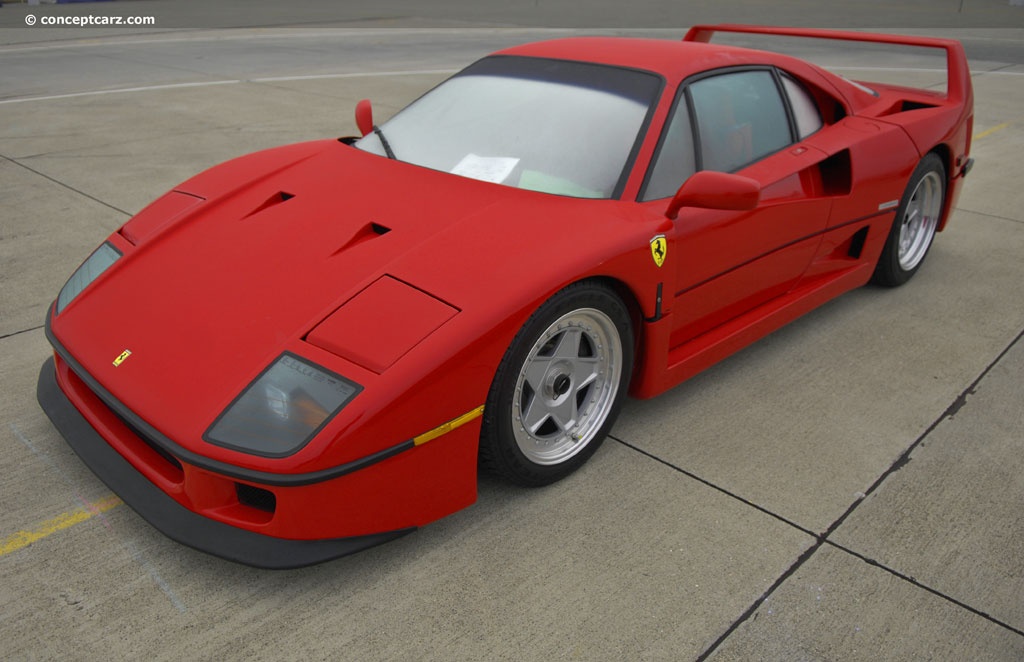
The 1992 Ferrari F40 Coupe, priced at approximately $400,000 (with dealer markup, the price often exceeded $700,000), was powered by a 90-degree, dual-overhead-cam, eight-cylinder engine with 32 valves, two IHI turbochargers with Behr intercoolers, and displaces 179 cubic inches (2,936cc). It had five main bearings, a Weber-Marelli engine management system, 7.8:1 compression, and produced 471 (SAE) horsepower at 7,000 RPM and 426 lb-f of torque at 4,000 RPM. It was paired with a five-speed manual in the rear transaxle, disc brakes, and a composite body on a steel-tube space frame. It had a 94.5-inch wheelbase, an overall length of 174.4 inches, a width of 78 inches, and stood 44.5 inches tall.1992 was the final production year of the F40.
by Daniel Vaughan | Aug 2019
Related Reading : Ferrari F40 History
The F40 was the last car introduced and commissioned by Enzo Ferrari himself. Its introduction and its name coincided with Ferraris 40th anniversary as an automobile constructor. The car was a celebration of the marque and the man seeking to safely provide owners with a race car for the street, embodying all the finest elements of 1987 automotive engineering. The F40 was to a large extent an evolution....
Continue Reading >>
Continue Reading >>
Related Reading : Ferrari F40 History
1987 was Ferraris 40th anniversary of the first Ferrari. A year prior, the Ferrari team had been commissioned to design and build a car to pay tribute the companys long and distinguished past. Enzo Ferrari said, Build a car to be the best in the world. The result was one of the greatest supercars to ever travel the roadways. It was a brilliant vehicle, had a futuristic design, and was void....
Continue Reading >>
Continue Reading >>
Related Reading : Ferrari F40 History
A mid-engine, rear-wheel drive, the Ferrari F40 is a two-door coupe sports car produced by Ferrari from 1987 until 1992. The F40 was the successor to the Ferrari 288 GTO. The F40 held a prestigious reputation as the worlds fastest street-legal production vehicle from 1976 until 1989. During its years of production, the F40 was Ferraris most expensive, fastest and most powerful car. The F40 was....
Continue Reading >>
Continue Reading >>
- 1992 Ferrari F40 Menu
- Article
- Image gallery
- Valuation
- Specifications
- Profiles
- Recalls
Ferrari
Similar Automakers
Similarly Sized Vehicles
from 1992


1992 Ferrari F40 Vehicle Profiles



Recent Vehicle Additions


Performance and Specification Comparison
Price Comparison
$122,185
$189,510
F40 Specification Comparison by Year
Year
Production
Wheelbase
Engine
Prices
Related Automotive News

Ferrari 250 GTO leads collection of the world's rarest Ferraris at Concours of Elegance
Concours of Elegance to assemble finest selection of classic Ferraris ever seen in UK to celebrate marques 75th birthday.
Jaw dropping line-up up to include hallowed one-of-36 250 GTO, perhaps the worlds most sought-after car
Other stunning Fer...

Ferraris In Full Force: Unique 599 GTZ Nibbio Spyder And F12Tdf '120Th Anniversary' Lead Clutch Of Additional Ferraris Headed To Rm Sotheby's Paris Sale
RM Sothebys reveals unique Ferrari F12tdf 120th Anniversary for upcoming Paris auction on 13 February widely known as a former press vehicle in the UK and Europe, uniquely carrying an Enzo Ferrari 120th anniversary plaque and driven by Sebastia...

Gooding & Company Announces Geared Online – New Online Only Auctions Commencing August 3rd
Santa Monica, Calif. (June 8, 2020) – Gooding %26 Company, the auction house revered for selling the worlds most desirable and prized collector cars, is pleased to announce an exciting new platform for auctions to be held exclusively through the...

Ferrari: Under The Skin
15 November 2017 - 15 April 2018
Major exhibition announced by the Design Museum in London to mark the 70th anniversary of Ferrari
£140M worth of Ferraris featured in exhibition displaying cars driven by racing drivers Peter Collins and Stir...

30th Anniversary Of The F40
Maranello, 21 July 2017 - Thirty years have passed since the official presentation of the F40, which took place on 21 July 1987 at the Civic Centre in Maranello, now home to the Ferrari Museum. Created to celebrate the companys 40th anniversary,...